



Question: 1. Why are activities drawn in a serial relationship in a network diagram? a. The activities use different resources. b. The activities are independent of
1. Why are activities drawn in a serial relationship in a network diagram?
a. The activities use different resources.
b. The activities are independent of each other.
c. From a technical standpoint, the activities must be performed in that sequence. d. The order of completion doesn't matter.
2. In addition to showing the technical constraints among activities, how does the network logic also take into account resource constraints?
a. Activities that use the same resource may not be able to occur in parallel to each other.
b. Activities that use different resources may be shown in a serial relationship. c. The activities could be shown in a loop relationship.
d. Resources that are unlimited are not shown in a resource assignment.
3. Select which of the following does not describe how the sequence of activities can be drawn to reflect the availability of a limited quantity of resources.
a. The activities using the limited resources are shown in a ladder relationship as they are available.
b. The activities using the limited resources are shown in a loop relationship as they are available.
c. The activities requiring the limited resource are assigned at different times. d. If there is no technical constraint for the activities, the activities could be arranged serially by the availability of the resources.
4. A resource requirements plan illustrates
a. who is responsible for which activities.
b. the amount of labor expenses for the project.
c. the expected utilization of resources by time period during the time span of the project.
d. the budget for material and cost resources.
5. If resources are to be considered in planning, it is necessary to
a. when each is taking vacation time or time off.
b. know the name of each resource on the project.
c. list all the projects to which the resources have been assigned.
d. indicate the amounts and types of resources needed to perform each activity.
1
MPM 7103
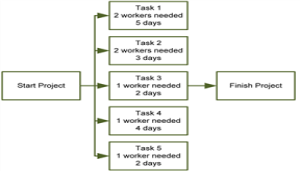
6. Given this project and the requirement that the number of resources working on a task cannot be less than the number assigned to the task, answer the following question.
What is the least number of resources that can be assigned to the project if all five tasks occur in parallel?
a. 24 workers
b. 1.5 workers per day
c. 7 workers
d. 2 workers
c
7. Resource leveling, or smoothing, levels the resources so that
a. equal number of resources is assigned to each task.
b. an equal number of tasks are completed each day by the resources on the project. c. they are applied as uniformly as possible without extending the project schedule beyond the required completion time.
d. the costs for the resources are even as possible across the project.
8. The start of noncritical activities are delayed beyond their earliest start times (but not beyond their latest start times) in order to
a. schedule with a technical constraint.
b. schedule with a resource constraint.
c. level the costs of the project.
d. maintain a uniform level of required resources.
9. When several activities need the same limited resource at the same time, the activities with a. the least slack have first priority.
b. the longest duration have first priority.
c. the near term have first priority.
d. use the most resources have first priority.
2
MPM 7103
10. This example has level resources of three resources for eight days. If the project is limited to two resources, how should the project be organized to meet the resource constraint and finish the project as early as possible? The tasks with the least slack have the lower number.
 a. Paths would be 1,2,3,5 and 1,2,4
b. Paths would be 1,2,3,4 and 1,2,5
c. Paths would be 1,2 and 3,4,5
d. Path would be 1,2,3,4,5
11. The total project cost is often estimated during the ____ phase of the project or when the project charter or a proposal is prepared
a. initiating
b. planning
c. performing
d. closing
12. Materials costs in the project costs estimate are the estimated costs of materials that the project team or contractor
a. want to have in supply in the office.
b. needs even if not for this particular project.
c. needs to purchase for the project.
d. might want to use on the project.
13. Facilities costs in the project costs estimate are for
a. general facilities for the project organization.
b. special facilities or additional space for the project team.
c. special facilities or additional space for the organization where other projects will be in progress.
d. storage of materials even if not for the project.
14. Contingency costs in the project costs estimate, also referred to as ____, are to cover unexpected situations that may come up during the project, such as items that may have been overlooked when the initial project scope was defined, activities that may have to be redone because they may not work the first time (redesigns), or a high probability or high impact risk that may occur. a. auxiliary funds
b. withholding
c. reserves
d. capital funds
15. At the beginning of the project, it may not be possible to estimate the costs for all activities with a level of confidence regarding their accuracy. This is especially true for
a. projects with a short term.
b. longer-term projects.
c. projects that are similar to ones completed by the organization before. d. projects with activities that are serially related.
3
MPM 7103
16. It may be easier to estimate the costs for ____, but as the project progresses, the project team can progressively elaborate the estimated costs as more information is known or becomes clear to allow for more accurate estimated costs.
a. near-term activities
b. activities near the end of the project
c. new activities with new procedures
d. activities with long durations
17. The project cost estimate is allocated to
a. the various work packages in the project work breakdown structure. b. the resources in the project.
c. the committed costs in the project.
d. the stakeholders.
18. The budget for each work package is
a. charged completely on the first day of the work package.
b. charged at the end of the project.
c. distributed over the duration of the work package.
d. charged completely on the last day of the work package.
19. Large projects would have charge codes for the work package numbers to a. have a place for other projects to charge expenses.
b. determine how the actual costs compare to the planned costs.
c. have resources be able to determine what tasks they should complete. d. allow for cutting of the budget for the activities if need to cut the budget.
20. Committed costs need to be treated in a special way so that the system
a. audits the amounts assigned.
b. periodically assigns a portion of their total cost to actual cost.
c. enters the amount of the cost one time at the end of the project.
d. enters the amount of the cost one time at the beginning of the project.
21. The process of closing the project involves various actions, including
a. conducting a post-project evaluation.
b. listening to the customer to make sure of what is needed in the project. c. evaluating and estimating the resources for the project.
d. performing the final work on tasks.
22. The process of closing the project involves various actions, including
a. using lessons learned from prior projects.
b. documenting lessons learned.
c. researching lessons learned in the knowledge base.
d. identifying the similarities of this project to other projects for planning.
23. The process of closing the project involves various actions, including
a. organizing and archiving project documents.
b. recording revision numbers in the names of documents.
c. using techniques such as track changes to record document edits.
d. creating a file structure to save and organize project documents.
4
MPM 7103
24. During the ____, the project team or contractor should ensure that copies of appropriate project documentation are properly organized, filed, and archived so that they can be readily retrieved for future use.
a. evaluating the project phase
b. controlling the project phase
c. performing the project phase
d. closing the project phase
25. The purposes of ____ should be to determine whether the project provided the customer with the expected benefits, assess the level of customer satisfaction, and obtain any feedback that would be helpful in future business relationships with this customer or with other customers. a. a post-project evaluation meeting with the customer or sponsor
b. a project progress meeting with project stakeholders
c. an analysis session with the project team
d. a pre-RFP meeting with the customer
26. Participants of ____ should include the project manager, key project team members, and key representatives of the customers organization who were involved with the project. a. a post-project evaluation meeting with the customer or sponsor
b. a project progress meeting with project stakeholders
c. an analysis session with the project team
d. a pre-RFP meeting with the customer
27. The project manager should schedule the post-project evaluation meeting with the customer or sponsor for a time when the customer is in a position to
a. pay all the expenses of the project to the contractor.
b. really determine whether the project met expectations and achieved the anticipated benefits.
c. solicit proposals for a new RFP.
d. begin planning for future projects or opportunities for the contractor.
28. The purpose of identifying and documenting lessons learned is to capitalize on the knowledge and experience gained on the project in order to
a. improve performance on future projects.
b. create a large database of information.
c. establish a procedure of identification and documentation.
d. keep project team members busy.
29. During project closing, the project team or contractor should ensure that copies of appropriate project documentation are properly organized, filed, and archived so that
a. they can be stored easily.
b. they can be readily retrieved for future use.
c. the files are ready for audit.
d. the project sponsor could review them.
30. As part of, or in addition to, the documents in the archive, it can be valuable to create a database of common data elements from past projects in order to analyze and determine if there are trends or correlations that
a. show a strong project team member that should be given additional compensation. b. should be shared with the project sponsors of all the projects.
c. could be helpful in bidding, planning, and/or performing future projects. d. should be shown on the annual reports for the organization.
Step by Step Solution
There are 3 Steps involved in it

Get step-by-step solutions from verified subject matter experts