Question: 1. You've read about Bentham and seen my example about a 2nd helping of desert. Now it's your turn! Consider whether or not you will
1.
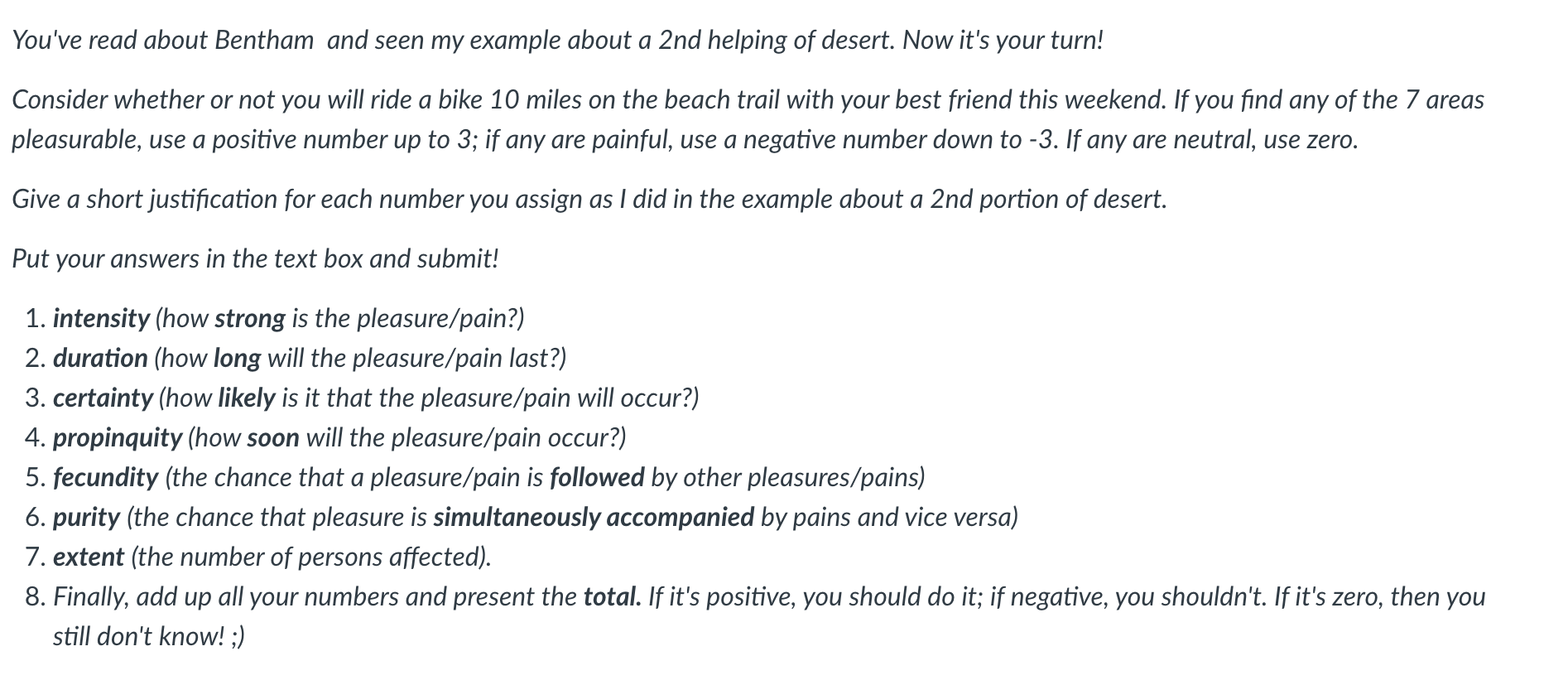
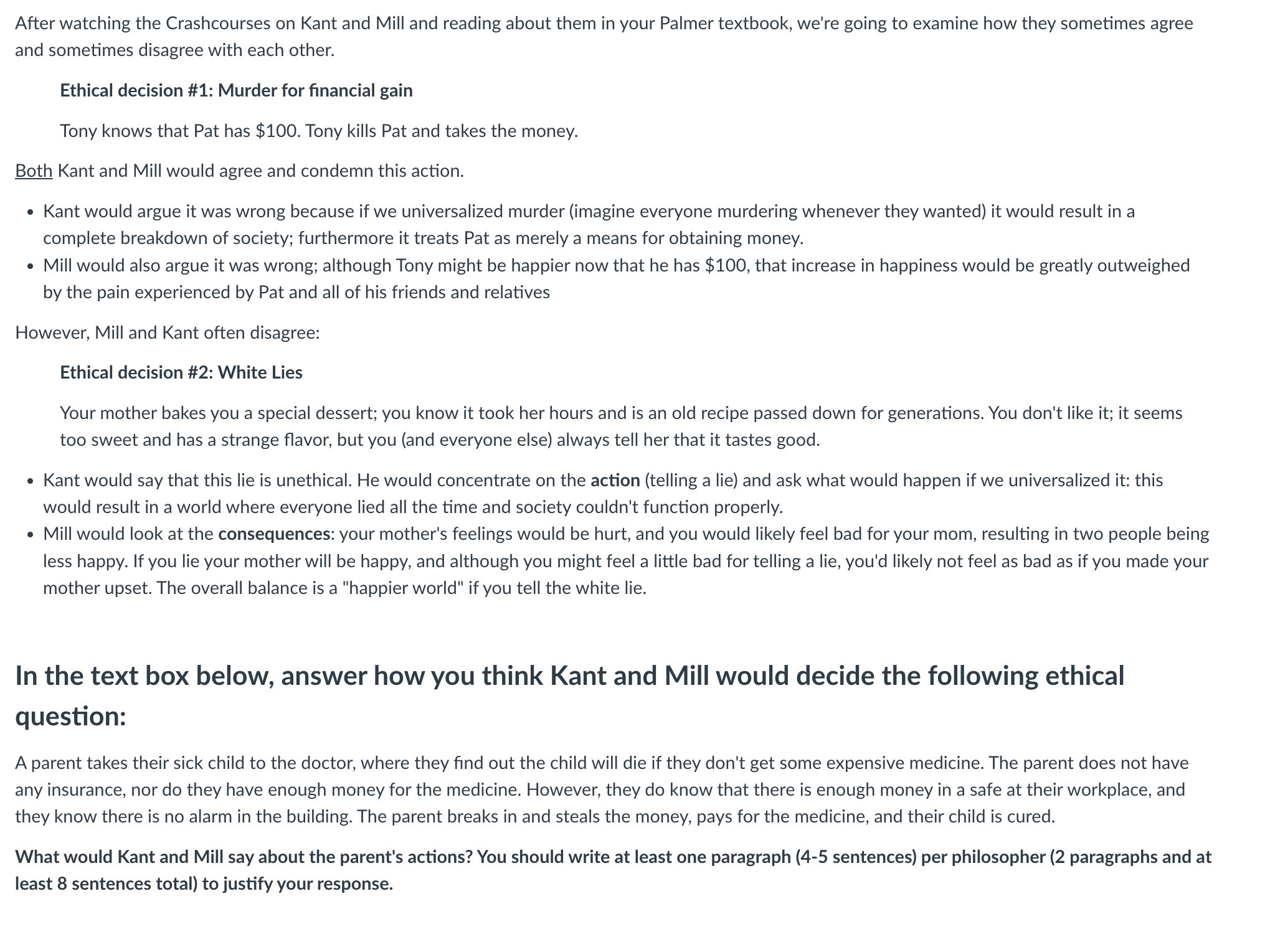
You've read about Bentham and seen my example about a 2nd helping of desert. Now it's your turn! Consider whether or not you will ride a bike 10 miles on the beach trail with your best friend this weekend. If you find any of the 7 areas pleasurable, use a positive number up to 3; if any are painful, use a negative number down to -3. If any are neutral, use zero. Give a short justification for each number you assign as I did in the example about a 2nd portion of desert. Put your answers in the text box and submit! 1. intensity (how strong is the pleasure/pain?) 2. duration (how long will the pleasure/pain last?) 3. certainty (how likely is it that the pleasure/pain will occur?) 4. propinquity (how soon will the pleasure/pain occur?) 5. fecundity (the chance that a pleasure/pain is followed by other pleasures/pains) 6. purity (the chance that pleasure is simultaneously accompanied by pains and vice versa) 7. extent (the number of persons affected). 8. Finally, add up all your numbers and present the total. If it's positive, you should do it; if negative, you shouldn't. If it's zero, then you still don't know! ;)After watching the Crashcourses on Kant and Mill and reading about them in your Palmer textbook, we're going to examine how they sometimes agree and sometimes disagree with each other. Ethical decision #1: Murder for nancial gain Tony knows that Pat has $100. Tony kills Pat and takes the money. o_th Kant and Mill would agree and condemn this action. 0 Kant would argue it was wrong because if we universalized murder (imagine everyone murdering whenever they wanted) it would result in a complete breakdown of society; furthermore it treats Pat as merely a means for obtaining money. . Mill would also argue it was wrong; although Tony might be happier now that he has $100, that increase in happiness would be greatly outweighed by the pain experienced by Pat and all of his friends and relatives However, Mill and Kant often disagree: Ethical decision #2: White Lies Your mother bakes you a special dessert; you know it took her hours and is an old recipe passed down for generations. You don't like it; it seems too sweet and has a strange avor, but you (and everyone else) always tell her that it tastes good. - Kant would say that this lie is unethical. He would concentrate on the action (telling a lie) and ask what would happen if we universalized it: this would result in a world where everyone lied all the time and society couldn't function properly. . Mill would look at the consequences: your mother's feelings would be hurt, and you would likely feel bad for your mom, resulting in two people being less happy. If you lie your mother will be happy, and although you might feel a little bad for telling a lie, you'd likely not feel as bad as if you made your mother upset. The overall balance is a "happier world" if you tell the white lie. In the text box below, answer how you think Kant and Mill would decide the following ethical question: A parent takes their sick child to the doctor, where they nd out the child will die if they don't get some expensive medicine. The parent does not have any insurance, nor do they have enough money for the medicine, However, they do know that there is enough money in a safe at their workplace, and they know there is no alarm in the building. The parent breaks in and steals the money, pays for the medicine, and their child is cured. What would Kant and Mill say about the parent's actions? You should write at least one paragraph (4-5 sentences) per philosopher (2 paragraphs and at least 8 sentences total) to justify your response
Step by Step Solution
There are 3 Steps involved in it
1 Expert Approved Answer
Step: 1 Unlock
Question Has Been Solved by an Expert!
Get step-by-step solutions from verified subject matter experts
Step: 2 Unlock
Step: 3 Unlock
Students Have Also Explored These Related Mathematics Questions!









 Study Help