Question: (10%) Problem 12: A merry- go-round is a playground ride that consists of a large disk mounted to that it can freely rotate in a
(10%) Problem 12: A merry- go-round is a(10%) Problem 12: A merry- go-round is a(10%) Problem 12: A merry- go-round is a(10%) Problem 12: A merry- go-round is a
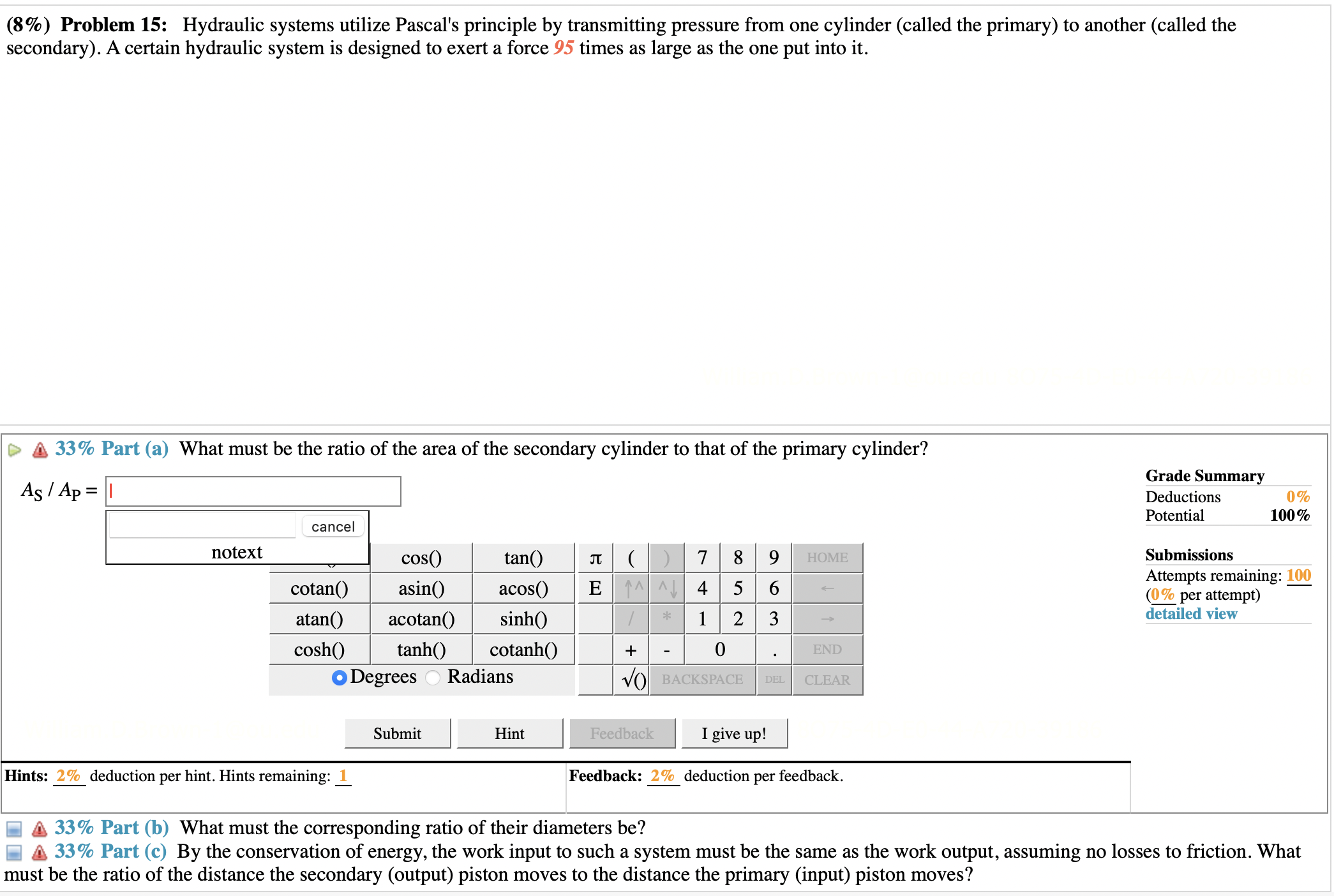
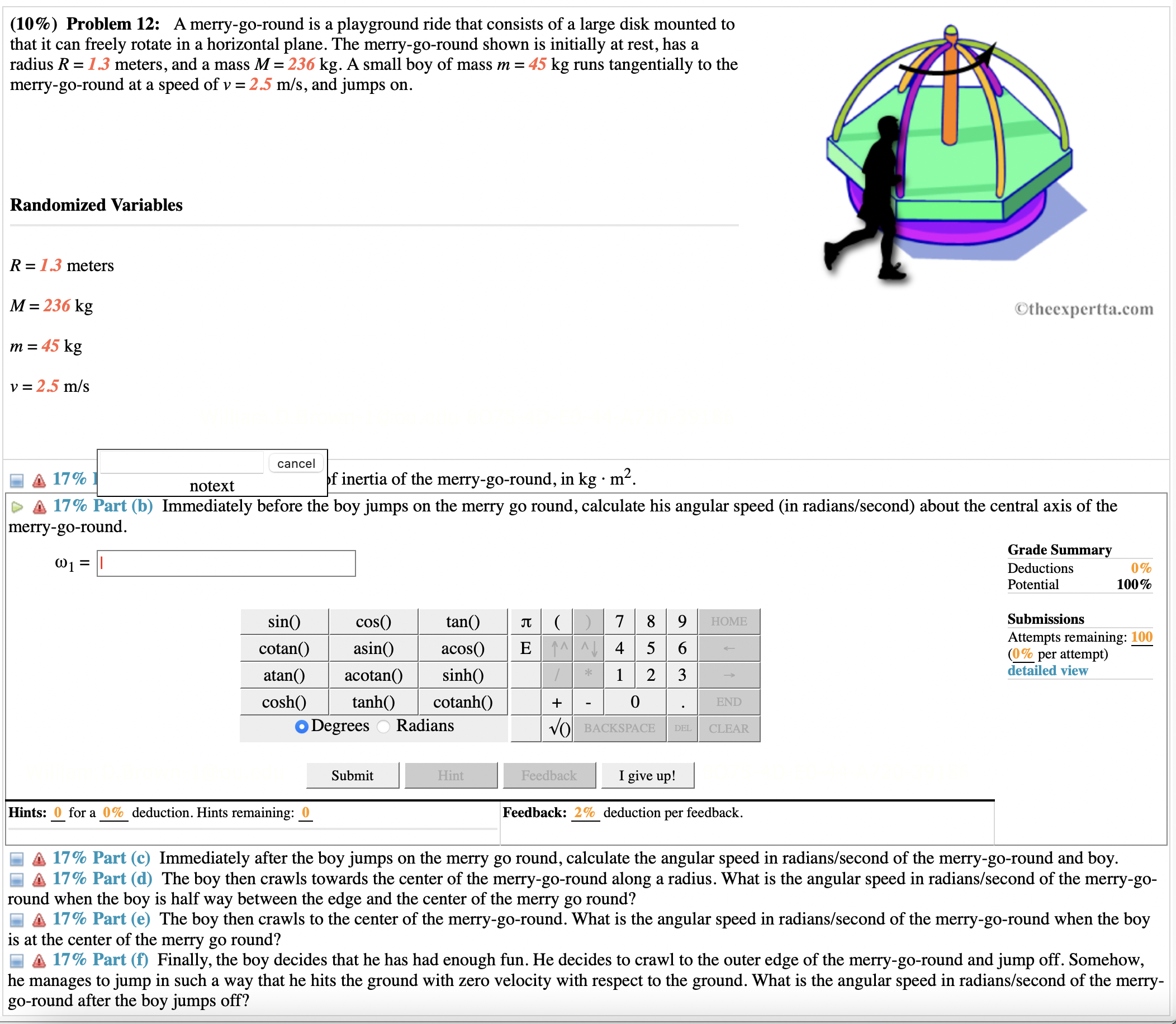
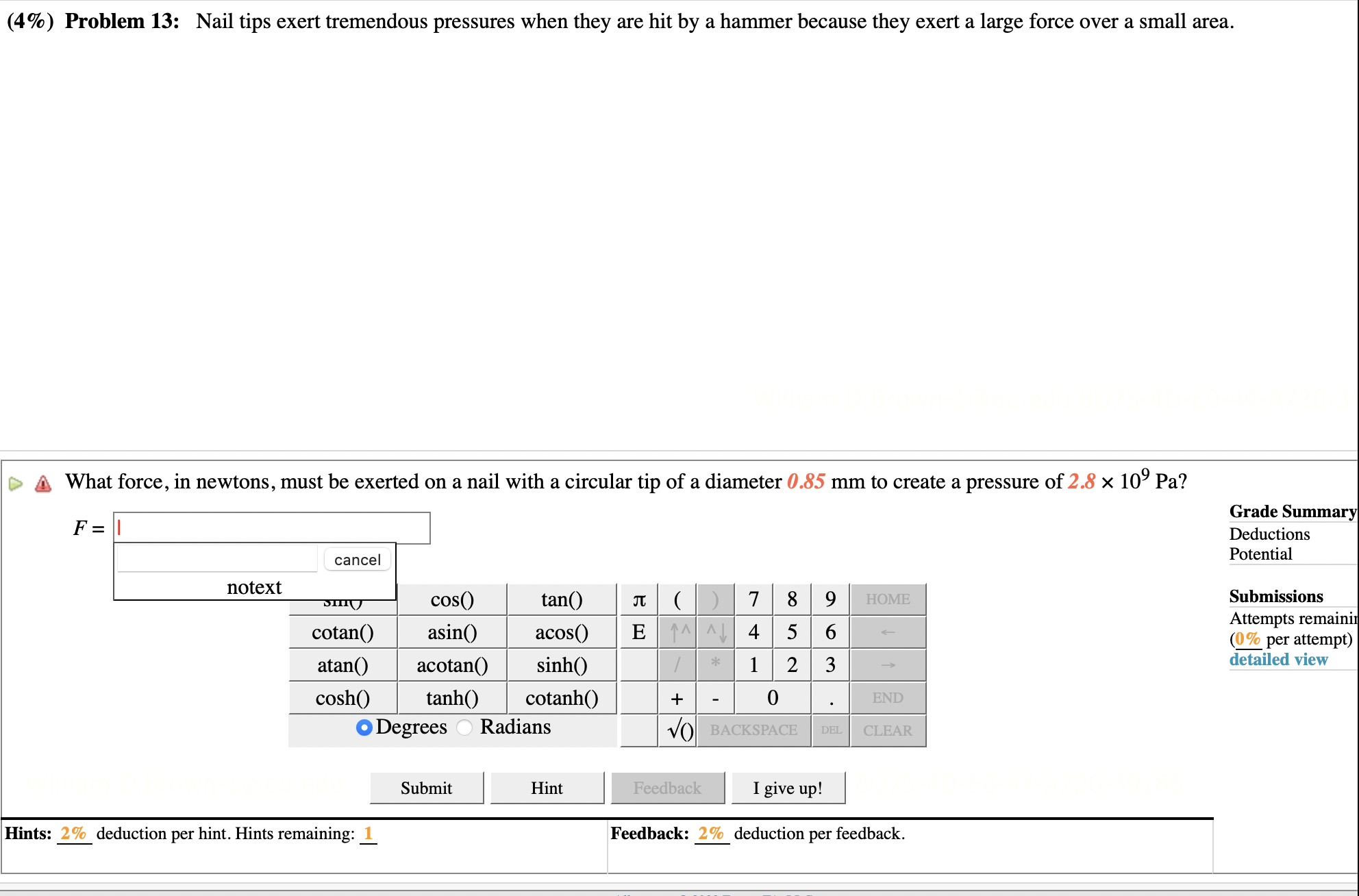
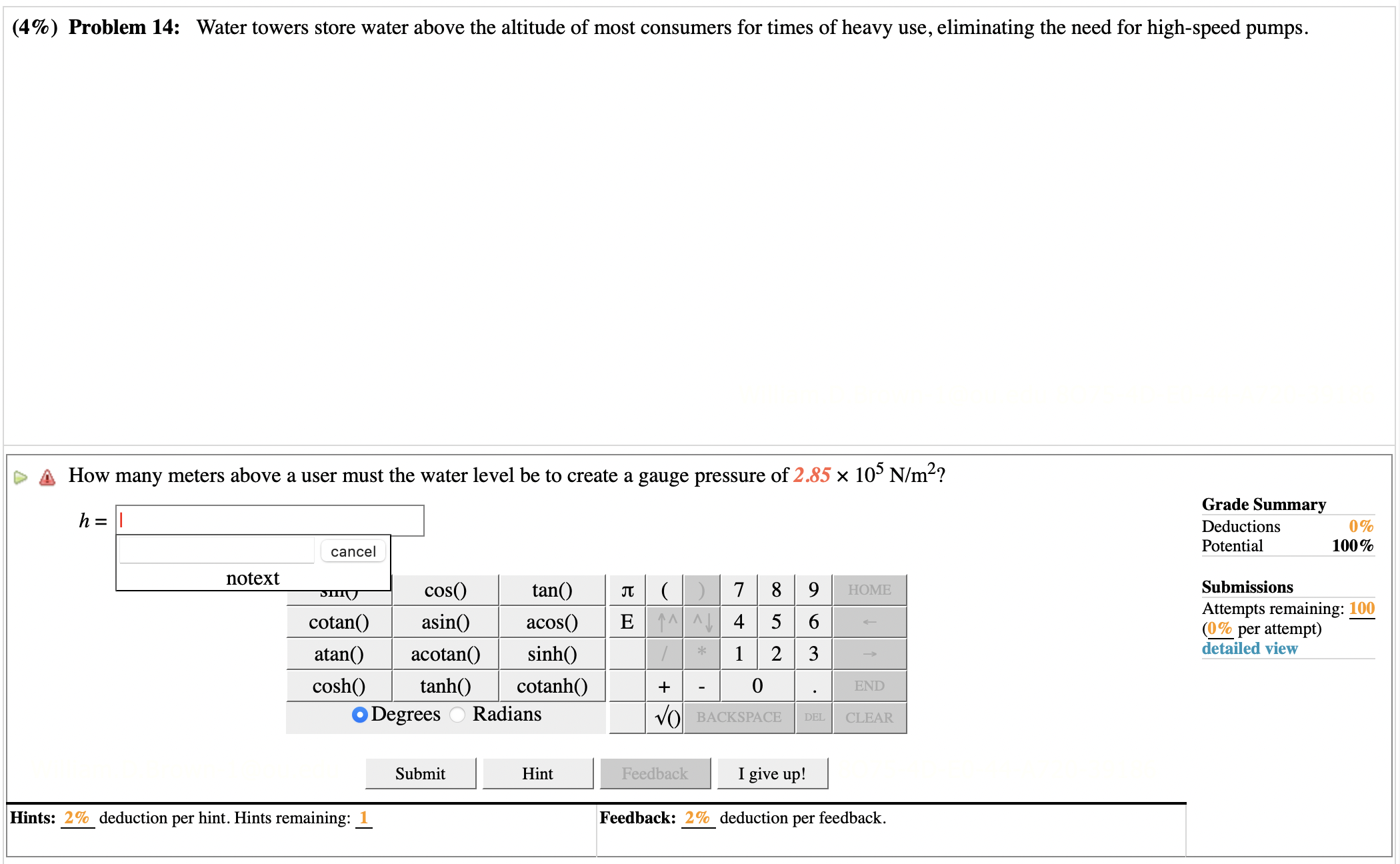
(10%) Problem 12: A merry- go-round is a playground ride that consists of a large disk mounted to that it can freely rotate in a horizontal plane. The merry-go-round shown is initially at rest, has a radius R = 1.3 meters, and a mass M = 23 6 kg. A small boy of mass m = 45 kg runs tangentially to the merry-go-round at a speed of v = 2.5 m/s, and jumps on. Randomized Variables R = 1.3 meters M=236kg I llucmpcrlluxmll m = 45 kg v :25 m/s cancel nf inertia of the merry-go-round, in kg - m2. A 17% ] notext [A 17% Part (b) Immediately before the boy jumps on the merry go round, calculate his angular speed (in radians/second) about the central axis of the merry-go-round. Grade Summary (\"1 = I Deductions Potential 100% sin() | cos() | mo | n| ( | 7 8 9 | Submissions ' _ cotan() | asin() | acos() | E | | 4 5 6 | fine'gsartffnfgngz atan() | acotanO | sinh() | | | 1 2 3 | (EM vim cosh() | tanh() | cotanh() | | + | 0 | ODegrees Radians I 0 I Submit l l l I give up! I Hints: _ for a deduction. Hints remaining: _ Feedback: deduction per feedback. [g 17% Part (c) Immediately after the boy jumps on the merry go round, calculate the angular speed in radians/second of the merry-go-round and boy. & 17% Part ((1) The boy then crawls towards the center of the merry-go-round along a radius. What is the angular speed in radians/ second of the merry-go- round when the boy is half way between the edge and the center of the merry go round? & 17% Part (e) The boy then crawls to the center of the merry-go-round. What is the angular speed in radians/second of the merry-go-round when the boy is at the center of the merry go round? as 17% Part (0 Finally, the boy decides that he has had enough fun. He decides to crawl to the outer edge of the merry-go-round and jump off. Somehow, he manages to jump in such a way that he hits the ground with zero velocity with respect to the ground. What is the angular speed in radians/second of the merry- go-round after the boy jumps off? (4%) Problem 13: Nail tips exert tremendous pressures when they are hit by a hammer because they exert a large force over a small area. A What force, in newtons, must be exerted on a nail with a circular tip of a diameter 0.85 mm to create a pressure of 2.8 x 10⁹ Pa? Hints: notext cosh() tanh() cotanh() - 0 . 0 Degrees Radl ans l I Submit | Hint | I give up! | deduction per hint. Hints remaining: _ Feedback: deduction per feedback. Grade Summa Deductions Potential Submissions Attempts remai ' (_ per attempt) detailed View (4%) Problem 14: Water towers store water above the altitude of most consumers for times of heavy use, eliminating the need for high-speed pumps. How many meters above a user must the water level be to create a gauge pressure of 2.85 x 10⁵ N/m2? Grade Summary h = Deductions 0% cancel Potential 100% notext cos() tan() 7 8 9 HOME Submissions Attempts remaining: 100 cotan() asin() acos() E 4 5 6 (0% per attempt) atan() acotan() sinh() 2 3 detailed view cosh() tanh() cotanh() + 0 END O Degrees O Radians VO BACKSPACE DEL CLEAR Submit Hint Feedback I give up! Hints: 2% deduction per hint. Hints remaining: 1 Feedback: 2% deduction per feedback.(8%) Problem 15: Hydraulic systems utilize Pascal's principle by transmitting pressure from one cylinder (called the primary) to another (called the secondary). A certain hydraulic system is designed to exert a force 95 times as large as the one put into it. A 33% Part (a) What must be the ratio of the area of the secondary cylinder to that of the primary cylinder? Grade Summary AS I AP = I Deductions Potential 100% cancel notext I 0050 mo 11: ( 7 8 9 Submissions , Attempts remaining: _ cotan() as1n() acos() E 4 5 6 (_ per attempt) atan() acotan() sinh() 1 2 3 detailed vim cosh() tanh() C0tanh() + - 0 0 Degrees Radi ans 1/0 Submit | Him | | I give up! | Hints: deduction per hint. Hints remaining: _ Feedback: deduction per feedback. A 33% Part (b) What must the corresponding ratio of their diameters be? A 33% Part (c) By the conservation of energy, the work input to such a system must be the same as the work output, assuming no losses to friction. What must be the ratio of the distance the secondary (output) piston moves to the distance the primary (input) piston moves
Step by Step Solution

There are 3 Steps involved in it

1 Expert Approved Answer
Step: 1 Unlock blur-text-image

Question Has Been Solved by an Expert!

Get step-by-step solutions from verified subject matter experts

Step: 2 Unlock
Step: 3 Unlock

Students Have Also Explored These Related Mathematics Questions!