







Question: (100) CASE STUDY Project Overview: Project 'A' was executed in West Shetland on the Atlantic Ocean. It was part of a $600m platform project for
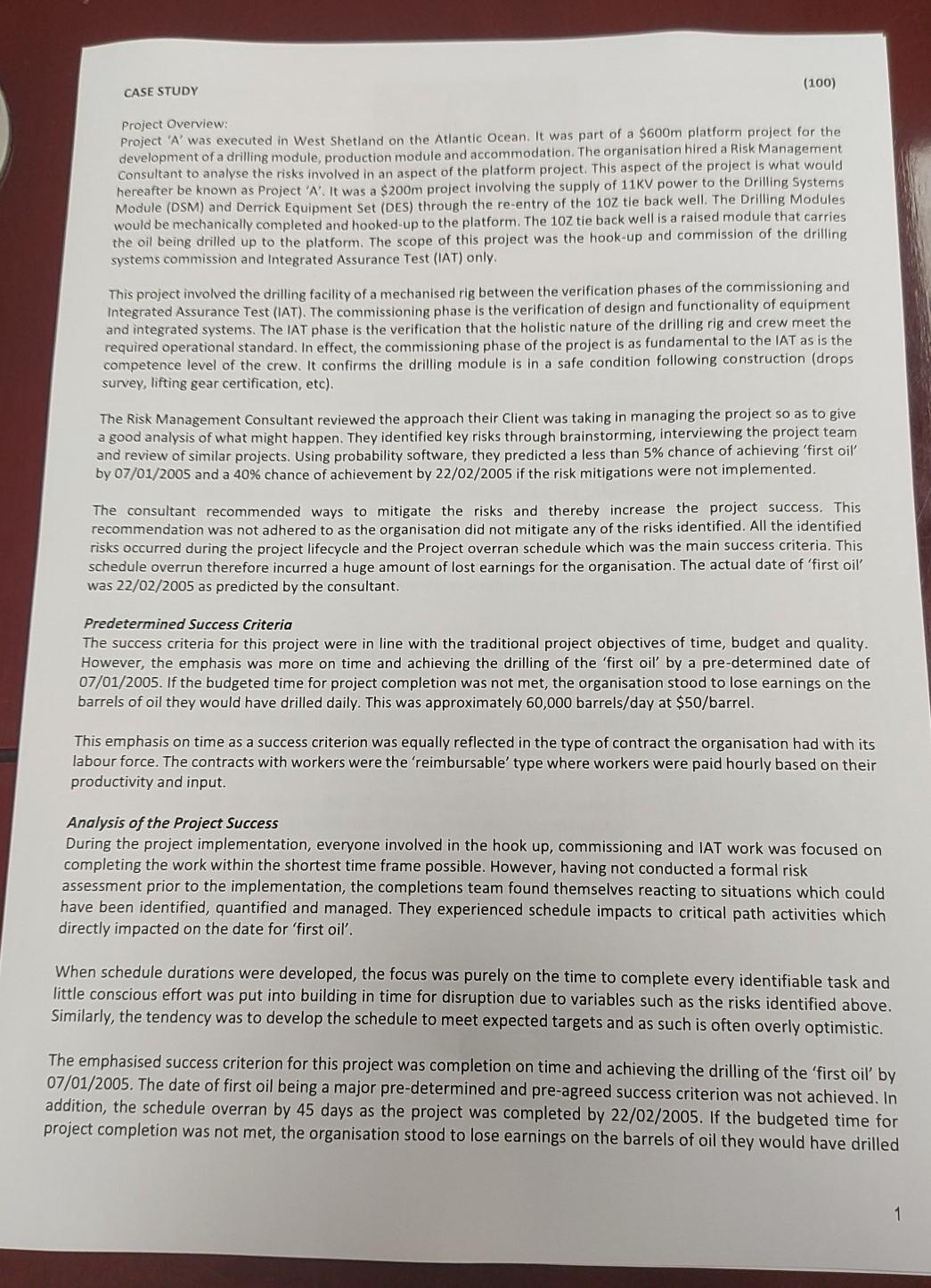
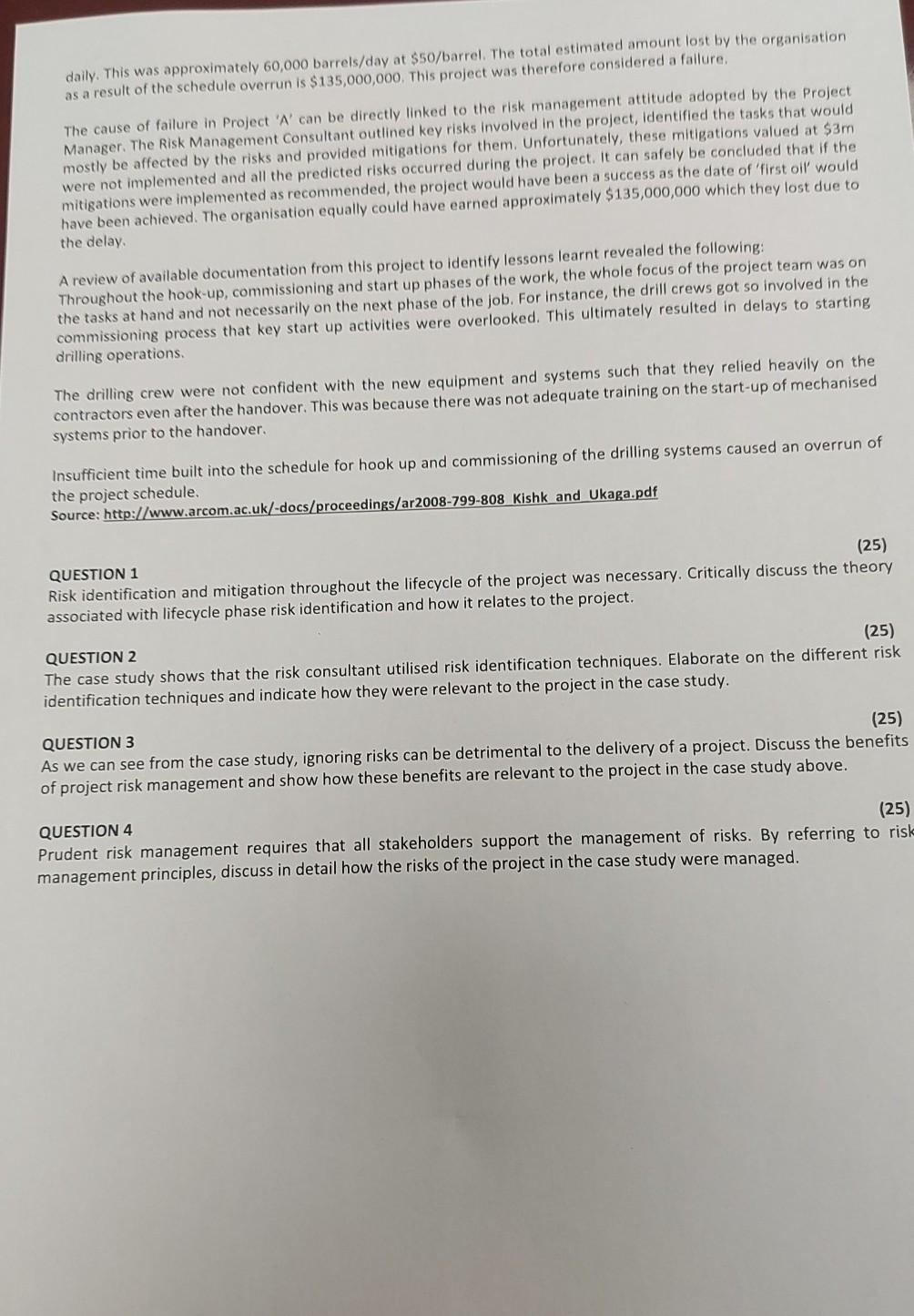
(100) CASE STUDY Project Overview: Project 'A' was executed in West Shetland on the Atlantic Ocean. It was part of a $600m platform project for the development of a drilling module, production module and accommodation. The organisation hired a Risk Management Consultant to analyse the risks involved in an aspect of the platform project. This aspect of the project is what would hereafter be known as Project 'A'. It was a $200m project involving the supply of 11KV power to the Drilling Systems Module (DSM) and Derrick Equipment Set (DES) through the re-entry of the 10z tie back well. The Drilling Modules would be mechanically completed and hooked-up to the platform. The 1oz tie back well is a raised module that carries the oil being drilled up to the platform. The scope of this project was the hook-up and commission of the drilling systems commission and Integrated Assurance Test (IAT) only. This project involved the drilling facility of a mechanised rig between the verification phases of the commissioning and Integrated Assurance Test (IAT). The commissioning phase is the verification of design and functionality of equipment and integrated systems. The IAT phase is the verification that the holistic nature of the drilling rig and crew meet the required operational standard. In effect, the commissioning phase of the project is as fundamental to the IAT as is the competence level of the crew. It confirms the drilling module is in a safe condition following construction (drops survey, lifting gear certification, etc). The Risk Management Consultant reviewed the approach their client was taking in managing the project so as to give a good analysis of what might happen. They identified key risks through brainstorming, interviewing the project team and review of similar projects. Using probability software, they predicted a less than 5% chance of achieving 'first oil by 07/01/2005 and a 40% chance of achievement by 22/02/2005 if the risk mitigations were not implemented. The consultant recommended ways to mitigate the risks and thereby increase the project success. This recommendation was not adhered to as the organisation did not mitigate any of the risks identified. All the identified risks occurred during the project lifecycle and the Project overran schedule which was the main success criteria. This schedule overrun therefore incurred a huge amount of lost earnings for the organisation. The actual date of 'first oil was 22/02/2005 as predicted by the consultant. Predetermined Success Criteria The success criteria for this project were in line with the traditional project objectives of time, budget and quality. However, the emphasis was more on time and achieving the drilling of the 'first oil' by a pre-determined date of 07/01/2005. If the budgeted time for project completion was not met, the organisation stood to lose earnings on the barrels of oil they would have drilled daily. This was approximately 60,000 barrels/day at $50/barrel. This emphasis on time as a success criterion was equally reflected in the type of contract the organisation had with its labour force. The contracts with workers were the 'reimbursable' type where workers were paid hourly based on their productivity and input. Analysis of the Project Success During the project implementation, everyone involved in the hook up, commissioning and IAT work was focused on completing the work within the shortest time frame possible. However, having not conducted a formal risk assessment prior to the implementation, the completions team found themselves reacting to situations which could have been identified, quantified and managed. They experienced schedule impacts to critical path activities which directly impacted on the date for 'first oil'. When schedule durations were developed, the focus was purely on the time to complete every identifiable task and little conscious effort was put into building in time for disruption due to variables such as the risks identified above. Similarly, the tendency was to develop the schedule to meet expected targets and as such is often overly optimistic. The emphasised success criterion for this project was completion on time and achieving the drilling of the 'first oil by 07/01/2005. The date of first oil being a major pre-determined and pre-agreed success criterion was not achieved. In addition, the schedule overran by 45 days as the project was completed by 22/02/2005. If the budgeted time for project completion was not met, the organisation stood to lose earnings on the barrels of oil they would have drilled 1 daily. This was approximately 60,000 barrels/day at $50/barrel. The total estimated amount lost by the organisation as a result of the schedule overrun is $135,000,000. This project was therefore considered a fallure The cause of failure in Project 'A' can be directly linked to the risk management attitude adopted by the Project Manager. The Risk Management Consultant outlined key risks involved in the project, identified the tasks that would mostly be affected by the risks and provided mitigations for them. Unfortunately, these mitigations valued at $3m were not implemented and all the predicted risks occurred during the project. It can safely be concluded that if the mitigations were implemented as recommended, the project would have been a success as the date of first oil would have been achieved. The organisation equally could have earned approximately $135,000,000 which they lost due to the delay A review of available documentation from this project to identify lessons learnt revealed the following: Throughout the hook-up, commissioning and start up phases of the work, the whole focus of the project team was on the tasks at hand and not necessarily on the next phase of the job. For instance, the drill crews got so involved in the commissioning process that key start up activities were overlooked. This ultimately resulted in delays to starting drilling operations The drilling crew were not confident with the new equipment and systems such that they relied heavily on the contractors even after the handover. This was because there was not adequate training on the start-up of mechanised systems prior to the handover. Insufficient time built into the schedule for hook up and commissioning of the drilling systems caused an overrun of the project schedule. Source: http://www.arcom.ac.uk/-docs/proceedings/ar2008-799-808 Kishk and Ukaga.pdf QUESTION 1 (25) Risk identification and mitigation throughout the lifecycle of the project was necessary. Critically discuss the theory associated with lifecycle phase risk identification and how it relates to the project. QUESTION 2 (25) The case study shows that the risk consultant utilised risk identification techniques. Elaborate on the different risk identification techniques and indicate how they were relevant to the project in the case study. QUESTION 3 (25) As we can see from the case study, ignoring risks can be detrimental to the delivery of a project. Discuss the benefits of project risk management and show how these benefits are relevant to the project in the case study above. QUESTION 4 (25) Prudent risk management requires that all stakeholders support the management of risks. By referring to risk management principles, discuss in detail how the risks of the project in the case study were managed. (100) CASE STUDY Project Overview: Project 'A' was executed in West Shetland on the Atlantic Ocean. It was part of a $600m platform project for the development of a drilling module, production module and accommodation. The organisation hired a Risk Management Consultant to analyse the risks involved in an aspect of the platform project. This aspect of the project is what would hereafter be known as Project 'A'. It was a $200m project involving the supply of 11KV power to the Drilling Systems Module (DSM) and Derrick Equipment Set (DES) through the re-entry of the 10z tie back well. The Drilling Modules would be mechanically completed and hooked-up to the platform. The 1oz tie back well is a raised module that carries the oil being drilled up to the platform. The scope of this project was the hook-up and commission of the drilling systems commission and Integrated Assurance Test (IAT) only. This project involved the drilling facility of a mechanised rig between the verification phases of the commissioning and Integrated Assurance Test (IAT). The commissioning phase is the verification of design and functionality of equipment and integrated systems. The IAT phase is the verification that the holistic nature of the drilling rig and crew meet the required operational standard. In effect, the commissioning phase of the project is as fundamental to the IAT as is the competence level of the crew. It confirms the drilling module is in a safe condition following construction (drops survey, lifting gear certification, etc). The Risk Management Consultant reviewed the approach their client was taking in managing the project so as to give a good analysis of what might happen. They identified key risks through brainstorming, interviewing the project team and review of similar projects. Using probability software, they predicted a less than 5% chance of achieving 'first oil by 07/01/2005 and a 40% chance of achievement by 22/02/2005 if the risk mitigations were not implemented. The consultant recommended ways to mitigate the risks and thereby increase the project success. This recommendation was not adhered to as the organisation did not mitigate any of the risks identified. All the identified risks occurred during the project lifecycle and the Project overran schedule which was the main success criteria. This schedule overrun therefore incurred a huge amount of lost earnings for the organisation. The actual date of 'first oil was 22/02/2005 as predicted by the consultant. Predetermined Success Criteria The success criteria for this project were in line with the traditional project objectives of time, budget and quality. However, the emphasis was more on time and achieving the drilling of the 'first oil' by a pre-determined date of 07/01/2005. If the budgeted time for project completion was not met, the organisation stood to lose earnings on the barrels of oil they would have drilled daily. This was approximately 60,000 barrels/day at $50/barrel. This emphasis on time as a success criterion was equally reflected in the type of contract the organisation had with its labour force. The contracts with workers were the 'reimbursable' type where workers were paid hourly based on their productivity and input. Analysis of the Project Success During the project implementation, everyone involved in the hook up, commissioning and IAT work was focused on completing the work within the shortest time frame possible. However, having not conducted a formal risk assessment prior to the implementation, the completions team found themselves reacting to situations which could have been identified, quantified and managed. They experienced schedule impacts to critical path activities which directly impacted on the date for 'first oil'. When schedule durations were developed, the focus was purely on the time to complete every identifiable task and little conscious effort was put into building in time for disruption due to variables such as the risks identified above. Similarly, the tendency was to develop the schedule to meet expected targets and as such is often overly optimistic. The emphasised success criterion for this project was completion on time and achieving the drilling of the 'first oil by 07/01/2005. The date of first oil being a major pre-determined and pre-agreed success criterion was not achieved. In addition, the schedule overran by 45 days as the project was completed by 22/02/2005. If the budgeted time for project completion was not met, the organisation stood to lose earnings on the barrels of oil they would have drilled 1 daily. This was approximately 60,000 barrels/day at $50/barrel. The total estimated amount lost by the organisation as a result of the schedule overrun is $135,000,000. This project was therefore considered a fallure The cause of failure in Project 'A' can be directly linked to the risk management attitude adopted by the Project Manager. The Risk Management Consultant outlined key risks involved in the project, identified the tasks that would mostly be affected by the risks and provided mitigations for them. Unfortunately, these mitigations valued at $3m were not implemented and all the predicted risks occurred during the project. It can safely be concluded that if the mitigations were implemented as recommended, the project would have been a success as the date of first oil would have been achieved. The organisation equally could have earned approximately $135,000,000 which they lost due to the delay A review of available documentation from this project to identify lessons learnt revealed the following: Throughout the hook-up, commissioning and start up phases of the work, the whole focus of the project team was on the tasks at hand and not necessarily on the next phase of the job. For instance, the drill crews got so involved in the commissioning process that key start up activities were overlooked. This ultimately resulted in delays to starting drilling operations The drilling crew were not confident with the new equipment and systems such that they relied heavily on the contractors even after the handover. This was because there was not adequate training on the start-up of mechanised systems prior to the handover. Insufficient time built into the schedule for hook up and commissioning of the drilling systems caused an overrun of the project schedule. Source: http://www.arcom.ac.uk/-docs/proceedings/ar2008-799-808 Kishk and Ukaga.pdf QUESTION 1 (25) Risk identification and mitigation throughout the lifecycle of the project was necessary. Critically discuss the theory associated with lifecycle phase risk identification and how it relates to the project. QUESTION 2 (25) The case study shows that the risk consultant utilised risk identification techniques. Elaborate on the different risk identification techniques and indicate how they were relevant to the project in the case study. QUESTION 3 (25) As we can see from the case study, ignoring risks can be detrimental to the delivery of a project. Discuss the benefits of project risk management and show how these benefits are relevant to the project in the case study above. QUESTION 4 (25) Prudent risk management requires that all stakeholders support the management of risks. By referring to risk management principles, discuss in detail how the risks of the project in the case study were managed
Step by Step Solution
There are 3 Steps involved in it
1 Expert Approved Answer
Step: 1 Unlock

Question Has Been Solved by an Expert!
Get step-by-step solutions from verified subject matter experts
Step: 2 Unlock
Step: 3 Unlock
 Study Help