







Question: 10.10 Chapter 10 HW - Spreadsheet Mastery (problem 1) please fill the table and answer questions with the blank boxes B H 1 J K
10.10 Chapter 10 HW - Spreadsheet Mastery (problem 1) please fill the table and answer questions with the blank boxes
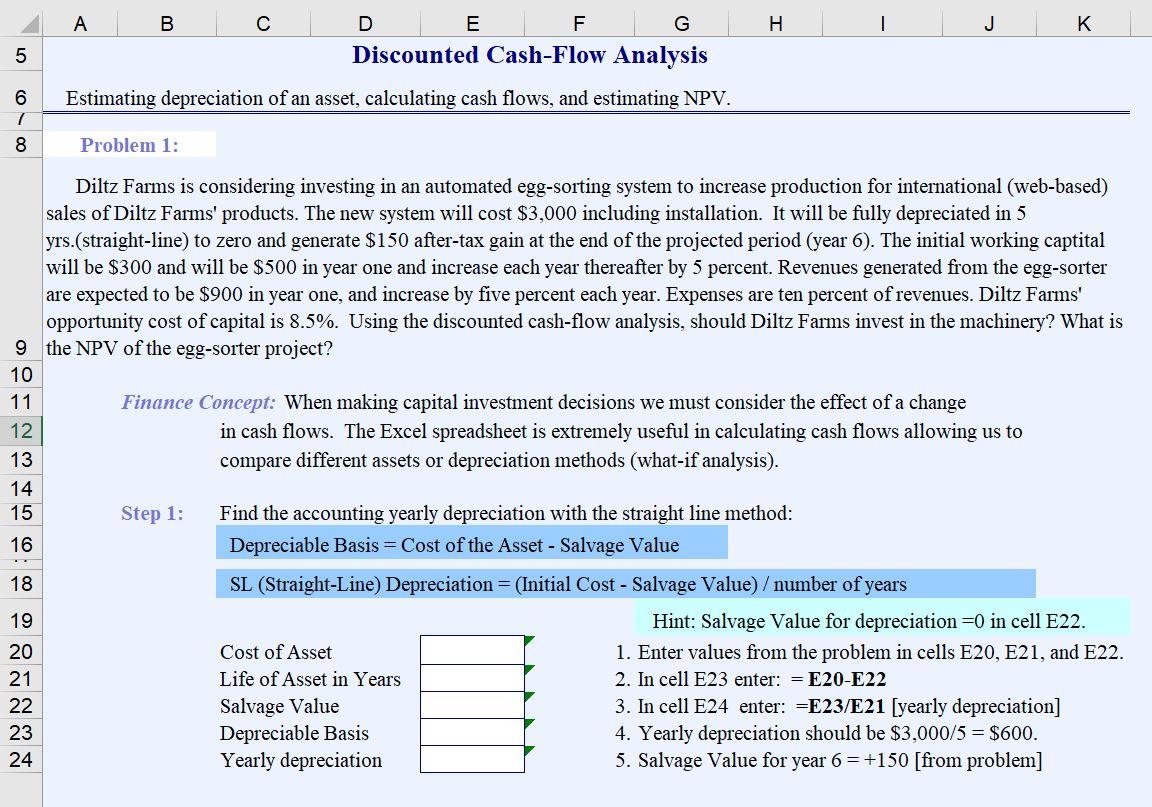
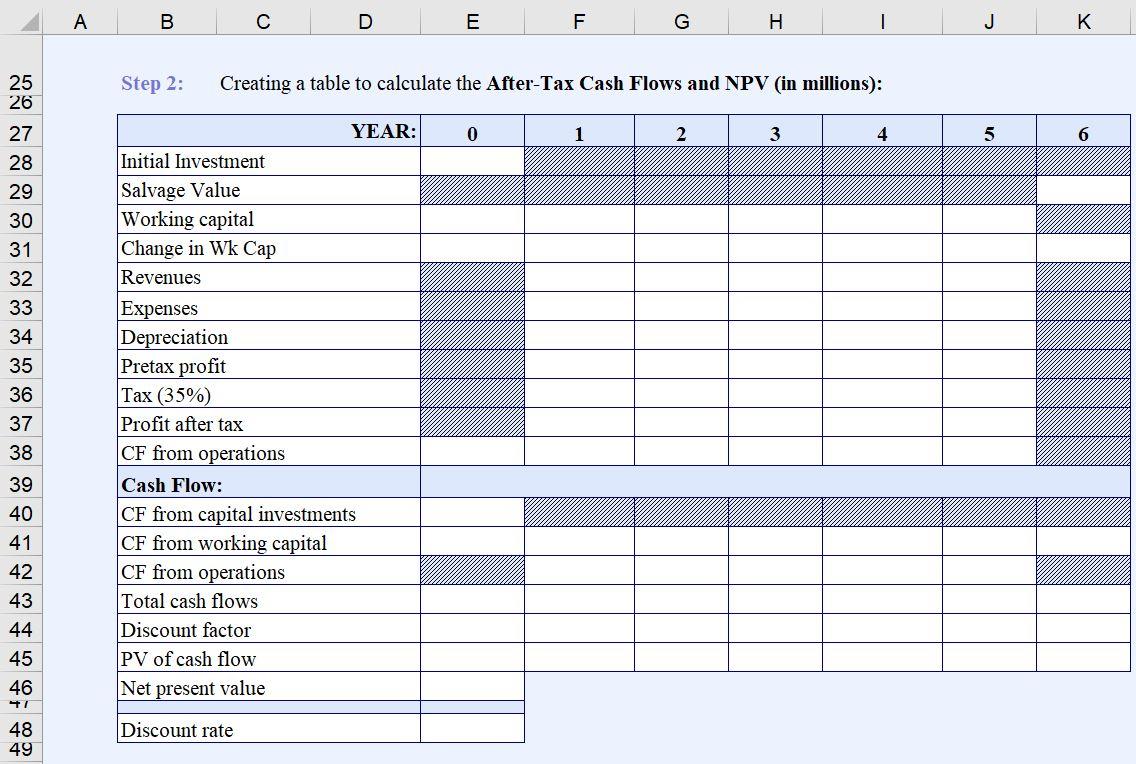
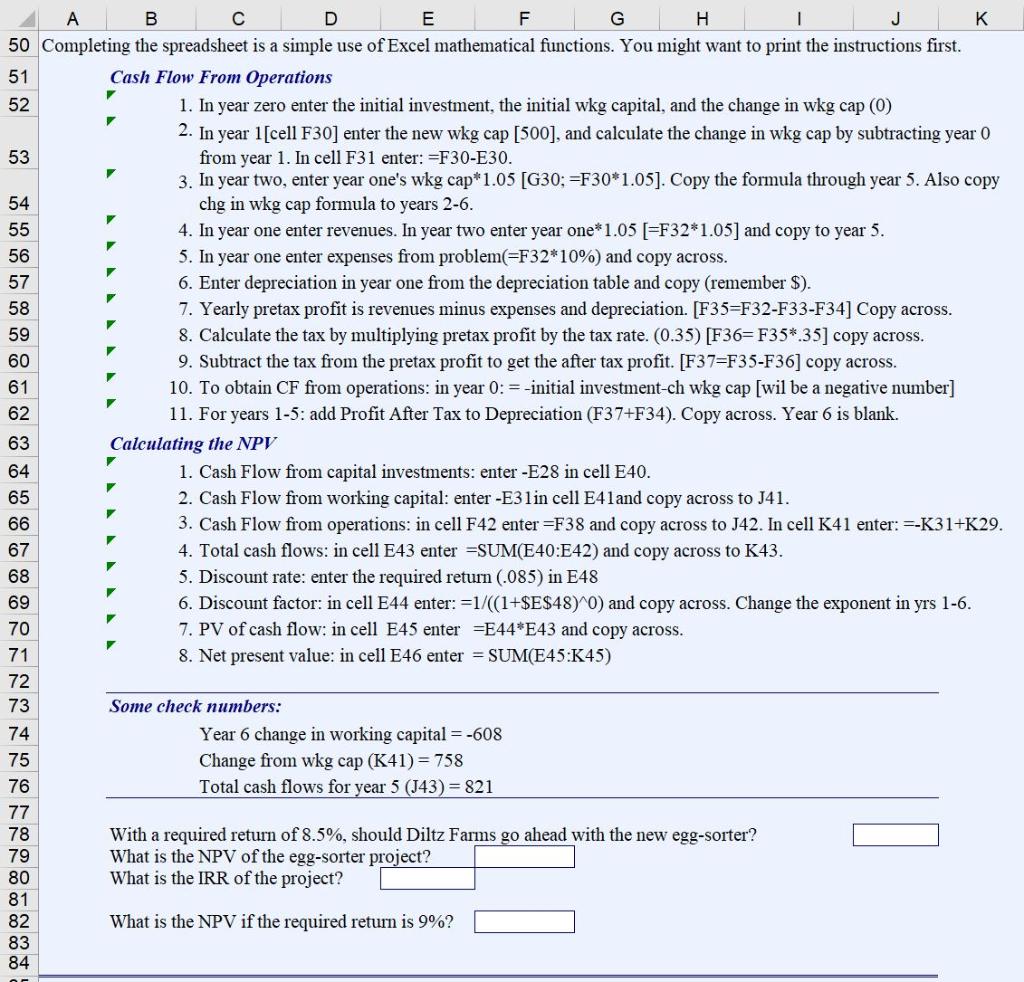
B H 1 J K 5 A D E F G Discounted Cash-Flow Analysis Estimating depreciation of an asset, calculating cash flows, and estimating NPV. 6 8 Problem 1: Diltz Farms is considering investing in an automated egg-sorting system to increase production for international (web-based) sales of Diltz Farms' products. The new system will cost $3,000 including installation. It will be fully depreciated in 5 yrs.(straight-line) to zero and generate $150 after-tax gain at the end of the projected period (year 6). The initial working captital will be $300 and will be $500 in year one and increase each year thereafter by 5 percent. Revenues generated from the egg-sorter are expected to be $900 in year one, and increase by five percent each year. Expenses are ten percent of revenues. Diltz Farms' opportunity cost of capital is 8.5%. Using the discounted cash-flow analysis, should Diltz Farms invest in the machinery? What is 9 the NPV of the egg-sorter project? 10 11 Finance Concept: When making capital investment decisions we must consider the effect of a change 12 in cash flows. The Excel spreadsheet is extremely useful in calculating cash flows allowing us to 13 compare different assets or depreciation methods (what-if analysis). 14 15 Step 1: Find the accounting yearly depreciation with the straight line method: 16 Depreciable Basis = Cost of the Asset - Salvage Value 18 SL (Straight-Line) Depreciation =(Initial Cost - Salvage Value) / number of years 19 Hint: Salvage Value for depreciation =0 in cell E22. 20 Cost of Asset 1. Enter values from the problem in cells E20, E21, and E22. 21 Life of Asset in Years 2. In cell E23 enter: = E20-E22 22 Salvage Value 3. In cell E24 enter: =E23/E21 [yearly depreciation] 23 Depreciable Basis 4. Yearly depreciation should be $3,000/5 = $600. 24 Yearly depreciation 5. Salvage Value for year 6 = +150 [from problem] A B C D E F G H J K 25 26 Step 2: Creating a table to calculate the After-Tax Cash Flows and NPV (in millions): 0 1 2 3 4 5 6 27 28 29 30 31 32 33 34 35 36 37 38 39 40 41 42 43 44 45 46 1 48 49 YEAR: Initial Investment Salvage Value Working capital Change in Wk Cap Revenues Expenses Depreciation Pretax profit Tax (35%) Profit after tax CF from operations Cash Flow: CF from capital investments CF from working capital CF from operations Total cash flows Discount factor PV of cash flow Net present value Discount rate B D E F G H J K 50 Completing the spreadsheet is a simple use of Excel mathematical functions. You might want to print the instructions first. 51 Cash Flow From Operations 52 1. In year zero enter the initial investment, the initial wkg capital, and the change in wkg cap (0) 2. In year 1[cell F30) enter the new wkg cap [500], and calculate the change in wkg cap by subtracting year 0 53 from year 1. In cell F31 enter: =F30-E30. 3. In year two, enter year one's wkg cap*1.05 (G30; =F30*1.05]. Copy the formula through year 5. Also copy 54 chg in wkg cap formula to years 2-6. 55 4. In year one enter revenues. In year two enter year one*1.05 (=F32*1.05] and copy to year 5. 56 5. In year one enter expenses from problem(=F32*10%) and copy across. 57 6. Enter depreciation in year one from the depreciation table and copy (remember $). 58 7. Yearly pretax profit is revenues minus expenses and depreciation. (F35=F32-F33-F34] Copy across. 59 8. Calculate the tax by multiplying pretax profit by the tax rate. (0.35) [F36=F35*.35] copy across. 60 9. Subtract the tax from the pretax profit to get the after tax profit. [F37=F35-F36] copy across. 61 10. To obtain CF from operations: in year 0:= -initial investment-ch wkg cap [wil be a negative number] 62 11. For years 1-5: add Profit After Tax to Depreciation (F37+F34). Copy across. Year 6 is blank. 63 Calculating the NPV 64 1. Cash Flow from capital investments: enter-E28 in cell E40. 65 2. Cash Flow from working capital: enter -E3 lin cell E41and copy across to J41. 66 3. Cash Flow from operations: in cell F42 enter =F38 and copy across to J42. In cell K41 enter:=-K31+K29. 67 4. Total cash flows: in cell E43 enter =SUM(E40:E42) and copy across to K43. 68 5. Discount rate: enter the required return (.085) in E48 69 6. Discount factor: in cell E44 enter: =1/((1+$E$48) 0) and copy across. Change the exponent in yrs 1-6. 70 7. PV of cash flow: in cell E45 enter =E44*E43 and copy across. 71 8. Net present value: in cell E46 enter = SUM(E45:K45) 72 73 Some check numbers: 74 Year 6 change in working capital = -608 75 Change from wkg cap (K41) = 758 76 Total cash flows for year 5 (J43) = 821 77 78 With a required return of 8.5%, should Diltz Farms go ahead with the new egg-sorter? 79 What is the NPV of the egg-sorter project? 80 What is the IRR of the project? 81 82 What is the NPV if the required return is 9%? 83 84
Step by Step Solution
There are 3 Steps involved in it

Get step-by-step solutions from verified subject matter experts
 Study Help