







Question: 10.(12 total points) For this question, use the following graph and (if multiple allowable choices exist as to which vertex to pick next) assume the
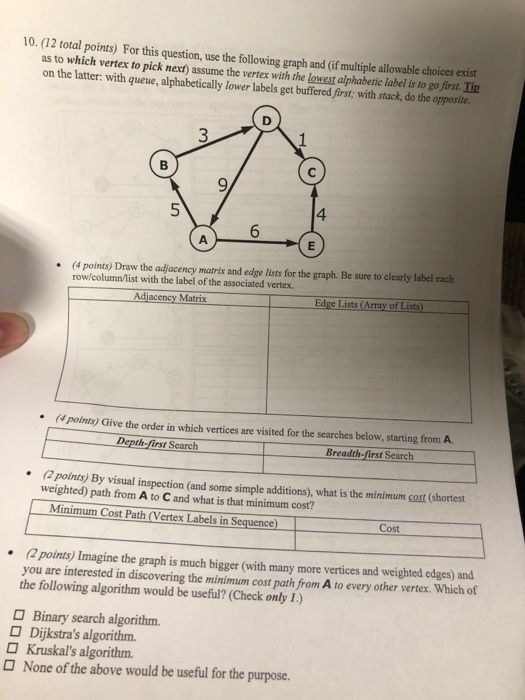
10.(12 total points) For this question, use the following graph and (if multiple allowable choices exist as to which vertex to pick next) assume the vertex with the lowest alphabetic label is to go first. Tin on the latter: with queue, alphabetically lower labels get buffered first; with stack, do the opposite 3 9 4 AE (4 points) Draw the adjacency matrix and edge lists for the graph. Be sure to clearly label each row/column/list with the label of the associated vertex. Adjacency Matrix Edge Lists (Array of Lists) (4 points) Give the order in which vertices are visited for the searches below, starting from A. Depth-first Search Breadth-first Search 2 points) By visual inspection (and some simple additions), what is the minimum cost (shortest weighted) path from A to C and what is that minimum cost? Minimum Cost Path Vertex Labels in Sequence) Cost (2 points) Imagine the graph is much bigger (with many more vertices and weighted edges) and you are interested in discovering the minimum cost path from A to every other vertex. Which of the following algorithm would be useful? (Check only 1.) Binary search algorithm. Dijkstra's algorithm. Kruskal's algorithm. None ofthe above would be useful for the purpose
Step by Step Solution
There are 3 Steps involved in it

Get step-by-step solutions from verified subject matter experts
 Study Help