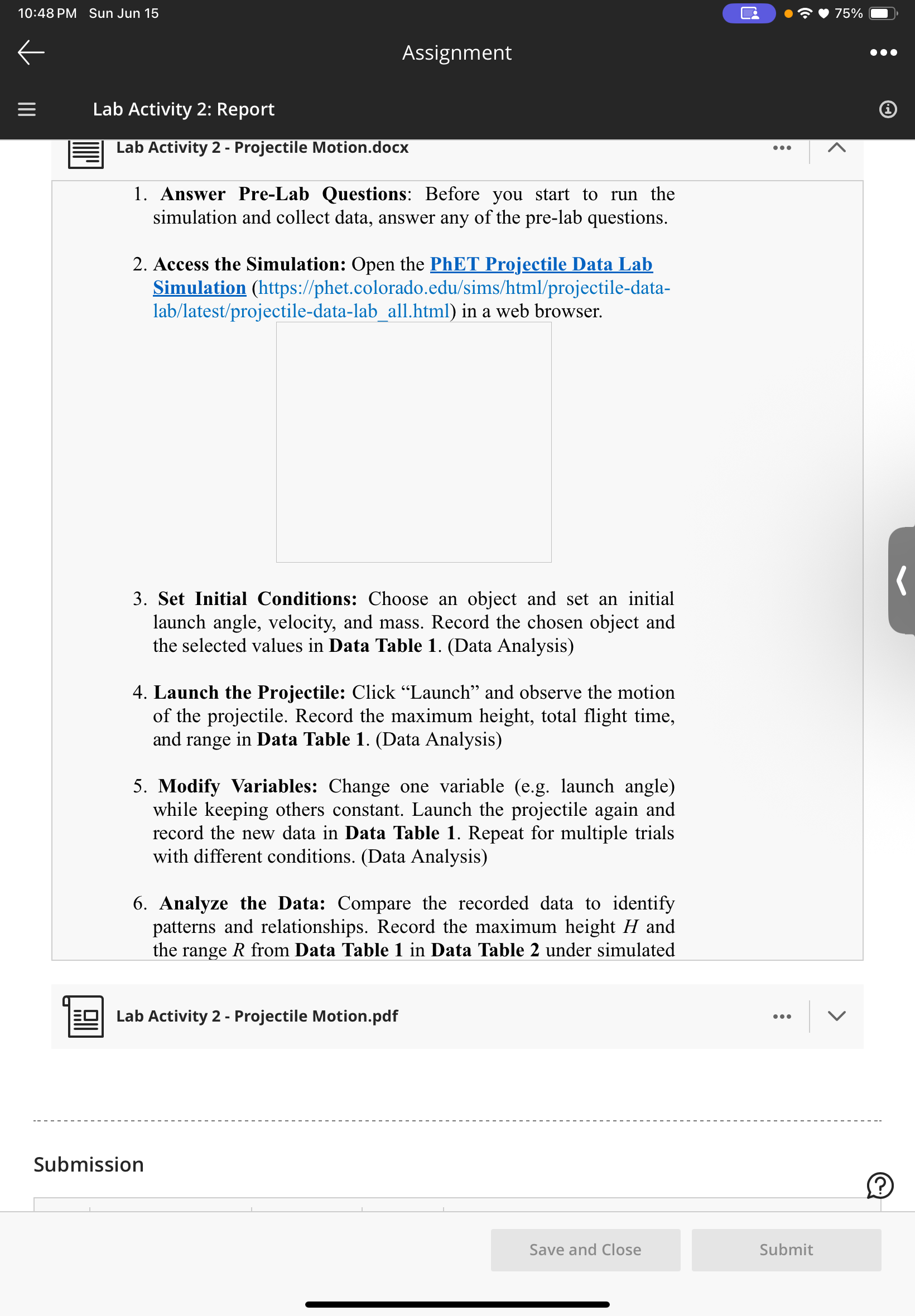
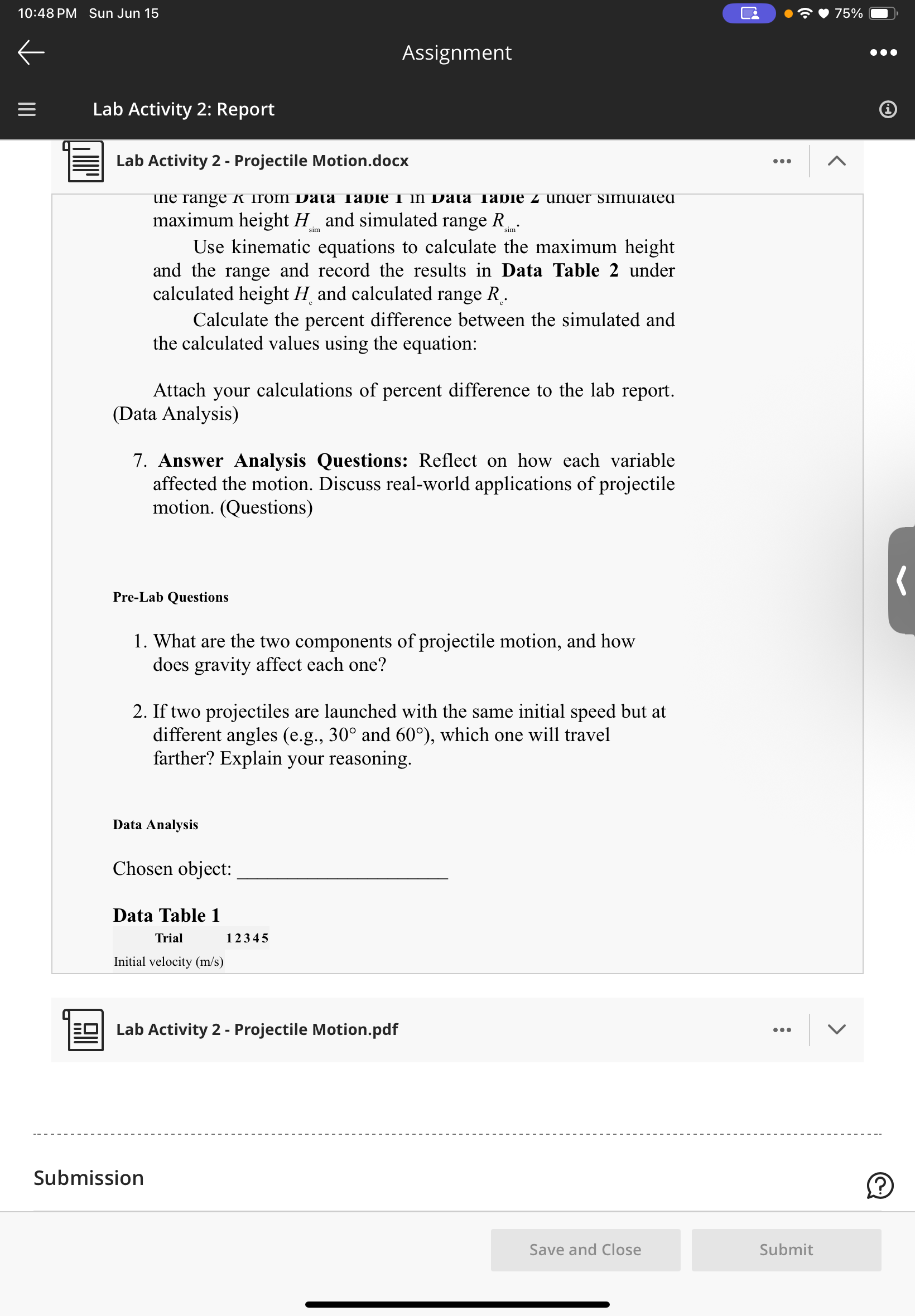
10:48 PM Sun Jun 15 . 75% Assignment . . . Lab Activity 2: Report Lab Activity 2 - Projectile Motion.docx . . . SCIT 1420 Lab Manual Professors Mckey, Roed Lab Activity 2: Projectile Motion Objective In this lab, students will use the PhET Projectile Data Lab Simulation to investigate how initial velocity, launch angle, and mass affect a projectile's motion. By collecting and analyzing data, students will apply kinematic equations to understand key aspects of projectile motion. Background and Introduction Projectile motion is a key concept in physics that describes the motion of an object launched into the air under the influence of gravity. It follows a curved trajectory known as a parabola and can be analyzed by separating its motion into horizontal and vertical components. Horizontal motion occurs at a constant velocity, while vertical motion is affected by the constant acceleration due to gravity. Understanding projectile motion is essential in various scientific and engineering fields, ranging from sports science to space exploration. In this lab, students will use the PhET Projectile Data Lab Simulation to investigate how different variables - such as initial velocity, launch angle, and mass - affect a projectile's trajectory. By collecting and analyzing simulation data, students will gain a deeper understanding of motion in two dimensions and apply mathematical principles to predict projectile behavior. The following equations describe the key aspects of projectile motion: . Horizontal motion (constant volonity) Lab Activity 2 - Projectile Motion.pdf ... V Submission ? Save and Close Submit10:48PM Sun Jun 15 Gi eFo75% a) a Cotaveayale = Lab Activity 2: Report |= Lab Activity 2 - Projectile Motion.docx Understanding projectile motion is essential in various scientific and engineering fields, ranging from sports science to space exploration. In this lab, students will use the PhET Projectile Data Lab Simulation to investigate how different variables such as initial velocity, launch angle, and mass affect a projectile's trajectory. By collecting and analyzing simulation data, students will gain a deeper understanding of motion in two dimensions and apply mathematical principles to predict projectile behavior. The following equations describe the key aspects of projectile motion: * Horizontal motion (constant velocity) * Vertical motion (constant acceleration) * Time of flight * Range (horizontal distance traveled) Maximum height In these equations, x is the horizontal displacement, v, and v, are the initial horizontal and vertical velocity components, f is time, y is vertical displacement, g is the acceleration due to gravity (9.8 m/s\"), v. is the initial velocity, and @ is the launch angle. By applying these equations and comparing theoretical predictions with simulation outcomes, students will reinforce their understanding of the principles governing projectile motion. Procedure 1. Answer Pre-Lab Questions: Before you start to run the simulation and collect data, answer any of the pre-lab questions. i Lab Activity 2 - Projectile Motion.pdf ooo Vv Submission Save and Close Submit 10:48PM Sun Jun 15 Gi eFo75% a) a Cotaveayale = Lab Activity 2: Report |= Lab Activity 2 - Projectile Motion.docx 1. Answer Pre-Lab Questions: Before you start to run the simulation and collect data, answer any of the pre-lab questions. 2. Access the Simulation: Open the PhET Projectile Data Lab Simulation (https://phet.colorado.edu/sims/html/projectile-data- lab/latest/projectile-data-lab_all.html) in a web browser. 3. Set Initial Conditions: Choose an object and set an initial launch angle, velocity, and mass. Record the chosen object and the selected values in Data Table 1. (Data Analysis) 4. Launch the Projectile: Click \"Launch\" and observe the motion of the projectile. Record the maximum height, total flight time, and range in Data Table 1. (Data Analysis) 5. Modify Variables: Change one variable (e.g. launch angle) while keeping others constant. Launch the projectile again and record the new data in Data Table 1. Repeat for multiple trials with different conditions. (Data Analysis) 6. Analyze the Data: Compare the recorded data to identify patterns and relationships. Record the maximum height H and the range R from Data Table 1 in Data Table 2 under simulated i Lab Activity 2 - Projectile Motion.pdf ooo Vv Submission Save and Close Submit 10:48 PM Sun Jun 15 . . 75% Assignment . . . E Lab Activity 2: Report Lab Activity 2 - Projectile Motion.docx . .. ne range A from Data Table I In Data Table 2 under simulated maximum height H and simulated range Rim. Use kinematic equations to calculate the maximum height and the range and record the results in Data Table 2 under calculated height H and calculated range R. Calculate the percent difference between the simulated and the calculated values using the equation: Attach your calculations of percent difference to the lab report. (Data Analysis) 7. Answer Analysis Questions: Reflect on how each variable affected the motion. Discuss real-world applications of projectile motion. (Questions) Pre-Lab Questions 1. What are the two components of projectile motion, and how does gravity affect each one? 2. If two projectiles are launched with the same initial speed but at different angles (e.g., 30 and 60), which one will travel farther? Explain your reasoning. Data Analysis Chosen object: Data Table 1 Trial 12345 Initial veloc Lab Activity 2 - Projectile Motion.pdf ... V Submission ? Save and Close Submit
Step by Step Solution
There are 3 Steps involved in it
1 Expert Approved Answer
Step: 1 Unlock
Question Has Been Solved by an Expert!
Get step-by-step solutions from verified subject matter experts
Step: 2 Unlock
Step: 3 Unlock
Students Have Also Explored These Related Accounting Questions!









 Study Help