Question: 11. Amazon should have used ________ to determine what variables would predict future product successes. Multiple Choice intuition meta-inference observation inference analytics 12. Google Flu
11.
Amazon should have used ________ to determine what variables would predict future product successes.
Multiple Choice
-
intuition
-
meta-inference
-
observation
-
inference
-
analytics
12.
Google Flu Trends may have succeeded if the company had employed experts who had expertise needed in the analysis of data, based on
Multiple Choice
13.
If Google wanted to know all the variables that might have predicted customers adopting new technology like Google Glass, the company may have searched for research that combined results of many other studies, called
Multiple Choice
-
evidence-based studies.
-
analytics.
-
qualitative analysis.
-
inference.
-
meta-analysis.
14.
Walmart found ________ between storms and purchase of Pop Tarts and wasnt sure if it was a ________ relationship but acted on it anyway.
Multiple Choice
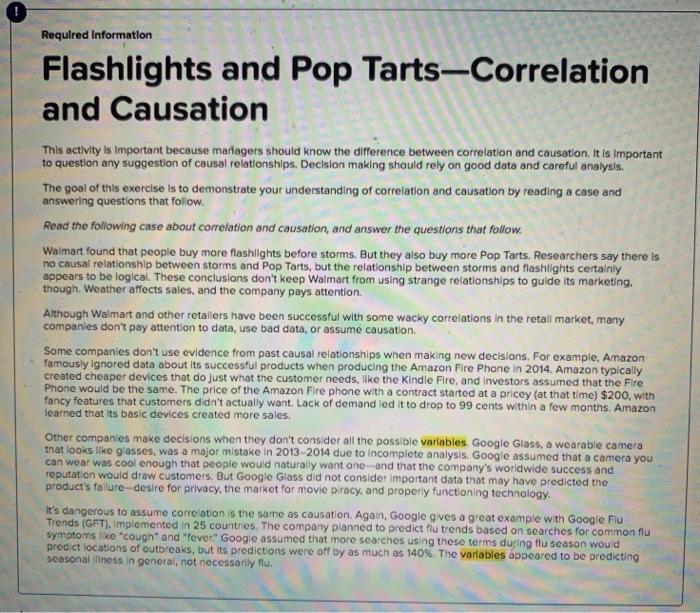
Required Information Flashlights and Pop Tarts-Correlation and Causation This activity is important because mariagers should know the difference between correlation and causation. It is important to question any suggestion of causal relationships. Decision making should rely on good data and careful analysis. The goal of this exercise is to demonstrate your understanding of correlation and causation by reading a case and answering questions that follow. Read the following case about correlation and causation, and answer the questions that follow. Walmart found that people buy more flashlights before storms. But they also buy more Pop Tarts. Researchers say there is no causal relationship between storms and Pop Torts, but the relationship between storms and flashlights certainly appears to be logical. These conclusions don't keep Walmart from using strange relationships to guide its marketing. though. Weather affects sales, and the company pays attention Although Walmart and other retailers have been successful with some wacky correlations in the retail market, many companies don't pay attention to data, use bad data, or assume causation Some companies don't use evidence from past causal relationships when making new decisions. For example, Amazon famously ignored data about its successful products when producing the Amazon Fire Phone in 2014. Amazon typically created cheaper devices that do just what the customer needs, like the Kindle Fire and investors assumed that the Fire Phone would be the same. The price of the Amazon Fire phone with a contract started at a pricey (at that time) $200, with fancy features that customers didn't actually want. Lack of demand led it to drop to 99 cents within a few months, Amazon learned that its basic devices created more sales. Other companies make decisions when they don't consider all the possible variables. Google Glass, a wearable camera that looks like glasses, was a major mistake in 2013-2014 due to incomplete analysis. Google assumed that a camera you can wear was cool enough that people would naturally want one and that the company's worldwide success and reputation would draw customers. But Google Glass did not consider Important data that may have predicted the product's fallure desire for privacy, the market for movie piracy, and properly functioning technology It's dangerous to assume correlation is the same as causation. Again, Google gives a great example with Google Fiu Trends (GPT). Implemented in 25 countries. The company planned to predict fiu trends based on searches for common flu symptoms like "cough" and "ever" Google assumed that more searches using these terms during flu season would predict locations of outbreaks, but its predictions were off by as much as 140%. The variables appeared to be predicting seasonal illness in general, not necessarily flu




