



Question: 11. Any risk left over after implementing safeguards is known as: A. Leftover risk B. Residual risk C. Remaining risk D. Totally leftover risk 12.
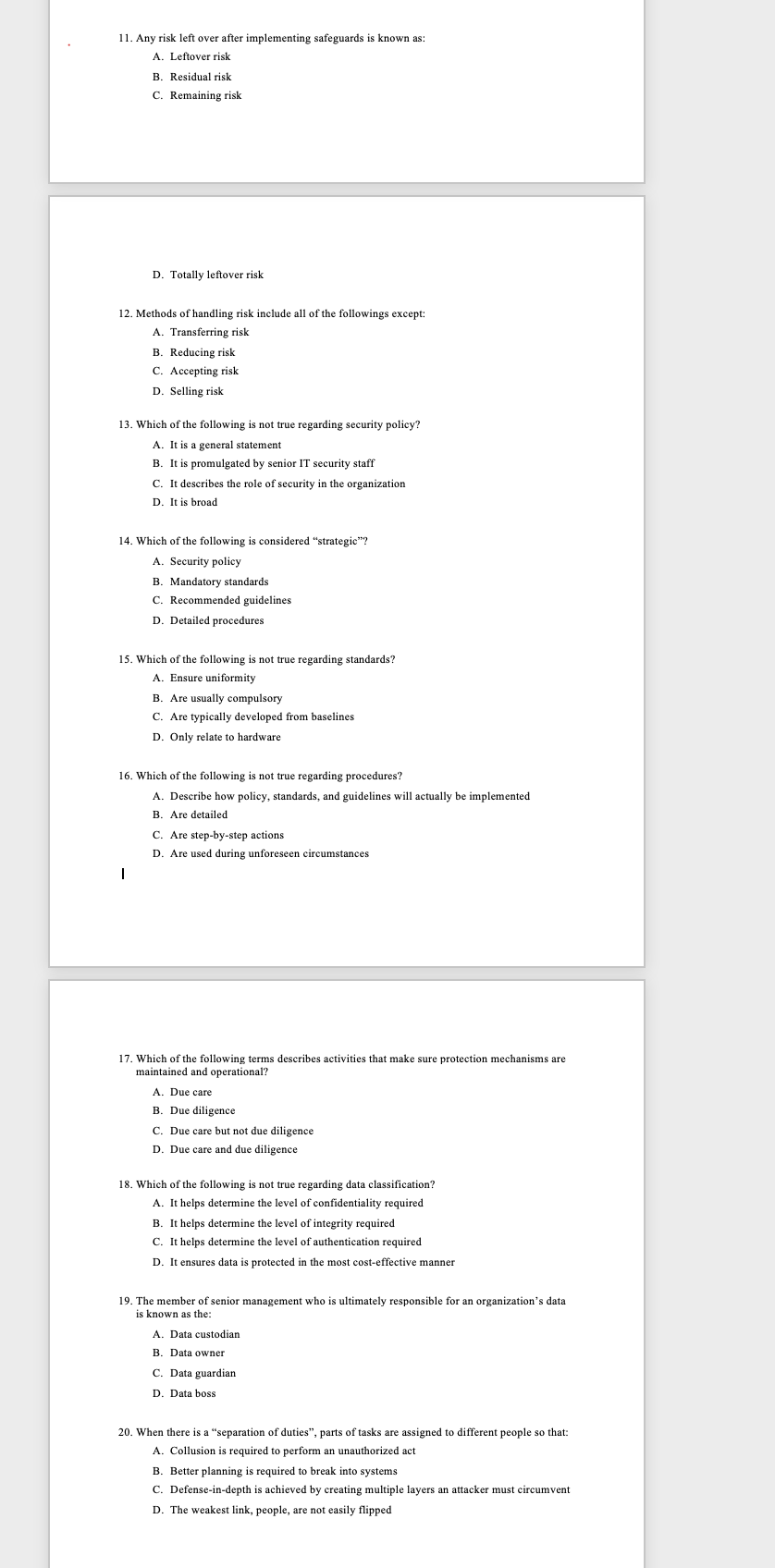
11. Any risk left over after implementing safeguards is known as: A. Leftover risk B. Residual risk C. Remaining risk D. Totally leftover risk 12. Methods of handling risk include all of the followings except: A. Transferring risk B. Reducing risk C. Accepting risk D. Selling risk 13. Which of the following is not true regarding security policy? A. It is a general statement B. It is promulgated by senior IT security staff c. It describes the role of security in the organization D. It is broad 14. Which of the following considered "strategic"? A. Security policy B. Mandatory standards C. Recommended guidelines D. Detailed procedures 15. Which of the following is not true regarding standards? A. Ensure uniformity B. Are usually compulsory C. Are typically developed from baselines D. Only relate to hardware 16. Which of the following is not true regarding procedures? A. Describe how policy, standards, and guidelines will actually be implemented B. Are detailed C. Are step-by-step actions D. Are used during unforeseen circumstances I 17. Which of the following terms describes activities that make sure protection mechanisms are maintained and operational? A Due care B. Due diligence C. Due care but not due diligence D. Due care and due diligence 18. Which of the following is not true regarding data classification? A. It helps determine the level of confidentiality required B. It helps determine the level of integrity required C. It helps determine the level of authentication required D. It ensures data protected in the most cost-effective manner 19. The member of senior management who is ultimately responsible for an organization's data is known as the: A. Data custodian B. Data owner C. Data guardian D. Data boss 20. When there is a "separation of duties, parts of tasks are assigned to different people so that: A. Collusion is required to perform an unauthorized act B. Better planning is required to break into systems C. Defense-in-depth is achieved by creating multiple layers an attacker must circumvent D. The weakest link, people, are not easily flipped
Step by Step Solution
There are 3 Steps involved in it

Get step-by-step solutions from verified subject matter experts