







Question: (11) Five batch jobs A through E, arrive at a computer center at almost the same time. They have estimated unning times of 19,6,2,5 and
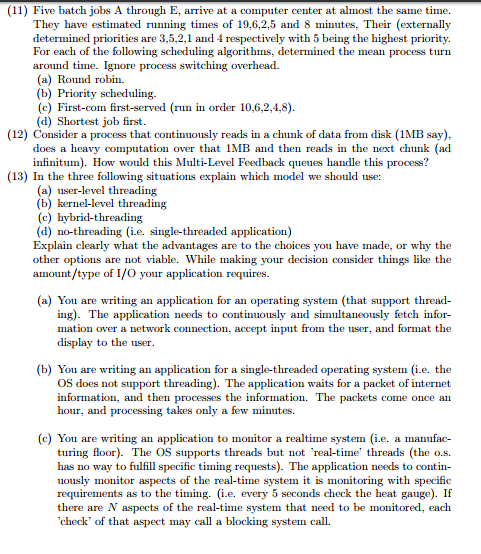
(11) Five batch jobs A through E, arrive at a computer center at almost the same time. They have estimated unning times of 19,6,2,5 and 8 minutes, Their (externally determined priorities are 3,5,2,1 and 4 respectively with 5 being the highest priority For each of the following scheduling algorithms, determined the mean process turn around time. Ignore process switching overhead. (a) Round robin. (b) Priority scheduling. (c) First-com first-served (run in order 10,6,2,4,8) (d) Shortest job first. (12) Consider a process that continuously reads in a chunk of data from disk (1MB say) does a heavy computation over that 1MB and then reads in the next chunk (ad infinitum). How would this Multi-Level Feedback queues handle this process? (13) In the three following situations explain which model we should use: (a) user-level threading (b) kernel-level threading (c) hybrid-threading (d) no-threading (i.e. single-threaded application) Explain clearly what the advantages are to the choices you have made, or why the other options are not viable. While making your decision consider things like the amount/type of I/O your application requires. (a) You are writing an application for an operating system (that support thread ing). The application needs to continuously and simultaneously fetch infor mation over a network connection, accept input from the user, and format the display to the user (b) You are writing an application for a single-threaded operating system (i.e. the acket of internet not support threading). The application waits for a p OS does information, and then processes the information. The packets come once an hour, and processing takes only a few minutes. (c) You are writing an application to monitor a realtime system (i.e. a manufac- turing floor). The OS supports threads but not real-time threads (the o.s. has no way to fulfill specific timing requests). The application needs to contin- uously monitor aspects of the real-time system it is monitoring with specific requirements as to the timing. (i.e. every 5 seconds check the heat gauge). If there are N aspects of the real-time system that need to be monitored, each check' of that aspect may call a blocking system call
Step by Step Solution
There are 3 Steps involved in it

Get step-by-step solutions from verified subject matter experts
 Study Help