







Question: 11. More on ratio analysis Aa Aa E Analysts and investors often use return on equity (ROE) to compare profitability of a company with other
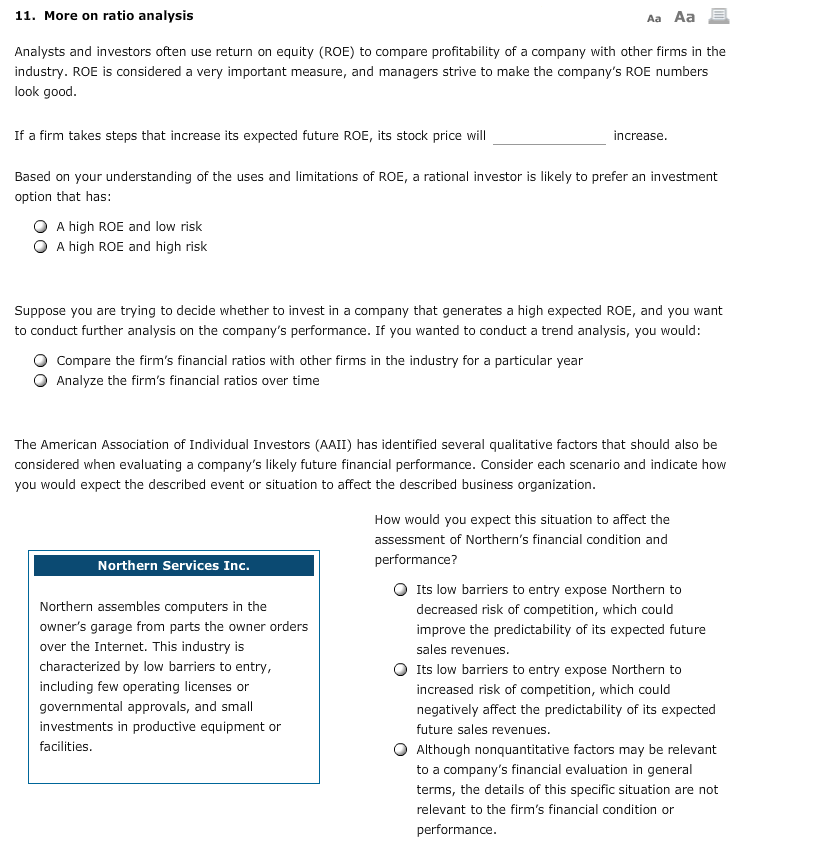
11. More on ratio analysis Aa Aa E Analysts and investors often use return on equity (ROE) to compare profitability of a company with other firms in the industry. ROE is considered a very important measure, and managers strive to make the company's ROE numbers look good. If a firm takes steps that increase its expected future ROE, its stock price will increase. Based on your understanding of the uses and limitations of ROE, a rational investor is likely to prefer an investment option that has: O O A high ROE and low risk A high ROE and high risk Suppose you are trying to decide whether to invest in a company that generates a high expected ROE, and you want to conduct further analysis on the company's performance. If you wanted to conduct a trend analysis, you would: Compare the firm's financial ratios with other firms in the industry for a particular year Analyze the firm's financial ratios over time The American Association of Individual Investors (AAII) has identified several qualitative factors that should also be considered when evaluating a company's likely future financial performance. Consider each scenario and indicate how you would expect the described event or situation to affect the described business organization. How would you expect this situation to affect the assessment of Northern's financial condition and performance? Northern Services Inc. Northern assembles computers in the owner's garage from parts the owner orders over the Internet. This industry is characterized by low barriers to entry, including few operating licenses or governmental approvals, and small investments in productive equipment or facilities. Its low barriers to entry expose Northern to decreased risk of competition, which could improve the predictability of its expected future sales revenues. Its low barriers to entry expose Northern to increased risk of competition, which could negatively affect the predictability of its expected future sales revenues. Although nonquantitative factors may be relevant to a company's financial evaluation in general terms, the details of this specific situation are not relevant to the firm's financial condition or performance
Step by Step Solution
There are 3 Steps involved in it

Get step-by-step solutions from verified subject matter experts
 Study Help