


Question: 1.1.2 Least-cost method: The least-cost method finds a better starting solution by targeting the cheapest routes. 1. It assigns as much as possible to the
1.1.2 Least-cost method: The least-cost method1.1.2 Least-cost method: The least-cost method

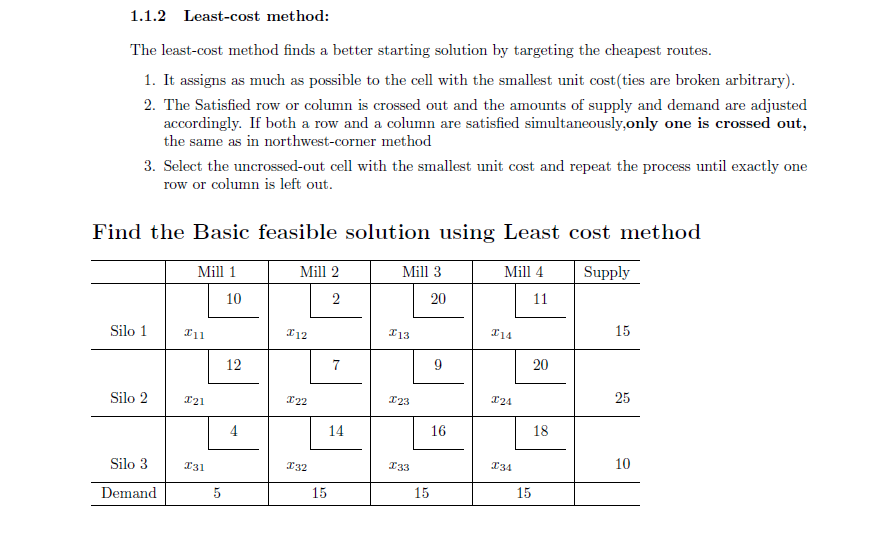
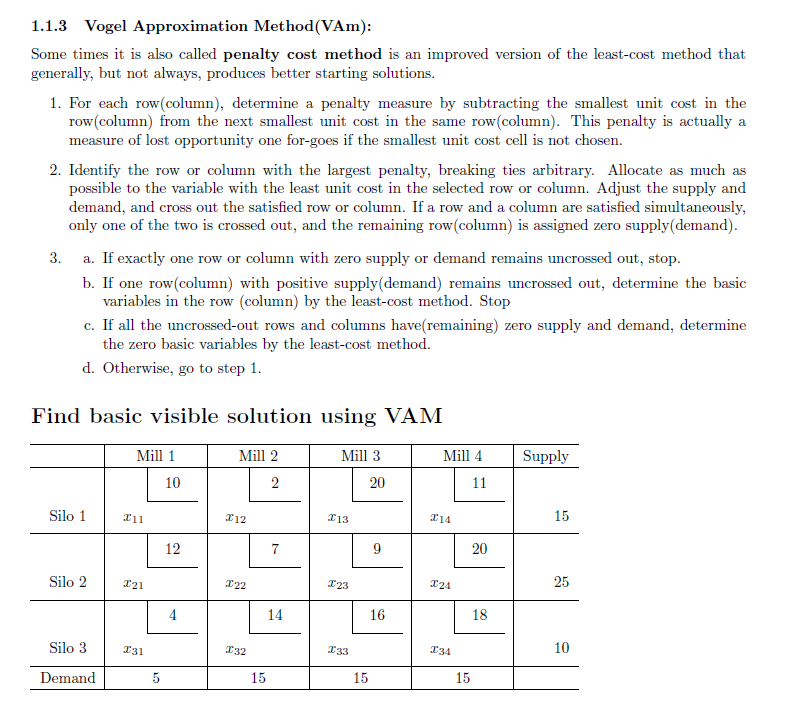
1.1.2 Least-cost method: The least-cost method finds a better starting solution by targeting the cheapest routes. 1. It assigns as much as possible to the cell with the smallest unit cost(ties are broken arbitrary). 2. The Satisfied row or column is crossed out and the amounts of supply and demand are adjusted accordingly. If both a row and a column are satisfied simultaneously,only one is crossed out, the same as in northwest-corner method 3. Select the uncrossed-out cell with the smallest unit cost and repeat the process until exactly one row or column is left out. Find the Basic feasible solution using Least cost method 1.1.3 Vogel Approximation Method(VAm): Some times it is also called penalty cost method is an improved version of the least-cost method that generally, but not always, produces better starting solutions. 1. For each row(column), determine a penalty measure by subtracting the smallest unit cost in the row(column) from the next smallest unit cost in the same row(column). This penalty is actually a measure of lost opportunity one for-goes if the smallest unit cost cell is not chosen. 2. Identify the row or column with the largest penalty, breaking ties arbitrary. Allocate as much as possible to the variable with the least unit cost in the selected row or column. Adjust the supply and demand, and cross out the satisfied row or column. If a row and a column are satisfied simultaneously, only one of the two is crossed out, and the remaining row(column) is assigned zero supply(demand). 3. a. If exactly one row or column with zero supply or demand remains uncrossed out, stop. b. If one row(column) with positive supply(demand) remains uncrossed out, determine the basic variables in the row (column) by the least-cost method. Stop c. If all the uncrossed-out rows and columns have(remaining) zero supply and demand, determine the zero basic variables by the least-cost method. d. Otherwise, go to step 1 . Find basic visible solution using VAM

Step by Step Solution

There are 3 Steps involved in it

1 Expert Approved Answer
Step: 1 Unlock blur-text-image

Question Has Been Solved by an Expert!

Get step-by-step solutions from verified subject matter experts

Step: 2 Unlock
Step: 3 Unlock

Students Have Also Explored These Related General Management Questions!