







Question: 11.3-11.4 Written Practice 1. A sequence can be both arithmetic and geometric. Give an example, and tell why it meets both sets of requirements. 2.
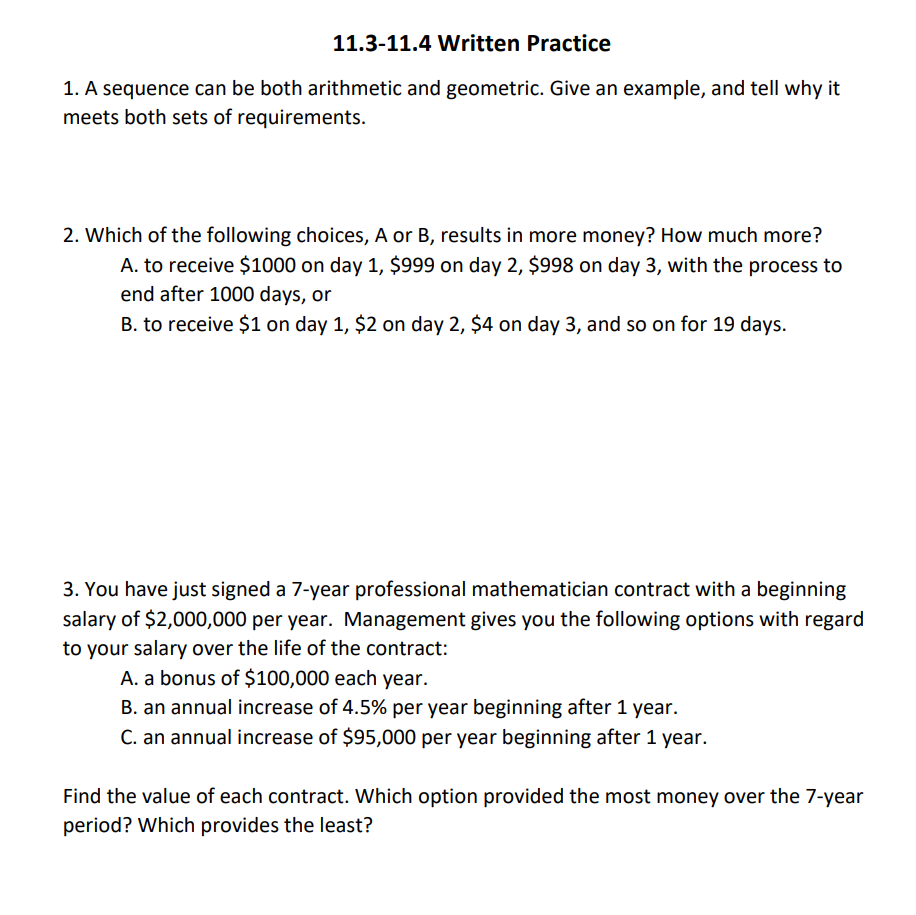
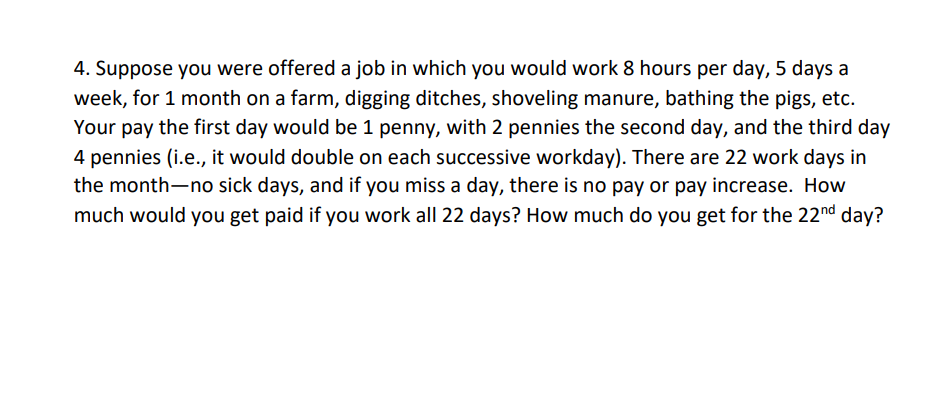
11.3-11.4 Written Practice 1. A sequence can be both arithmetic and geometric. Give an example, and tell why it meets both sets of requirements. 2. Which of the following choices, A or B, results in more money? How much more? A. to receive $1000 on day 1, $999 on day 2, $998 on day 3, with the process to end after 1000 days, or B. to receive $1 on day 1, $2 on day 2, $4 on day 3, and so on for 19 days. 3. You havejust signed a 1-year professional mathematician contract with a beginning salary of $2,000,000 per year. Management gives you the following options with regard to your salary over the life of the contract: A. a bonus of $100,000 each year. B. an annual increase of 4.5% per year beginning after 1 year. C. an annual increase of $95,000 per year beginning after 1 year. Find the value of each contract. Which option provided the most money over the 1-year period? Which provides the least? 4. Suppose you were offered a job in which you would work 8 hours per day, 5 days a week, for 1 month on a farm, digging ditches, shoveling manure, bathing the pigs, etc. Your pay the first day would be 1 penny, with 2 pennies the second day, and the third day 4 pennies (i.e., it would double on each successive workday). There are 22 work days in the monthno sick days, and if you miss a day, there is no pay or pay increase. How much would you get paid if you work all 22 days? How much do you get for the 22\"L1 clay
Step by Step Solution
There are 3 Steps involved in it

Get step-by-step solutions from verified subject matter experts
 Study Help