







Question: 1.14 Consider the widget exchange. Suppose that each widget contract has a market value of $O and a notional value of $100. There are three
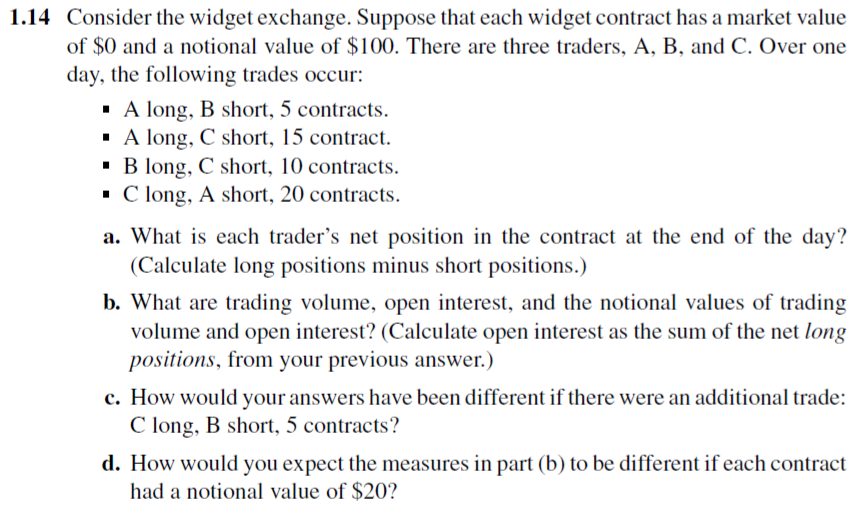
1.14 Consider the widget exchange. Suppose that each widget contract has a market value of $O and a notional value of $100. There are three traders, A, B, and C. Over one day, the following trades occur: A long, B short, 5 contracts. A long, C short, 15 contract B long, C short, 10 contracts C long, A short, 20 contracts. a. What is each trader's net position in the contract at the end of the day? Calculate long positions minus short positions.) b. What are trading volume, open interest, and the notional values of trading volume and open interest? (Calculate open interest as the sum of the net long positions, from your previous answer.) C long, B short, 5 contracts? had a notional value of $20? c. How would your answers have been different if there were an additional trade: d. How would you expect the measures in part (b) to be different if each contract 1.14 Consider the widget exchange. Suppose that each widget contract has a market value of $O and a notional value of $100. There are three traders, A, B, and C. Over one day, the following trades occur: A long, B short, 5 contracts. A long, C short, 15 contract B long, C short, 10 contracts C long, A short, 20 contracts. a. What is each trader's net position in the contract at the end of the day? Calculate long positions minus short positions.) b. What are trading volume, open interest, and the notional values of trading volume and open interest? (Calculate open interest as the sum of the net long positions, from your previous answer.) C long, B short, 5 contracts? had a notional value of $20? c. How would your answers have been different if there were an additional trade: d. How would you expect the measures in part (b) to be different if each contract
Step by Step Solution
There are 3 Steps involved in it

Get step-by-step solutions from verified subject matter experts
 Study Help