







Question: 11:59 PM You Be the Judge Scenario. This case involves a specialized insurance policy to protect a food manufacturing and distribution company from claims based
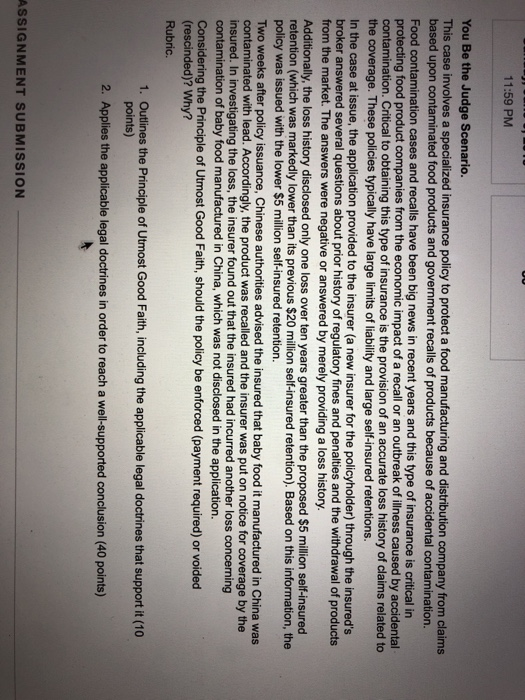
11:59 PM You Be the Judge Scenario. This case involves a specialized insurance policy to protect a food manufacturing and distribution company from claims based upon contaminated food products and government recalls of products because of accidental contamination. Food contamination cases and recalls have been big news in recent years and this type of insurance is critical in protecting food product companies from the economic impact of a recall or an outbreak of illness caused by accidental contamination. Critical to obtaining this type of insurance is the provision of an accurate loss history of claims related to the coverage. These policies typically have large limits of liability and large self-insured retentions. In the case at issue, the application provided to the insurer (a new insurer for the policyholder) through the insured's broker answered several questions about prior history of regulatory fines and penalties and the withdrawal of products from the market. The answers were negative or answered by merely providing a loss history Additionally, the loss history disclosed only one loss over ten years greater than the proposed $5 million self-insured retention (which was markedly lower than its previous $20 million self-insured retention). Based on this information, the policy was issued with the lower $5 million self-insured retention. Two weeks after policy issuance, Chinese authorities advised the insured that baby food it manufactured in China was contaminated with lead. Accordingly, the product was recalled and the insurer was put on notice for coverage by the insured. In investigating the loss, the insurer found out that the insured had incurred another loss concerning contamination of baby food manufactured in China, which was not disclosed in the application. Considering the Principle of Utmost Good Faith, should the policy be enforced (payment required) or voided (rescinded)? Why? Rubric. 1. Outlines the Principle of Utmost Good Faith, including the applicable legal doctrines that support it (10 points) 2. Applies the applicable legal doctrines in order to reach a well-supported conclusion (40 points) ASSIGNMENT SUBMISSION 11:59 PM You Be the Judge Scenario. This case involves a specialized insurance policy to protect a food manufacturing and distribution company from claims based upon contaminated food products and government recalls of products because of accidental contamination. Food contamination cases and recalls have been big news in recent years and this type of insurance is critical in protecting food product companies from the economic impact of a recall or an outbreak of illness caused by accidental contamination. Critical to obtaining this type of insurance is the provision of an accurate loss history of claims related to the coverage. These policies typically have large limits of liability and large self-insured retentions. In the case at issue, the application provided to the insurer (a new insurer for the policyholder) through the insured's broker answered several questions about prior history of regulatory fines and penalties and the withdrawal of products from the market. The answers were negative or answered by merely providing a loss history Additionally, the loss history disclosed only one loss over ten years greater than the proposed $5 million self-insured retention (which was markedly lower than its previous $20 million self-insured retention). Based on this information, the policy was issued with the lower $5 million self-insured retention. Two weeks after policy issuance, Chinese authorities advised the insured that baby food it manufactured in China was contaminated with lead. Accordingly, the product was recalled and the insurer was put on notice for coverage by the insured. In investigating the loss, the insurer found out that the insured had incurred another loss concerning contamination of baby food manufactured in China, which was not disclosed in the application. Considering the Principle of Utmost Good Faith, should the policy be enforced (payment required) or voided (rescinded)? Why? Rubric. 1. Outlines the Principle of Utmost Good Faith, including the applicable legal doctrines that support it (10 points) 2. Applies the applicable legal doctrines in order to reach a well-supported conclusion (40 points) ASSIGNMENT SUBMISSION
Step by Step Solution
There are 3 Steps involved in it

Get step-by-step solutions from verified subject matter experts
 Study Help