







Question: 12. Convort the nfa defioed by with Initial state o and final state .into an equivalent dfa. 13. Prove that for every nfa with an
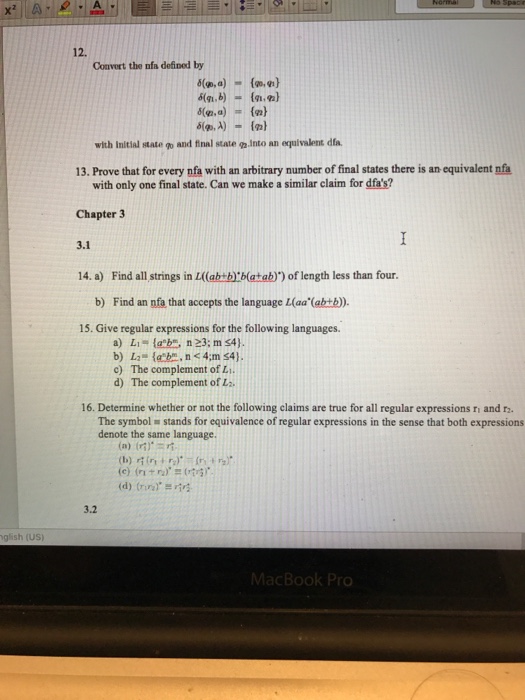
12. Convort the nfa defioed by with Initial state o and final state .into an equivalent dfa. 13. Prove that for every nfa with an arbitrary number of final states there is an equivalent nfa with only one final state. Can we make a similar claim for dfa's? Chapter 3 3.1 14. a) Find all strings in L(abtb blatab)") of length less than four. b) Find an nfa that accepts the language Laa (abb). 15. Give regular expressions for the following languages. c) The complement of Li d) The complement of L. 16. Determine whether or not the following claims are true for all regular expressions ri and r. The symbol stands for equivalence of regular expressions in the sense that both expressions denote the same language (n) (r1)"- (c) (ntr) (3 3.2 gis 12. Convort the nfa defioed by with Initial state o and final state .into an equivalent dfa. 13. Prove that for every nfa with an arbitrary number of final states there is an equivalent nfa with only one final state. Can we make a similar claim for dfa's? Chapter 3 3.1 14. a) Find all strings in L(abtb blatab)") of length less than four. b) Find an nfa that accepts the language Laa (abb). 15. Give regular expressions for the following languages. c) The complement of Li d) The complement of L. 16. Determine whether or not the following claims are true for all regular expressions ri and r. The symbol stands for equivalence of regular expressions in the sense that both expressions denote the same language (n) (r1)"- (c) (ntr) (3 3.2 gis
Step by Step Solution
There are 3 Steps involved in it

Get step-by-step solutions from verified subject matter experts
 Study Help