







Question: Convert the nfa defined by delta (q_0, a) = {q_0, q_1} delta(q_1, b) = {q_1, q_2} delta(q_2, a) = {q_2} delta(q_0, lambda) = {q_2} with
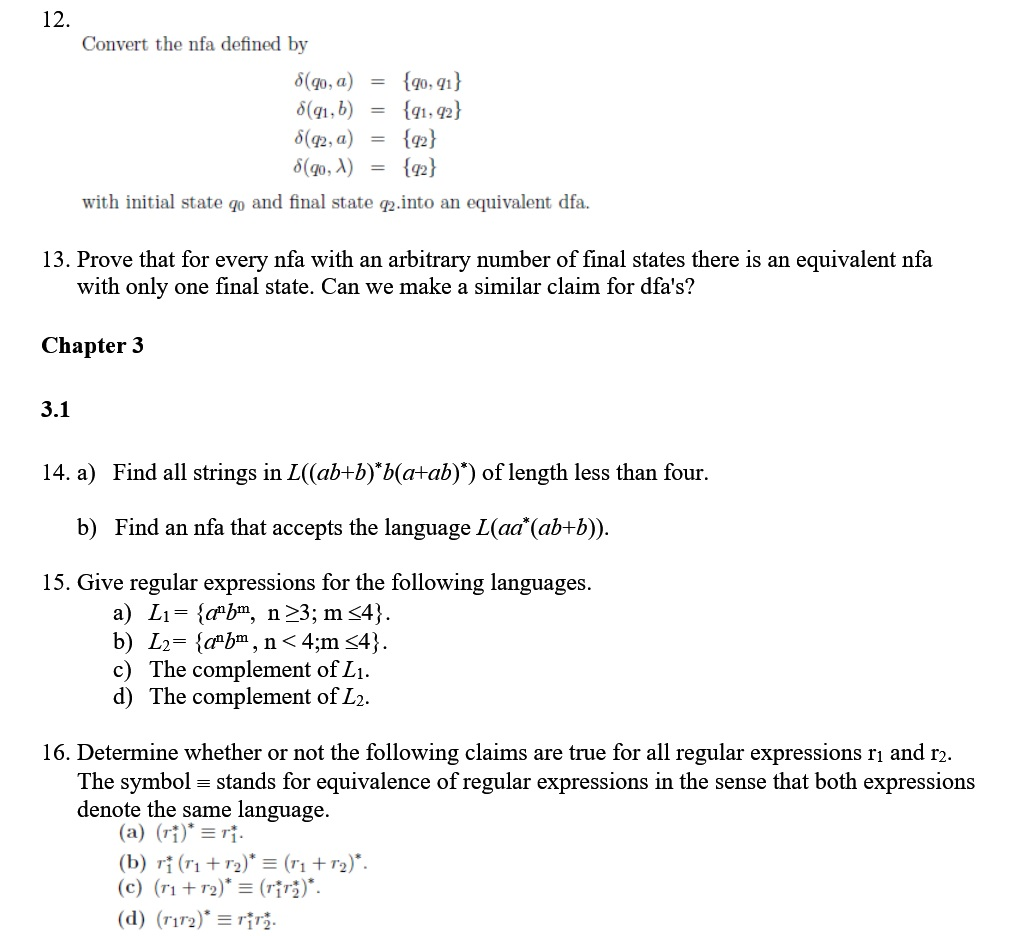
Convert the nfa defined by delta (q_0, a) = {q_0, q_1} delta(q_1, b) = {q_1, q_2} delta(q_2, a) = {q_2} delta(q_0, lambda) = {q_2} with initial state q_0 and final state q_2. into an equivalent dfa. Prove that for every nfa with an arbitrary number of final states there is an equivalent nfa with only one final state. Can we make a similar claim for dfa's? a) Find all strings in L(ab + b)*b(a + ab)*) of length less than four. b) Find an nfa that accepts the language L(aa* (ab + b)) Give regular expressions for the following languages. a) L_1 = {a^n b^m, n greaterthanorequalto 3: m lessthanorequalto 4} b) L_2 = {a^n b^m, n
Step by Step Solution
There are 3 Steps involved in it

Get step-by-step solutions from verified subject matter experts
 Study Help