







Question: 1.2, Elementary properties Let gamma :z=z(t),tin(a,b) . We define the opposite arc, written -gamma , by -gamma :z=z(-t),tin(-b;-a) Then, int_(-7) f(z)dz=int_(-b)^(-a) f(z(-t))(d)/(dt)[z(-t)]dt=-int_(-b)^(-a) f(z(-t))(dz)/(dt)(-t)dt=-int_a^b f(z(t))(dz)/(dt)(t)dt
1.2,Elementary properties\ Let
\\\\gamma :z=z(t),tin(a,b). We define the opposite arc, written
-\\\\gamma , by\
-\\\\gamma :z=z(-t),tin(-b;-a)\ Then,\
\\\\int_(-7) f(z)dz=\\\\int_(-b)^(-a) f(z(-t))(d)/(dt)[z(-t)]dt=-\\\\int_(-b)^(-a) f(z(-t))(dz)/(dt)(-t)dt=-\\\\int_a^b f(z(t))(dz)/(dt)(t)dt\ where the last equality is obtained with a simple change of variable. Hence\
\\\\int_(-\\\\gamma ) f(z)dz=-\\\\int_(\\\\gamma ) f(z)dz 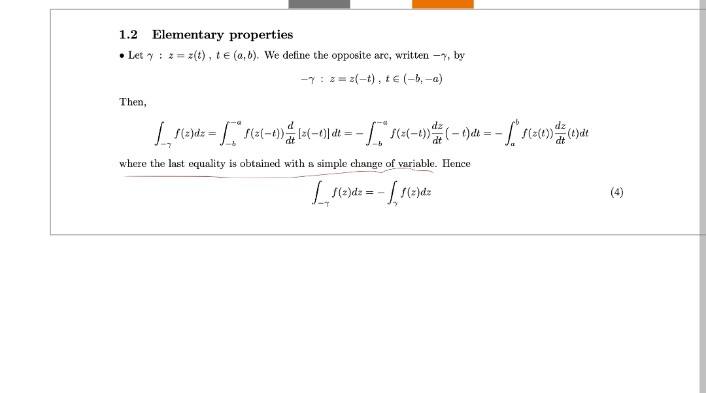
1.2 Elementary properties - Let :z=z(t),t(a,b). We define the opposite arc, written , by :z=z(t),t(b,a) Then, 7f(z)dz=baf(z(t))dtd[z(t)]dt=baf(z(t))dtdz(t)dt=abf(z(t))dtdz(t)dt where the last equality is obtained with s simple change of variable. Hence f(z)dz=f(z)dz
Step by Step Solution
There are 3 Steps involved in it
1 Expert Approved Answer
Step: 1 Unlock

Question Has Been Solved by an Expert!
Get step-by-step solutions from verified subject matter experts
Step: 2 Unlock
Step: 3 Unlock
 Study Help