



Question: 12. In class diagram, an aggregation relationship: (4.) shows how classes are composed of other classes. 6. Is implemented using the class inheritance mechanism. c.
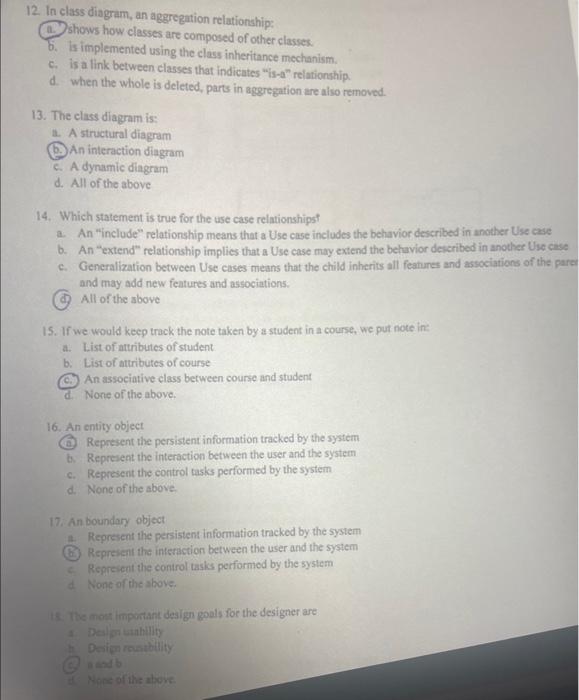
12. In class diagram, an aggregation relationship: (4.) shows how classes are composed of other classes. 6. Is implemented using the class inheritance mechanism. c. is a link between classes that indicates "is-a" relationship. d. When the whole is deleted, parts in aggregation are also removed. 13. The class diagrain is: a. A structural diagram (6.) An interaction diagram c. A dynamic diagram d. All of the above 14. Which statement is true for the use case relationshipst a. An "include" relationship means that a Use cuse includes the behavior described in anether Use case b. An "extend" relationship implies that a Use case may extend the behavior described in another Use case c. Generalization between Use cuses means that the child inherits all features and associations of the pare and may add new features and associations. (d) All of the above 15. If we would keep track the note taken by a student in a course, we put note in: a. List of attributes of student b. List of attributes of course (c.) An associative class between course and student d. None of the above. 16. An entity object (a) Represent the persistent information tracked by the system b. Represent the interaction between the user and the system c. Represent the control tasks performed by the system d. None of the above. 17. An boundary object 17. An Respresent the persistent information tracked by the system Represent the interaction between the user and the system Represent the control tasks performed by the system 4. None of the above
Step by Step Solution
There are 3 Steps involved in it

Get step-by-step solutions from verified subject matter experts