



Question: 12. Suppose that you are writing an assembler for a machine on which the length of an assembled instruction depends upon the type of the
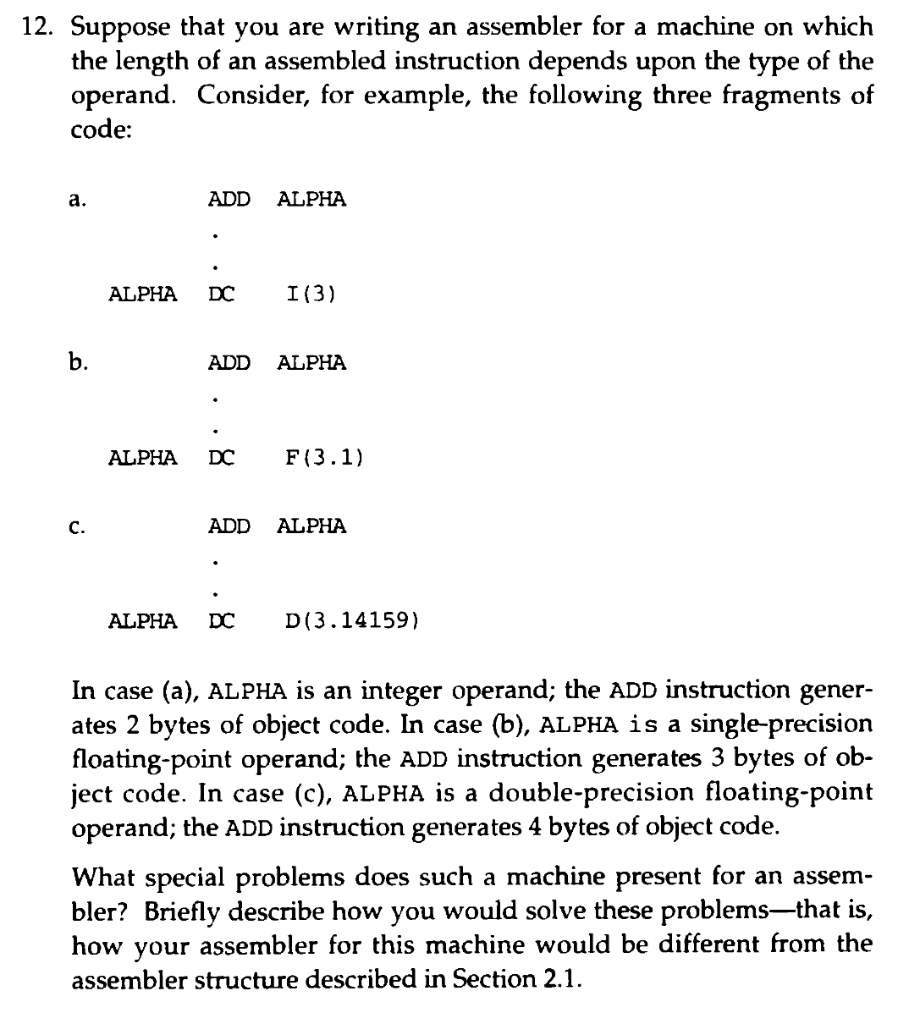
12. Suppose that you are writing an assembler for a machine on which the length of an assembled instruction depends upon the type of the operand. Consider, for example, the following three fragments of code: In case (a), ALPHA is an integer operand; the ADD instruction generates 2 bytes of object code. In case (b), ALPHA is a single-precision floating-point operand; the ADD instruction generates 3 bytes of object code. In case (c), ALPHA is a double-precision floating-point operand; the ADD instruction generates 4 bytes of object code. What special problems does such a machine present for an assembler? Briefly describe how you would solve these problems-that is, how your assembler for this machine would be different from the assembler structure described in Section 2.1
Step by Step Solution
There are 3 Steps involved in it

Get step-by-step solutions from verified subject matter experts