







Question: 12.27 Write the explicit numerical form of (i) the wavefunction n=Nsin(Ln)n=1,2,3, and (ii) the corresponding probability density for n=I and L=100pm at x= (a) 10pm,
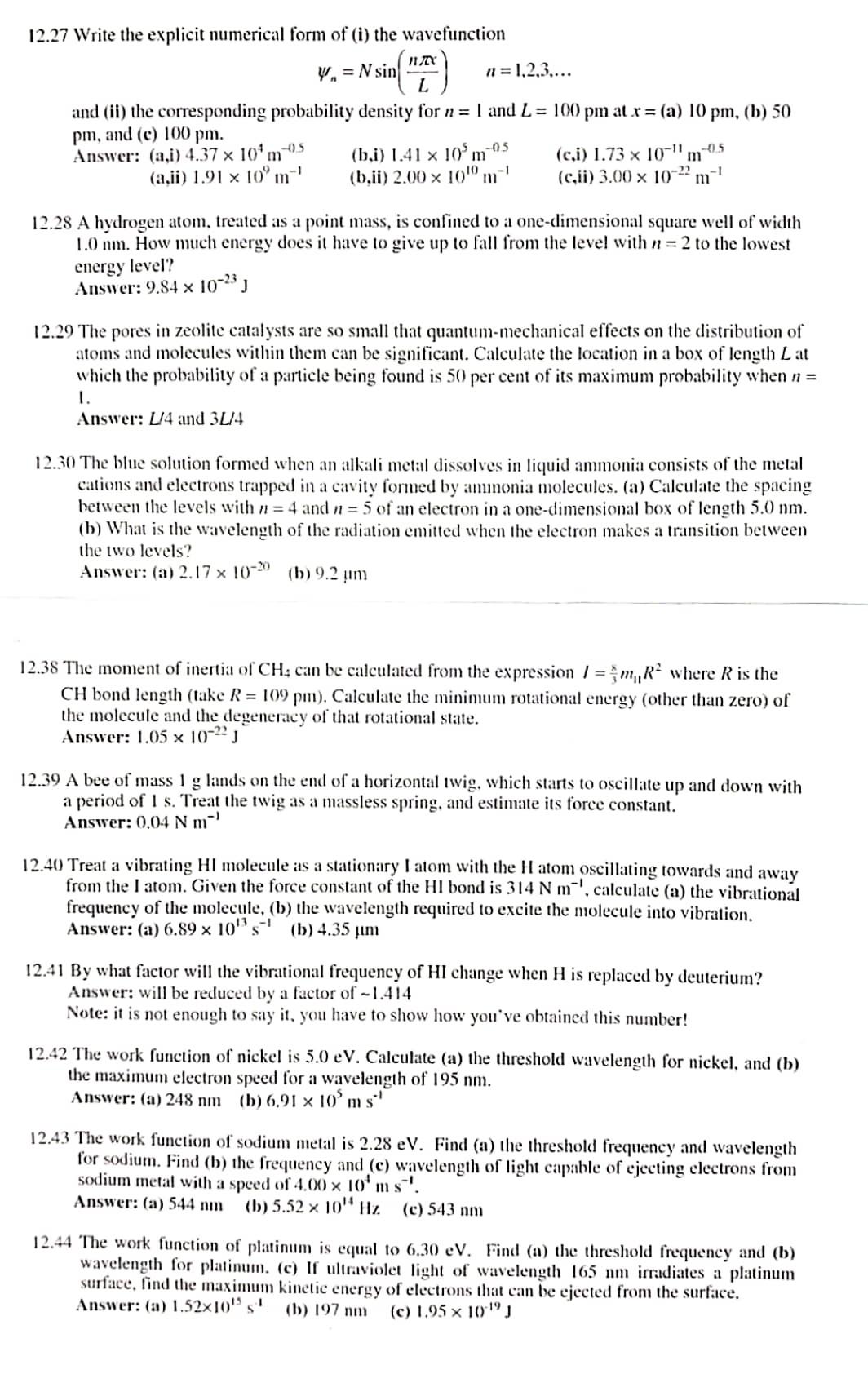
12.27 Write the explicit numerical form of (i) the wavefunction n=Nsin(Ln)n=1,2,3, and (ii) the corresponding probability density for n=I and L=100pm at x= (a) 10pm, (b) 50 pm, and (c) 100pm. Answer:(a,i)4.37104m0.5(a,ii)1.91109m1(b,i)1.41105m0.5(b,ii)2.001010m1(c,i)1.731011m0.5(c,ii)3.001022m1 12.28 A hydrogen atom. treated as a point mass, is confined to a one-dimensional square well of width 1.0mm. How much energy does it have to give up to fall from the level with n=2 to the lowest energy level? Answer: 9.841023J 12.29 The pores in zeolite catalysts are so small that quantum-mechanical effects on the distribution of atoms and molecules within them can be significant. Calculate the location in a box of length L at which the probability of a particle being found is 50 per cent of its maximum probability when n= I. Answer: L/4 and 3L/4 12.30 The blue solution formed when an alkali metal dissolves in liquid ammonia consists of the metal cations and electrons trapped in a cavity formed by ammonia molecules. (a) Calculate the spacing between the levels with n=4 and n=5 of an electron in a one-dimensional box of length 5.0nm. (b) What is the wavelength of the radiation emitted when the electron makes a transition between the two levels? Answer: (a) 2.171020 (b) 9.2m 12.38 The moment of inertia of CH4 can be calculated from the expression I=3xm11R2 where R is the CH bond length (take R=109pm ). Calculate the minimum rotational energy (other than zero) of the molecule and the degeneracy of that rotational state. Answer: 1.051022J 12.39 A bee of mass 1g lands on the end of a horizontal twig, which starts to oscillate up and down with a period of 1s. Treat the twig as a massless spring, and estimate its force constant. Answer: 0.04Nm1 12.40 Treat a vibrating HI molecule as a stationary I atom with the H atom oscillating towards and away from the 1 atom. Given the force constant of the HI bond is 314Nm1. calculate (a) the vibrational frequency of the molecule, (b) the wavelength required to excite the molecule into vibration. Answer: (a) 6.891013s1 (b) 4.35m 12.41 By what factor will the vibrational frequency of HI change when H is replaced by deuterium? Answer: will be reduced by a factor of 1.414 Note: it is not enough to say it, you have to show how you've obtained this number! 12.42 The work function of nickel is 5.0eV. Calculate (a) the threshold wavelength for nickel, and (b) the maximum electron speed for a wavelength of 195nm. Answer: (a) 248nm (b) 6.91105ms1 12.43 The work function of sodium metal is 2.28eV. Find (a) the threshold frequency and wavelength for sodium. Find (b) the frequency and (c) wavelength of light capable of ejecting electrons from sodium metal with a speed of 4.00104ms1. Answer: (a) 544nm (b) 5.521014Hz (c) 543nm 12.44 The work function of platinum is equal to 6.30eV. Find (a) the threshold frequency and (b) wavelength for platinum. (c) If ultraviolet light of wavelength 165nm irradiates a platinum surface, find the maximum kinetic energy of electrons that can be ejected from the surface. Answer: (a) 1.521013s1 (b) 197nm (c) 1.951019J
Step by Step Solution
There are 3 Steps involved in it

Get step-by-step solutions from verified subject matter experts
 Study Help