







Question: 1.24. Let N, g, and A be positive integers (note that N need not be prime) Prove that the following algorithm, which is a low-storage
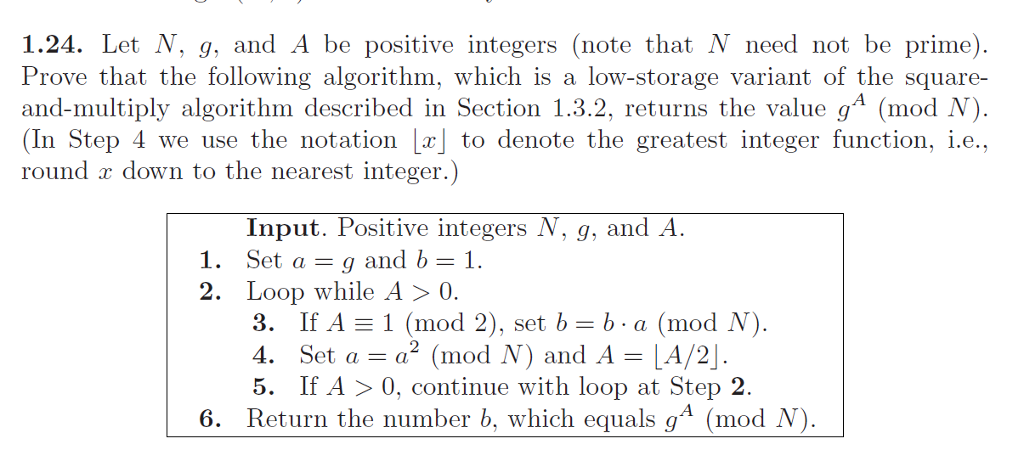
1.24. Let N, g, and A be positive integers (note that N need not be prime) Prove that the following algorithm, which is a low-storage variant of the square- and-multiply algorithm described in Section 1.3.2, returns the value g4 (mod N) (In Step 4 we use the notation x to denote the greatest integer function, i.e. round x down to the nearest integeir. Input. Positive integers N, g, and A 1. Set a g and b 1 2. Loop while A > 0. 3. If A 1 (mod 2), set b-b a (mod N) 4. Set a -a2 (mod N) and A LA/2] 5. If A >0, continue with loop at Step 2 6. Return the number b, which equals gA (mod N)
Step by Step Solution
There are 3 Steps involved in it
1 Expert Approved Answer
Step: 1 Unlock

Question Has Been Solved by an Expert!
Get step-by-step solutions from verified subject matter experts
Step: 2 Unlock
Step: 3 Unlock
 Study Help