







Question: 12.8.3 (a) The function f(z) = d does not vanish at the endpoints of the range of argz, a and . Show, with the help
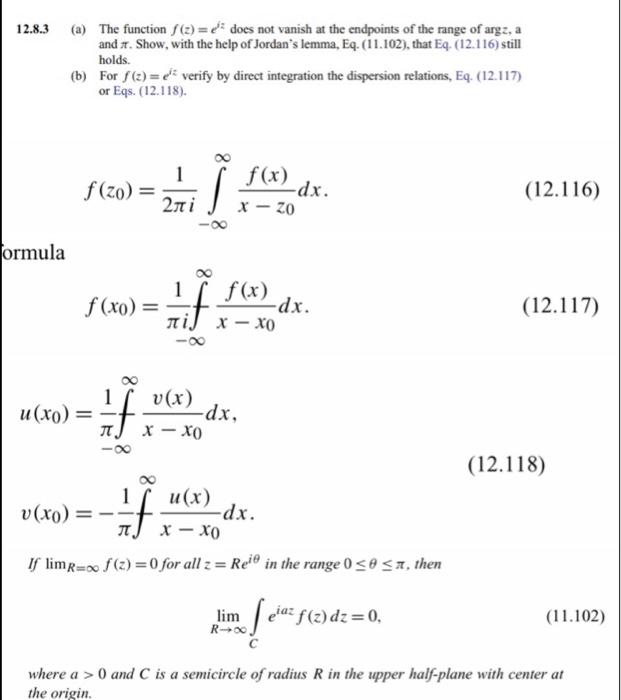
12.8.3 (a) The function f(z) = d does not vanish at the endpoints of the range of argz, a and . Show, with the help of Jordan's lemma, Eq. (11.102), that Eq. (12.116) still holds. (b) For f(2)= d verify by direct integration the dispersion relations, Eq. (12.117) or Eq. (12.118). f(0) = 2 i f(x) dx. erilli (12.116) X - 20 formula 1 f(x) f (x0) = -dx. xo (12.117) u(x0) = of v(x) -dx, X - XO (12.118) u(x) dx. 1 v(xo) = -dx. TJ X - XO If limr=f(z)=0 for all z = Rei in the range 0 0 and C is a semicircle of radius R in the upper half-plane with center at the origin. 12.8.3 (a) The function f(z) = d does not vanish at the endpoints of the range of argz, a and . Show, with the help of Jordan's lemma, Eq. (11.102), that Eq. (12.116) still holds. (b) For f(2)= d verify by direct integration the dispersion relations, Eq. (12.117) or Eq. (12.118). f(0) = 2 i f(x) dx. erilli (12.116) X - 20 formula 1 f(x) f (x0) = -dx. xo (12.117) u(x0) = of v(x) -dx, X - XO (12.118) u(x) dx. 1 v(xo) = -dx. TJ X - XO If limr=f(z)=0 for all z = Rei in the range 0 0 and C is a semicircle of radius R in the upper half-plane with center at the origin
Step by Step Solution
There are 3 Steps involved in it

Get step-by-step solutions from verified subject matter experts
 Study Help