







Question: 13. In this problem we want to delve deeper into the M/M/1 queue. In an M/M/1 queue arrivals are determined by a Poisson process
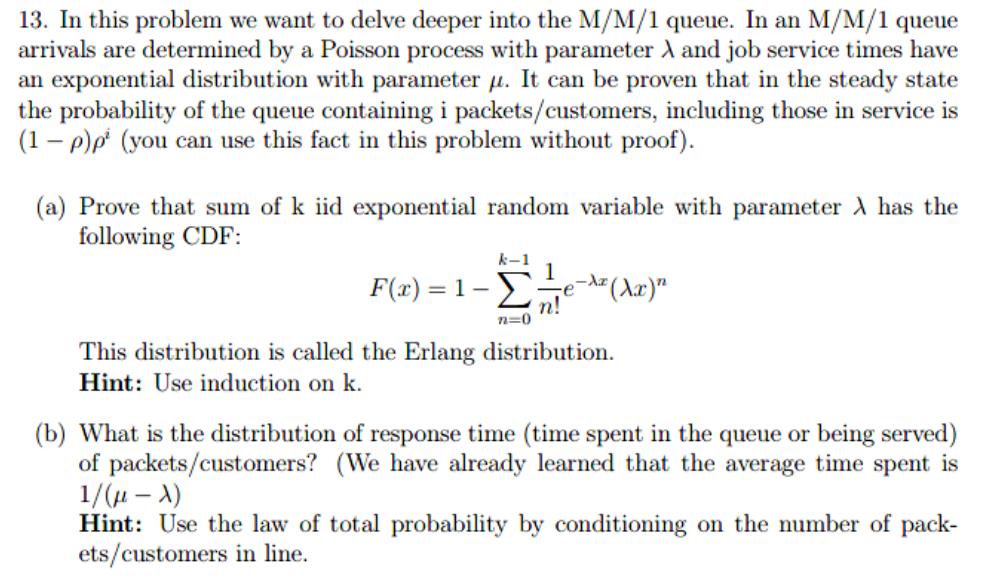
13. In this problem we want to delve deeper into the M/M/1 queue. In an M/M/1 queue arrivals are determined by a Poisson process with parameter A and job service times have an exponential distribution with parameter u. It can be proven that in the steady state the probability of the queue containing i packets/customers, including those in service is (1 p)p (you can use this fact in this problem without proof). (a) Prove that sum of k iid exponential random variable with parameter A has the following CDF: k-1 1 n=0 F(x) = 1- This distribution is called the Erlang distribution. Hint: Use induction on k. e *(Xx)" n! (b) What is the distribution of response time (time spent in the queue or being served) of packets/customers (We have already learned that the average time spent is 1/(-X) Hint: Use the law of total probability by conditioning on the number of pack- ets/customers in line.
Step by Step Solution
3.40 Rating (156 Votes )
There are 3 Steps involved in it
Prove that sum of k iid exponential random variable with parameter A has the following CDF k1 Fx 1 n... View full answer

Get step-by-step solutions from verified subject matter experts
 Study Help