







Question: (-/13 Points) DEVORESTAT9 1.E.053. DETAILS MY NOTES ASK YOUR TEACHER PRACTICE ANOTHER A mutual fund is a professionally managed investment scheme that pools money from
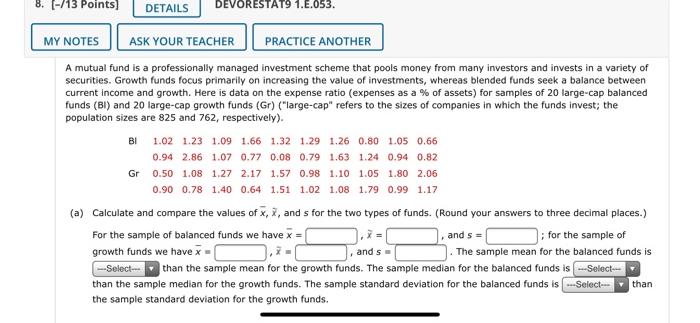
(-/13 Points) DEVORESTAT9 1.E.053. DETAILS MY NOTES ASK YOUR TEACHER PRACTICE ANOTHER A mutual fund is a professionally managed investment scheme that pools money from many investors and invests in a variety of securities. Growth funds focus primarily on increasing the value of investments, whereas blended funds seek a balance between current income and growth. Here is data on the expense ratio (expenses as a % of assets) for samples of 20 large-cap balanced funds (BI) and 20 large-cap growth funds (Gr) ("large-cap" refers to the sizes of companies in which the funds invest; the population sizes are 825 and 762, respectively). BI 1.02 1.23 1.09 1.66 1.32 1.29 1.26 0.80 1.05 0.66 0.94 2.86 1.07 0.77 0.08 0.79 1.63 1.24 0.94 0.82 Gr 0.50 1.08 1.27 2.17 1.57 0.98 1.10 1.05 1.80 2.06 0.90 0.78 1.40 0.64 1.51 1.02 1.08 1.79 0.99 1.17 and s = (a) Calculate and compare the values of X, X, and s for the two types of funds. (Round your answers to three decimal places.) For the sample of balanced funds we have x = for the sample of growth funds we have x - and s The sample mean for the balanced funds is than the sample mean for the growth funds. The sample median for the balanced funds is --Select- than the sample median for the growth funds. The sample standard deviation for the balanced funds is --Select- the sample standard deviation for the growth funds. -Select than (-/13 Points) DEVORESTAT9 1.E.053. DETAILS MY NOTES ASK YOUR TEACHER PRACTICE ANOTHER A mutual fund is a professionally managed investment scheme that pools money from many investors and invests in a variety of securities. Growth funds focus primarily on increasing the value of investments, whereas blended funds seek a balance between current income and growth. Here is data on the expense ratio (expenses as a % of assets) for samples of 20 large-cap balanced funds (BI) and 20 large-cap growth funds (Gr) ("large-cap" refers to the sizes of companies in which the funds invest; the population sizes are 825 and 762, respectively). BI 1.02 1.23 1.09 1.66 1.32 1.29 1.26 0.80 1.05 0.66 0.94 2.86 1.07 0.77 0.08 0.79 1.63 1.24 0.94 0.82 Gr 0.50 1.08 1.27 2.17 1.57 0.98 1.10 1.05 1.80 2.06 0.90 0.78 1.40 0.64 1.51 1.02 1.08 1.79 0.99 1.17 and s = (a) Calculate and compare the values of X, X, and s for the two types of funds. (Round your answers to three decimal places.) For the sample of balanced funds we have x = for the sample of growth funds we have x - and s The sample mean for the balanced funds is than the sample mean for the growth funds. The sample median for the balanced funds is --Select- than the sample median for the growth funds. The sample standard deviation for the balanced funds is --Select- the sample standard deviation for the growth funds. -Select than
Step by Step Solution
There are 3 Steps involved in it

Get step-by-step solutions from verified subject matter experts
 Study Help