





Question: 13. Strategy 4 - Asset allocation Asset allocation is the proportion of your overall investment portfolio that you have invested in various categories of assets.
13. Strategy 4 - Asset allocation Asset
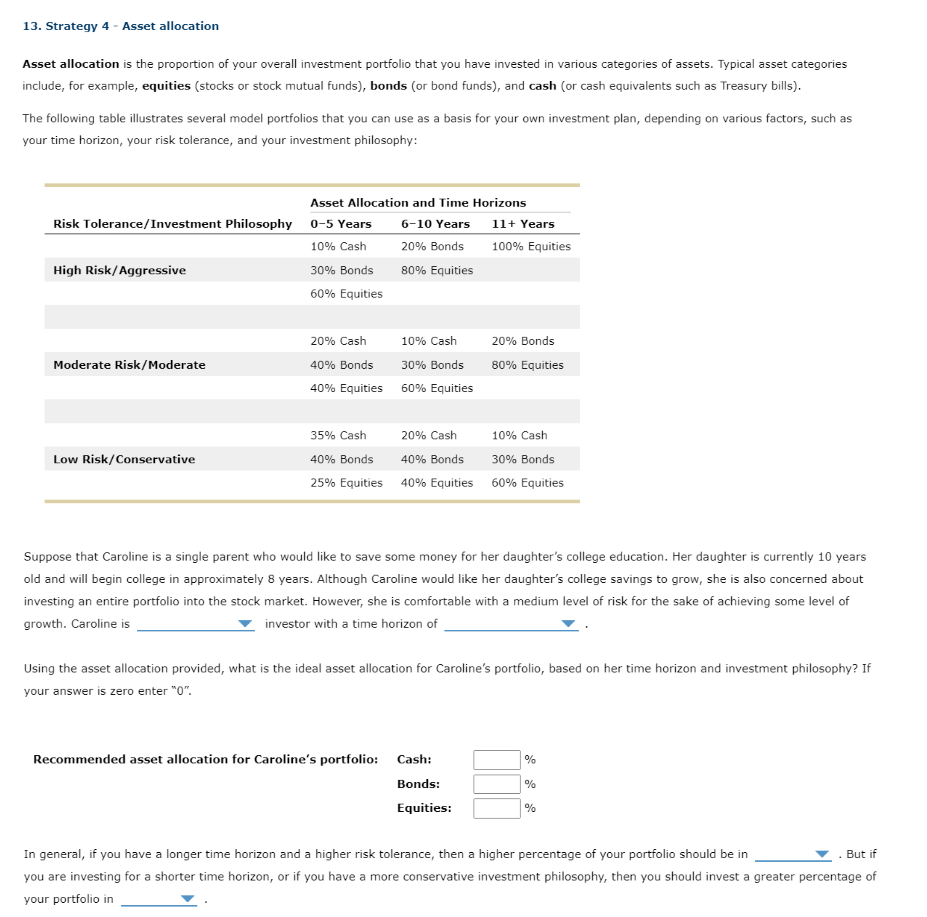
13. Strategy 4 - Asset allocation Asset allocation is the proportion of your overall investment portfolio that you have invested in various categories of assets. Typical asset categories include, for example, equities (stocks or stock mutual funds), bonds (or bond funds), and cash (or cash equivalents such as Treasury bills). The following table illustrates several model portfolios that you can use as a basis for your own investment plan, depending on various factors, such as your time horizon, your risk tolerance, and your investment philosophy: Asset Allocation and Time Horizons Risk Tolerance/Investment Philosophy 0-5 Years 6-10 Years 11+ Years 10% Cash 20% Bonds 100% Equities High Risk/ Aggressive 30% Bonds 80% Equities 60% Equities 20% Cash 10% Cash 20% Bonds Moderate Risk/Moderate 40% Bonds 30% Bonds 80% Equities 40% Equities 60% Equities 35% Cash 20% Cash 10% Cash Low Risk/Conservative 40% Bonds 40% Bonds 30% Bonds 25% Equities 40% Equities 60% Equities Suppose that Caroline is a single parent who would like to save some money for her daughter's college education. Her daughter is currently 10 years old and will begin college in approximately 8 years. Although Caroline would like her daughter's college savings to grow, she is also concerned about investing an entire portfolio into the stock market. However, she is comfortable with a medium level of risk for the sake of achieving some level of growth. Caroline is investor with a time horizon of Using the asset allocation provided, what is the ideal asset allocation for Caroline's portfolio, based on her time horizon and investment philosophy? If your answer is zero enter "0". Recommended asset allocation for Caroline's portfolio: Cash: % Bonds: % Equities: In general, if you have a longer time horizon and a higher risk tolerance, then a higher percentage of your portfolio should be in . But if you are investing for a shorter time horizon, or if you have a more conservative investment philosophy, then you should invest a greater percentage of your portfolio in

Step by Step Solution

There are 3 Steps involved in it

1 Expert Approved Answer
Step: 1 Unlock blur-text-image
Question Has Been Solved by an Expert!

Get step-by-step solutions from verified subject matter experts

Step: 2 Unlock
Step: 3 Unlock

Students Have Also Explored These Related Finance Questions!