







Question: 14. An example of a covalent network solid is A) Diamond. B) Potassium. C) lodine. D) Sodium chloride E) None of these. 15. Which one
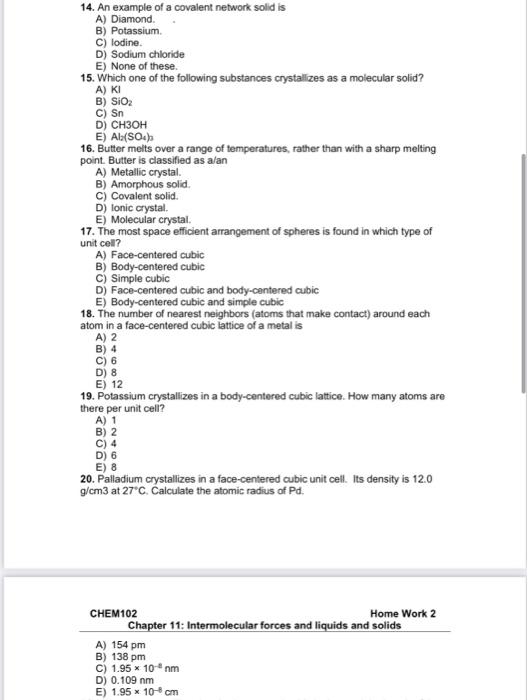
14. An example of a covalent network solid is A) Diamond. B) Potassium. C) lodine. D) Sodium chloride E) None of these. 15. Which one of the following substances crystallzzes as a molecular solid? A) KI B) SiO2 C) Sn D) CH3OH E) Al(SO4)3 16. Butter melts over a range of temperatures, rather than with a sharp melting point. Butter is classified as a/an A) Metallic crystal. B) Amorphous solid. C) Covalent solid. D) Ionic crystal. E) Molecular crystal. 17. The most space efficient arrangement of spheres is found in which type of unit cell? A) Face-centered cubic B) Body-centered cubic C) Simple cubic D) Face-centered cubic and body-centered cubic E) Body-centered cubic and simple cubic 18. The number of nearest neighbors (atoms that make contact) around each atom in a face-centered cubic lattice of a metal is A) 2 B) 4 C) 6 D) 8 E) 12 19. Potassium crystallizes in a body-centered cubic lattice. How many atoms are there per unit cell? A) 1 B) 2 C) 4 D) 6 E) 8 20. Palladium crystallizes in a face-centered cubic unit cell. Its density is 12.0 g/cm3 at 27C. Calculate the atomic radius of Pd. CHEM102 Home Work 2 Chapter 11: Intermolecular forces and liquids and solids A) 154pm B) 138pm C) 1.95108nm D) 0.109nm E) 1.95106cm
Step by Step Solution
There are 3 Steps involved in it

Get step-by-step solutions from verified subject matter experts
 Study Help