







Question: 14) Calculating Square Roots: Herron's Method [24 Marks, 4 for each part] Let a > 0. Let a1 = 1 and anti = ; (an
![part] Let a > 0. Let a1 = 1 and anti =](https://s3.amazonaws.com/si.experts.images/answers/2024/06/666842c060b95_864666842c03ff38.jpg)
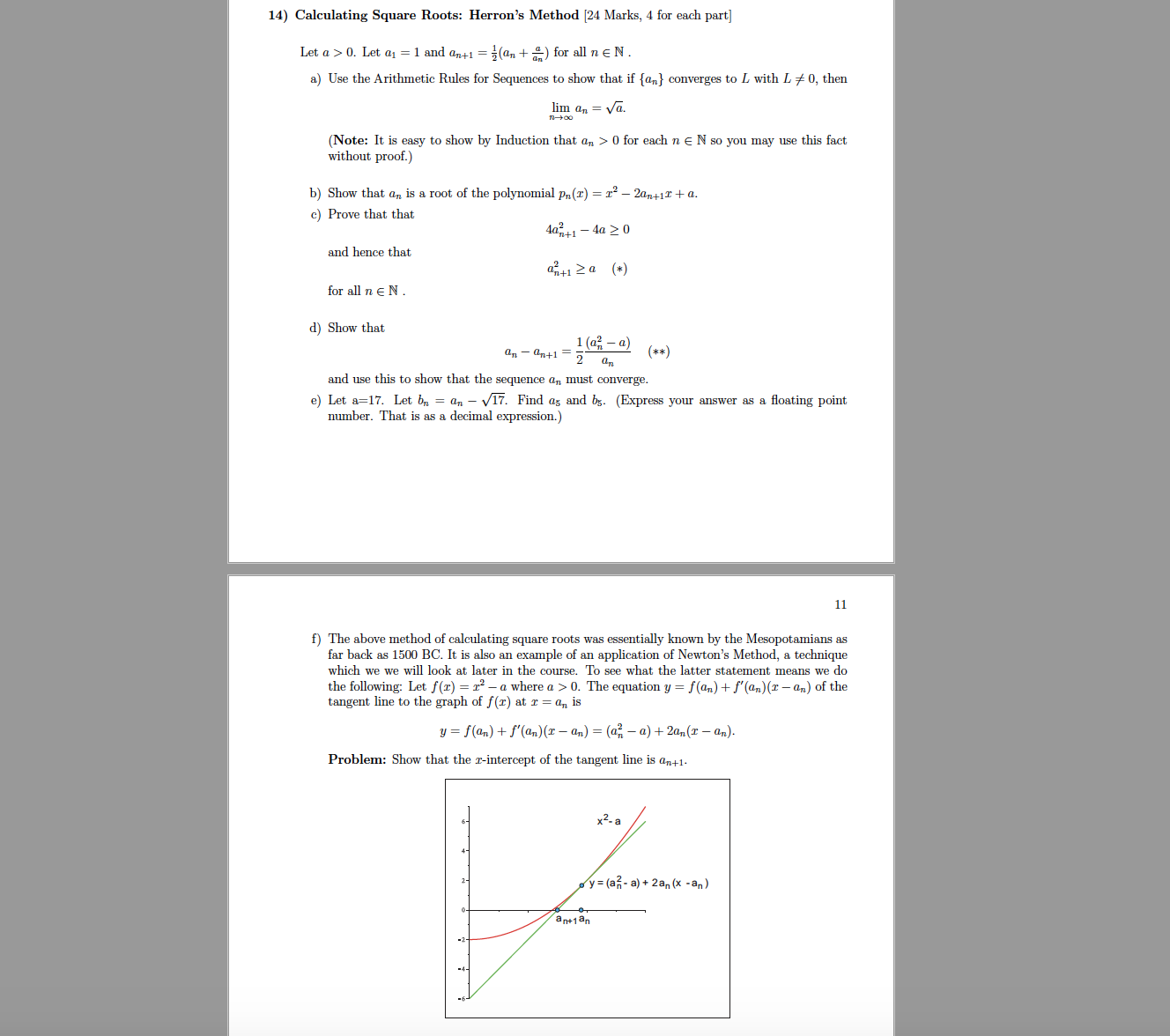
14) Calculating Square Roots: Herron's Method [24 Marks, 4 for each part] Let a > 0. Let a1 = 1 and anti = ; (an + ) for all n EN . a) Use the Arithmetic Rules for Sequences to show that if {an} converges to L with L # 0, then lim an = va. (Note: It is easy to show by Induction that an > 0 for each n E N so you may use this fact without proof. b) Show that an is a root of the polynomial pr(r) = 12 - 2antir + a. c) Prove that that 407+1 - 4a 2 0 and hence that an+1 20 (*) for all n E N . d) Show that an - On+1 = 1 (@; -a) (* *) 2 an and use this to show that the sequence an must converge. e) Let a=17. Let by = an - V17. Find as and by. (Express your answer as a floating point number. That is as a decimal expression.) 11 f) The above method of calculating square roots was essentially known by the Mesopotamians as far back as 1500 BC. It is also an example of an application of Newton's Method, a technique which we we will look at later in the course. To see what the latter statement means we do the following: Let f(r) = r - a where a > 0. The equation y = f(an) + f'(an)(r - an) of the tangent line to the graph of f(r) at r = a, is y = f(an) + f'(an)(I - an) = (a2 - a) + 2an(1 - an). Problem: Show that the r-intercept of the tangent line is an+1. * 2 _ a o y = (a - a) + 2an (x -an) anti ar
Step by Step Solution
There are 3 Steps involved in it

Get step-by-step solutions from verified subject matter experts
 Study Help