Question: (14 Part B - Case Study Marks) Read the below case study and also can search over the internet to answer the below Questions: Short
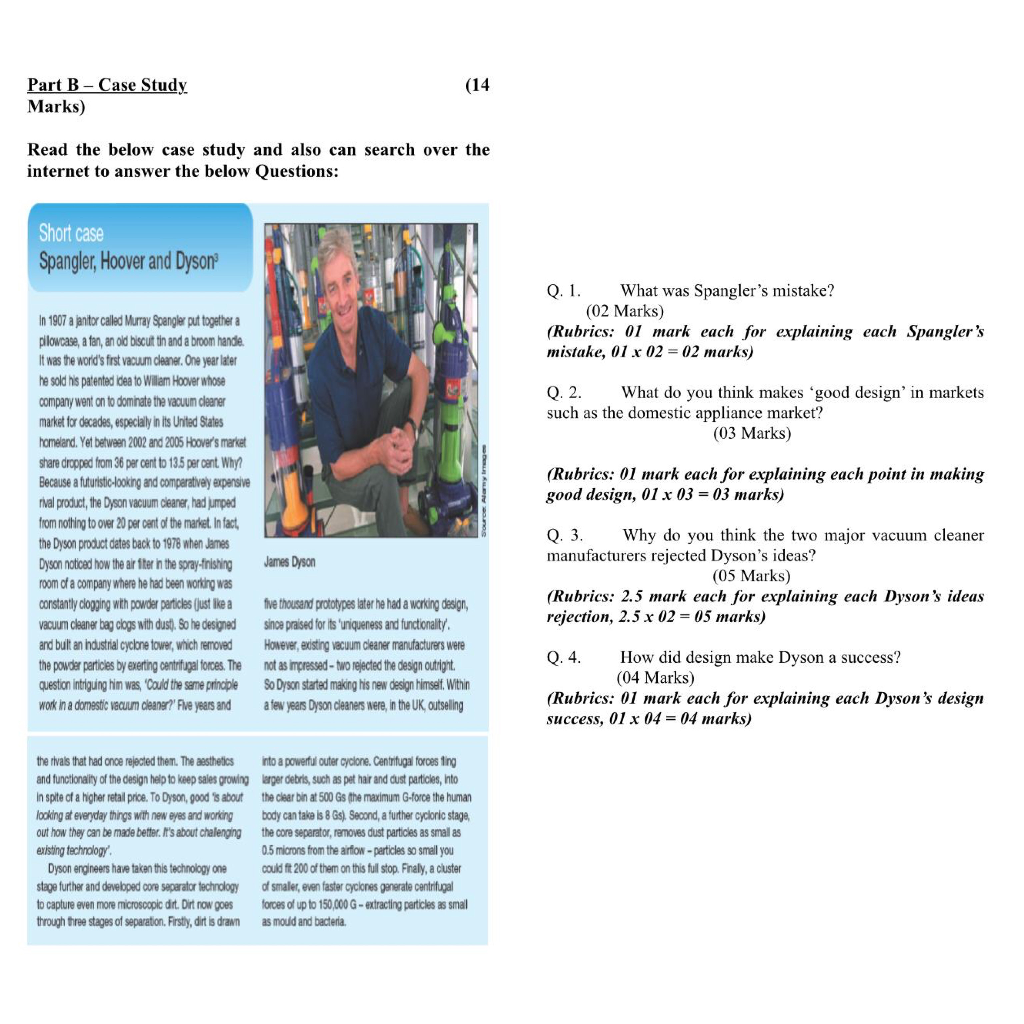
(14 Part B - Case Study Marks) Read the below case study and also can search over the internet to answer the below Questions: Short case Spangler, Hoover and Dyson Q.1. What was Spangler's mistake? (02 Marks) (Rubrics: 01 mark each for explaining cach Spangler's mistake, 01. 02 = 02 marks) Q. 2. What do you think makes good design' in markets such as the domestic appliance market? (03 Marks) (Rubrics: 01 mark each for explaining each point in making good design, 01 x 03 = 03 marks) In 1907 a janitor called Murray Spangler put together a pillowcase, a fan, an old biscut tin and a broom hande. It was the world's first vacuum cleaner. One year later he sold his patented idea to William Hoover whose company went on to dominate the vacuum cleaner market for decades, especially in its United States homeland. Yet between 2002 and 2005 Hoover's market share dropped from 36 per cent to 13.5 per cent. Why? Because a futuristic-looking and comparatively expensive rival product, the Dyson vacuum cleaner had jumped from nothing to over 20 per cent of the market. In fact, the Dyson product dates back to 1978 when James Dyson noticed how the air filter in the spray-finishing room of a company where he had been working was constantly clogging with powder particles (just like a Vacuum cleaner bag clogs with dust). So he designed and built an Industrial cyclone tower, which removed the powder particles by exerting centrifugal forces. The question intriguing him was, "Could the same principle work in a domestic vacuum cleaner?' Five years and James Dyson Q. 3. Why do you think the two major vacuum cleaner manufacturers rejected Dyson's ideas? (05 Marks) (Rubrics: 2.5 mark each for explaining each Dyson's ideas rejection, 2.5 x 02 = 05 marks) five thousand prototypes later he had a working design, since praised for its 'uniqueness and functionality. However, existing vacuum cleaner manufacturers were not as impressed two rejected the design outright. So Dyson started making his new design himself. Within a few years Dyson cleaners were, in the UK, Outseling Q. 4. How did design make Dyson a success? (04 Marks) (Rubrics: 01 mark each for explaining each Dyson's design success, 01 x 04 = 04 marks) the rivals that had once rejected them. The aesthetics into a powerful outer cyclone. Centrifugal forces fing and functionality of the design help to keep sales growing larger debris, such as pet hair and dust particles, into In spite of a higher retail price. To Dyson, good 's about the clear bin at 500 Gs (the maximum G-force the human looking at everyday things with new eyes and working body can take is 8 Gs). Second, a further cyclonic stage, out how they can be made better. It's about chalenging the core separator, removes dust particles as smal as existing technology 0.5 microns from the airfion - particles so small you Dyson engineers have taken this technology one could ft 200 of them on this ful stop. Finally, a cluster stage further and developed core separator technology of smaler, even faster cyclones generate centrifugal to capture even more microscopic dirt. Dirt now goes forces of up to 150,000 G - extracting particles as small through three stages of separation. Firstly, dirt is drawn as mould and bacteria









 Study Help