







Question: (14%) Problem 3: The circuit shown contains a voltage source with emf & = 5.99 V, a resistor with resistance R = 135 k2,
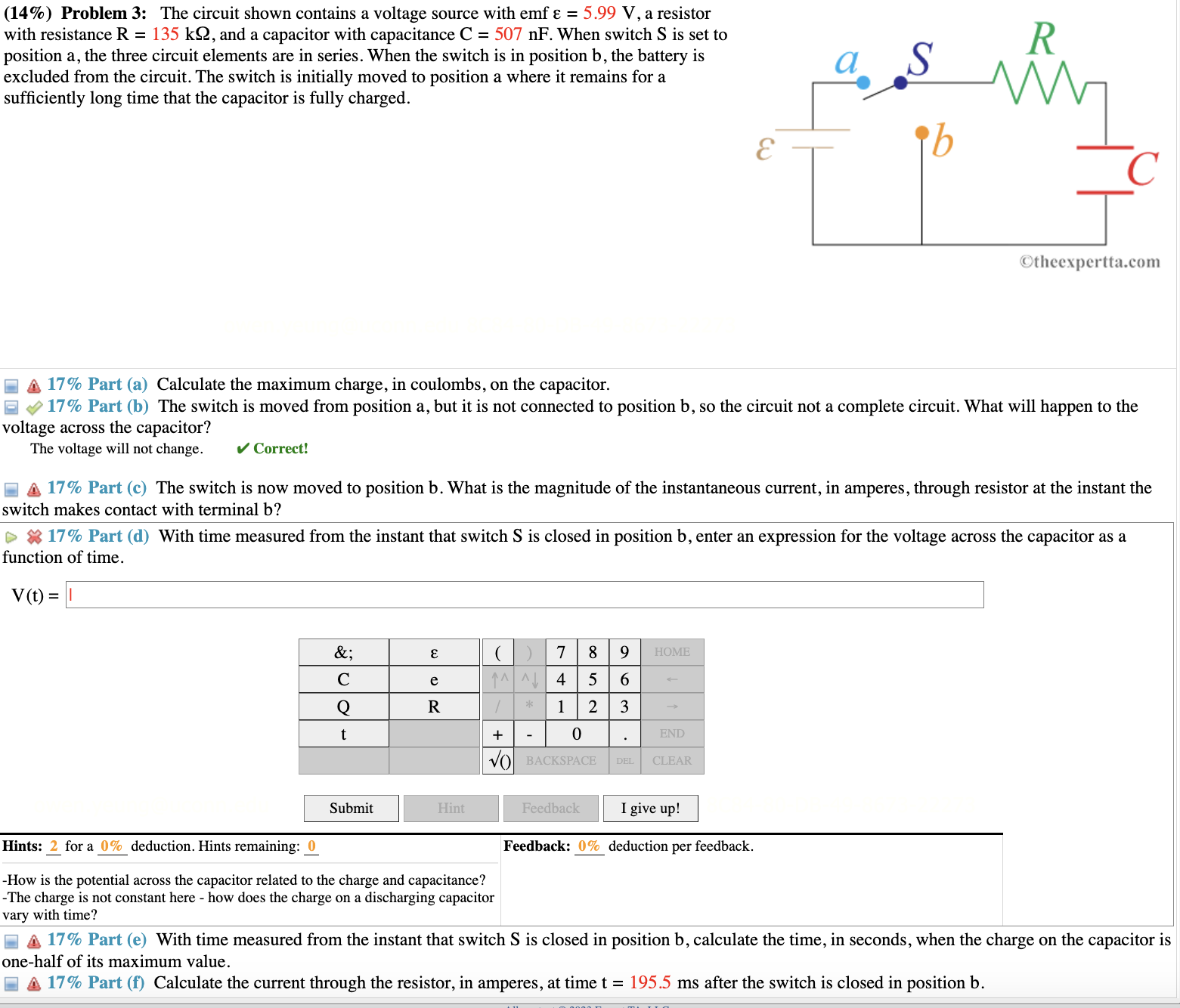
(14%) Problem 3: The circuit shown contains a voltage source with emf & = 5.99 V, a resistor with resistance R = 135 k2, and a capacitor with capacitance C = 507 nF. When switch S is set to position a, the three circuit elements are in series. When the switch is in position b, the battery is excluded from the circuit. The switch is initially moved to position a where it remains for a sufficiently long time that the capacitor is fully charged. a E R S b C T Otheexpertta.com A 17% Part (a) Calculate the maximum charge, in coulombs, on the capacitor. 17% Part (b) The switch is moved from position a, but it is not connected to position b, so the circuit not a complete circuit. What will happen to the voltage across the capacitor? The voltage will not change. Correct! A 17% Part (c) The switch is now moved to position b. What is the magnitude of the instantaneous current, in amperes, through resistor at the instant the switch makes contact with terminal b? 17% Part (d) With time measured from the instant that switch S is closed in position b, enter an expression for the voltage across the capacitor as a function of time. V(t) = || &; ( C e Q R * t + - Submit Hint 741 0 8 9 HOME 5 6 2 3 END . O BACKSPACE DEL CLEAR Feedback I give up! Hints: 2 for a 0% deduction. Hints remaining: 0 -How is the potential across the capacitor related to the charge and capacitance? -The charge is not constant here - how does the charge on a discharging capacitor vary with time? Feedback: 0% deduction per feedback. A 17% Part (e) With time measured from the instant that switch S is closed in position b, calculate the time, in seconds, when the charge on the capacitor is one-half of its maximum value. A 17% Part (f) Calculate the current through the resistor, in amperes, at time t = 195.5 ms after the switch is closed in position b.
Step by Step Solution
There are 3 Steps involved in it
Part a Calculate the maximum charge on the capacitor The maximum charge Q max Qtextmax Qmax on a capacitor can be calculated using the formula Q max C Qtextmax C cdot epsilon QmaxC where C C C is the ... View full answer

Get step-by-step solutions from verified subject matter experts
 Study Help