







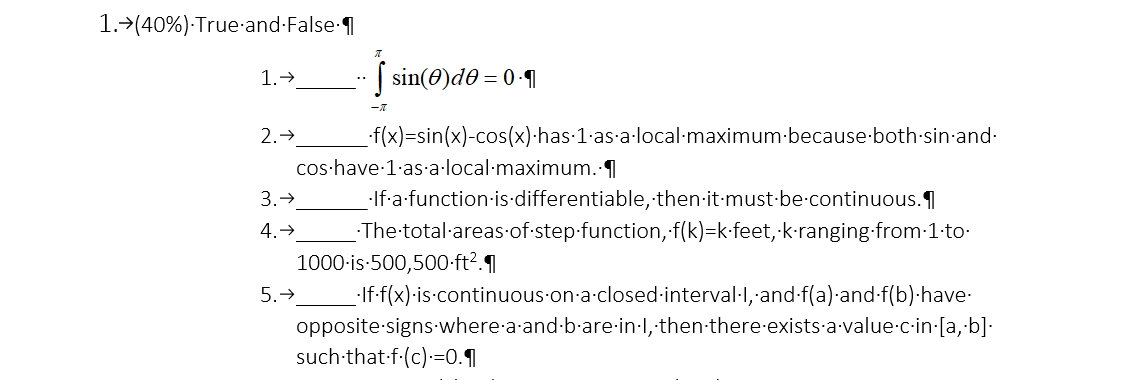
Question: 1.>(40%) .True.and.False.1 1. = |sin(@)de = 0.9 - * 2 . f(x)=sin(x)-cos(x).has.1.as.a.local.maximum.because.both.sin.and. cos.have.1.as.a.local.maximum. . 1 3.- .If.a.function.is.differentiable, then.it.must be.continuous. 1 4.> The.total-areas.of.step.function,.f(k)=k.feet, .k.ranging from.1.to. 1000.is.500,500.ft2
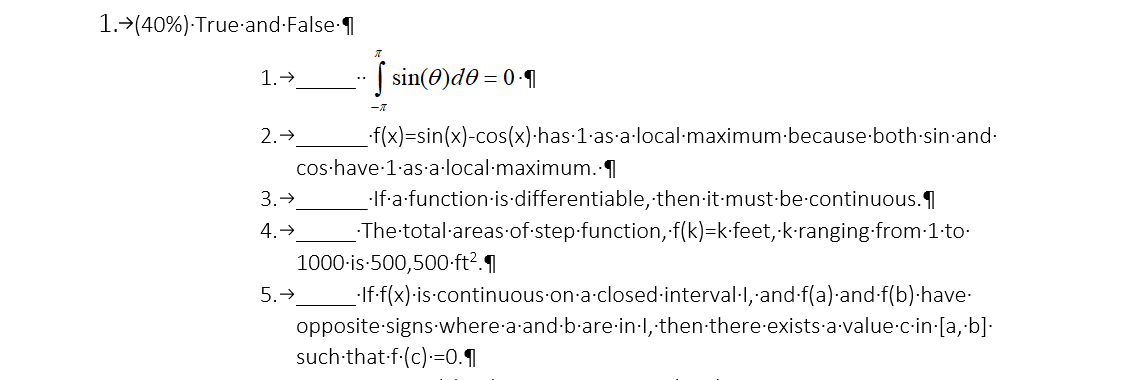
1.>(40%) .True.and.False.1 1. = |sin(@)de = 0.9 - * 2 . f(x)=sin(x)-cos(x).has.1.as.a.local.maximum.because.both.sin.and. cos.have.1.as.a.local.maximum. . 1 3.- .If.a.function.is.differentiable, then.it.must be.continuous. 1 4.> The.total-areas.of.step.function,.f(k)=k.feet, .k.ranging from.1.to. 1000.is.500,500.ft2 . 1 If.f(x).is.continuous.on.a.closed.interval.I, and.f(a) and.f(b) .have. opposite.signs.where.a.and.bare.in.I, then.there.exists.a.value.c.in.[a,.b]. such.that.f.(c) .=0.1
Step by Step Solution
There are 3 Steps involved in it
1 Expert Approved Answer
Step: 1 Unlock

Question Has Been Solved by an Expert!
Get step-by-step solutions from verified subject matter experts
Step: 2 Unlock
Step: 3 Unlock
 Study Help