


Question: 14-1 How does a project manager price out a job in which the specifications are not prepared until the job is over? 14-2 Beta Corporation
14-1 How does a project manager price out a job

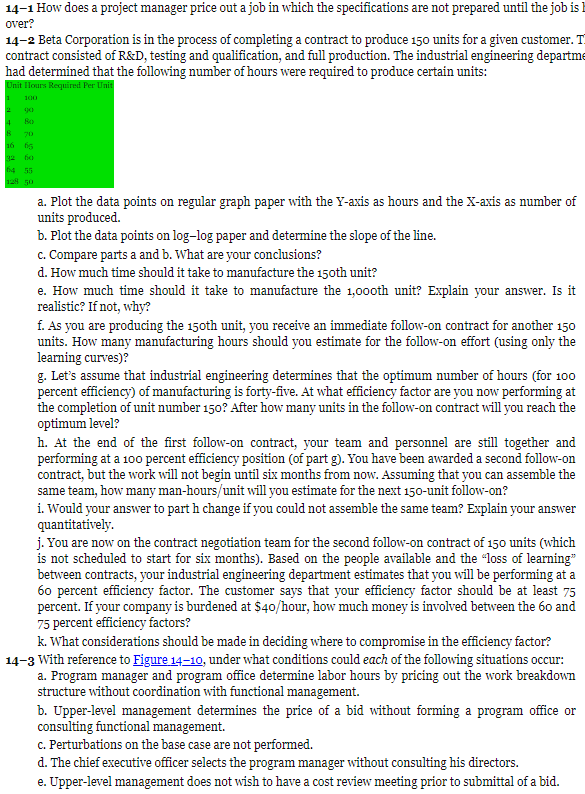
14-1 How does a project manager price out a job in which the specifications are not prepared until the job is over? 14-2 Beta Corporation is in the process of completing a contract to produce 150 units for a given customer. T contract consisted of R&D, testing and qualification, and full production. The industrial engineering departm had determined that the following number of hours were required to produce certain units: Unit Tours Required Per Unit 1010 40 4. BO B 16 is 322 14 55 a. Plot the data points on regular graph paper with the Y-axis as hours and the X-axis as number of units produced. b. Plot the data points on log-log paper and determine the slope of the line. C. Compare parts a and b. What are your conclusions? d. How much time should it take to manufacture the 150th unit? e. How much time should it take to manufacture the 1,000th unit? Explain your answer. Is it realistic? If not, why? f. As you are producing the 150th unit, you receive an immediate follow-on contract for another 150 units. How many manufacturing hours should you estimate for the follow-on effort (using only the learning curves)? g. Let's assume that industrial engineering determines that the optimum number of hours (for 100 percent efficiency) of manufacturing is forty-five. At what efficiency factor are you now performing at the completion of unit number 150? After how many units in the follow-on contract will you reach the optimum level? h. At the end of the first follow-on contract, your team and personnel are still together and performing at a 100 percent efficiency position (of part g). You have been awarded a second follow-on contract, but the work will not begin until six months from now. Assuming that you can assemble the same team, how many man-hours/unit will you estimate for the next 150-unit follow-on? i. Would your answer to part h change if you could not assemble the same team? Explain your answer quantitatively. j. You are now on the contract negotiation team for the second follow-on contract of 150 units (which is not scheduled to start for six months). Based on the people available and the "loss of learning between contracts, your industrial engineering department estimates that you will be performing at a 60 percent efficiency factor. The customer says that your efficiency factor should be at least 75 percent. If your company is burdened at $40/hour, how much money is involved between the 60 and 75 percent efficiency factors? k. What considerations should be made in deciding where to compromise in the efficiency factor? 14-3 With reference to Figure 1410, under what conditions could each of the following situations occur: a. Program manager and program office determine labor hours by pricing out the work breakdown structure without coordination with functional management. b. Upper-level management determines the price of a bid without forming a program office or consulting functional management. c. Perturbations on the base case are not performed. d. The chief executive officer selects the program manager without consulting his directors. e. Upper-level management does not wish to have a cost review meeting prior to submittal of a bid

Step by Step Solution

There are 3 Steps involved in it

1 Expert Approved Answer
Step: 1 Unlock blur-text-image

Question Has Been Solved by an Expert!

Get step-by-step solutions from verified subject matter experts

Step: 2 Unlock
Step: 3 Unlock

Students Have Also Explored These Related General Management Questions!