



Question: 14-8: Suggest a systematic process that Daimler could have followed to increase the likelihood of merger success? Provide an example of how Daimler might have
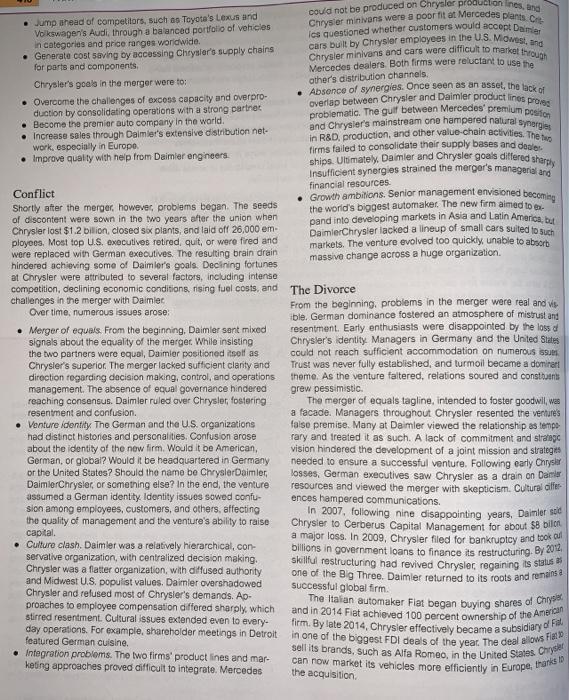
14-8: Suggest a systematic process that Daimler could have followed to increase the likelihood of merger success? Provide an example of how Daimler might have made such a process succeed?
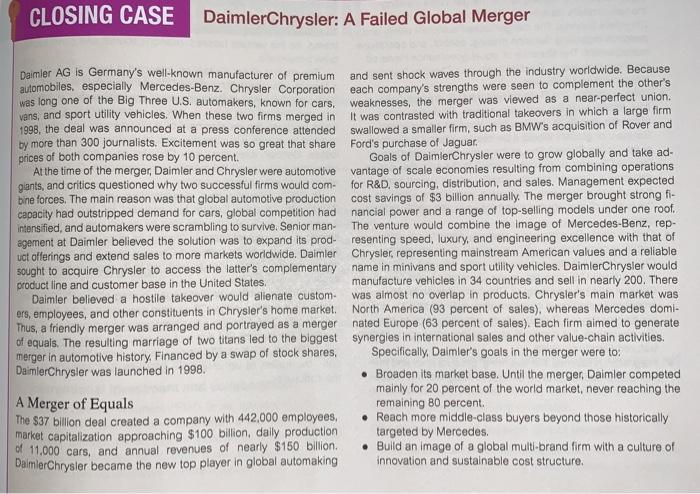
DaimlerChrysler: A Failed Global Merger Daimler AG is Germany's well-known manufacturer of premium and sent shock waves through the industry worldwide. Because automobiles, especially Mercedes-Benz. Chrysler Corporation each company's strengths were seen to complement the other's was long one of the Big Three U.S. automakers, known for cars, weaknesses, the merger was viewed as a near-perfect union. vens, and sport utility vehicles. When these two firms merged in it was contrasted with traditional takeovers in which a large firm 1998, the deal was announced at a press conference attended swallowed a smaller firm, such as BMW's acquisition of Rover and by more than 300 journalists. Excitement was so great that share Ford's purchase of Jaguar. prices of both companies rose by 10 percent. Goals of DaimlerChrysler were to grow globally and take adAt the time of the merger, Daimler and Chryslerwere automotive vantage of scale economies resulting from combining operations gints, and critics questioned why two successful firms would com- for R\&D, sourcing, distribution, and sales. Management expected bine forces. The main reason was that global automotive production cost savings of $3 billion annually. The merger brought strong ficapacity had outstripped demand for cars, global compettion had nancial power and a range of top-selling models under one roof. intensified, and automakers were scrambling to survive. Senior man- The venture would combine the image of Mercedes-Benz, repagement at Daimler believed the solution was to expand its prod- resenting speed, luxury, and engineering excellence with that of vot offerings and extend sales to more markets worldwide. Daimler Chrysler, representing mainstream American values and a reliable sought to acquire Chrysler to access the latter's complementary name in minivans and sport utility vehicles. DaimlerChrysler would product line and customer base in the United States. manufacture vehicles in 34 countries and sell in nearly 200 . There Daimler believed a hostile takeover would alienate custom. Was almost no overlap in products. Chrysler's main market was ers, employees, and other constituents in Chrysler's home market. North America (93 percent of sales), whereas Mercedes domiThus, a friendly merger was arranged and portrayed as a merger nated Europe ( 63 percent of sales). Each firm aimed to generate merger in automotive history. Financed by a swap of stock shares. Specifically, Daimler's goals in the merger were to: DaimlerChrysler was launched in 1998. - Broaden its market base. Until the merger, Daimler competed mainly for 20 percent of the world market, never reaching the A Merger of Equals remaining 80 percent. The $37 billion deal created a company with 442,000 employees, - Reach more middle-class buyers beyond those historically market capitalization approaching $100 bilion, dally production targeted by Mercedes. DaimlerChrysler became the new top player in global automaking - Build an image of a global multi-brand firm with a culture of innovation and sustainable cost structureStep by Step Solution
There are 3 Steps involved in it
1 Expert Approved Answer
Step: 1 Unlock

Question Has Been Solved by an Expert!
Get step-by-step solutions from verified subject matter experts
Step: 2 Unlock
Step: 3 Unlock