







Question: [15 marks) Posterior computations. For this question upload handwritten solutions and upload a running code (either in R or Python) for part iv). Consider the
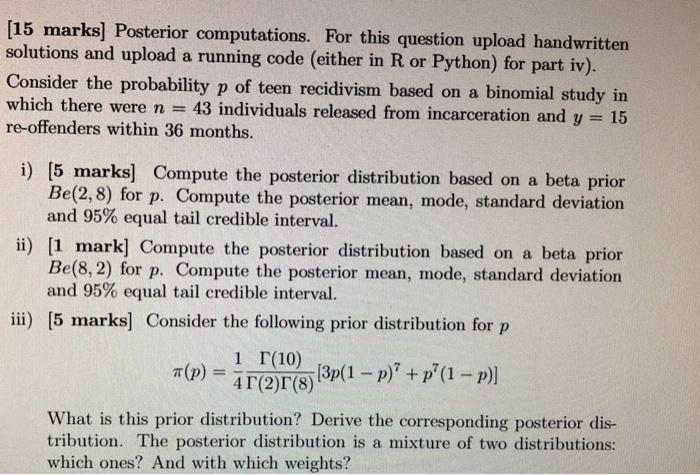
[15 marks) Posterior computations. For this question upload handwritten solutions and upload a running code (either in R or Python) for part iv). Consider the probability p of teen recidivism based on a binomial study in which there were n = 43 individuals released from incarceration and y = 15 re-offenders within 36 months. i) (5 marks] Compute the posterior distribution based on a beta prior Be(2,8) for p. Compute the posterior mean, mode, standard deviation and 95% equal tail credible interval. ii) (1 mark] Compute the posterior distribution based on a beta prior Be(8,2) for p. Compute the posterior mean, mode, standard deviation and 95% equal tail credible interval. iii) [5 marks] Consider the following prior distribution for p 1 1(10) (p) [3p(1 - p)' + p'(1 - p)] 41(2)(8) What is this prior distribution? Derive the corresponding posterior dis- tribution. The posterior distribution is a mixture of two distributions: which ones? And with which weights? [15 marks) Posterior computations. For this question upload handwritten solutions and upload a running code (either in R or Python) for part iv). Consider the probability p of teen recidivism based on a binomial study in which there were n = 43 individuals released from incarceration and y = 15 re-offenders within 36 months. i) (5 marks] Compute the posterior distribution based on a beta prior Be(2,8) for p. Compute the posterior mean, mode, standard deviation and 95% equal tail credible interval. ii) (1 mark] Compute the posterior distribution based on a beta prior Be(8,2) for p. Compute the posterior mean, mode, standard deviation and 95% equal tail credible interval. iii) [5 marks] Consider the following prior distribution for p 1 1(10) (p) [3p(1 - p)' + p'(1 - p)] 41(2)(8) What is this prior distribution? Derive the corresponding posterior dis- tribution. The posterior distribution is a mixture of two distributions: which ones? And with which weights
Step by Step Solution
There are 3 Steps involved in it

Get step-by-step solutions from verified subject matter experts
 Study Help