Question: [15 marks & suggested time 25 mins Part B - Case Study #1 7.1 Deploying the Wireless Local Area Network at Intermountain Healthcare Deploying a
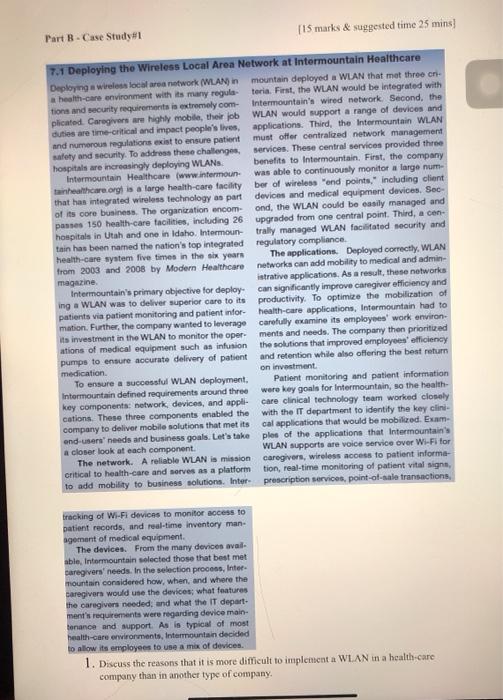
[15 marks & suggested time 25 mins Part B - Case Study #1 7.1 Deploying the Wireless Local Area Network at Intermountain Healthcare Deploying a weles local area network (WLAN) in mountain deployed a WLAN that met three chi health-care environment with its many regula toria. First, the WLAN would be integrated with tions and security requirements is extremely com- Intermountain's wired network Second, the plicated. Caregivers are highly mobile, their job WLAN would support a range of devices and duties are time-critical and impact people's lives, applications. Third, the Intermountain WLAN and numerous regulations exist to ensure patient must offer centralized network management safety and security. To address these challenges services. These central services provided three hospitals are increasingly deploying WLAN benefits to Intermountain. First, the company Intermountain Healthcare (www.intermoun- was able to continuously monitor a large num tainhealthcare.org is a large health-care facility ber of wireless "ond points, including client that has integrated wireless technology as part devices and medical equipment devices, Sec of its core business. The organisation encom- ond, the WLAN could be easily managed and passes 150 health-care facilities, including 26 upgraded from one central point. Third, a cen. hospitals in Utah and one in Idaho Intermoun trally managed WLAN facilitated security and tain has been named the nation's top integrated regulatory compliance health-care system five times in the six years The applications. Deployed correctly, WLAN from 2003 and 2008 by Modern Healthcare networks can add mobility to medical and admin magazine istrative applications. As a result, these networks Intermountain's primary objective for deploy. can significantly improve caregiver efficiency and ing a WLAN was to deliver superior care to its productivity. To optimize the mobilization of patients via patient monitoring and patient infor health-care applications, Intermountain had to mation. Further, the company wanted to leverage carefully examine its employees' work environ its investment in the WLAN to monitor the oper. ments and needs. The company then priorited ations of medical equipment such an infusion the solutions that improved employees officiency pumps to ensure accurate delivery of patient and retention while also offering the best return medication on investment To ensure a successful WLAN deployment, Patient monitoring and patient information Intermountain defined requirements around three were key goals for Intermountain, so the health key components: network devices, and appli care clinical technology team worked closely cations. These three components enabled the with the IT department to identify the key clini company to deliver mobile solutions that met its cal applications that would be mobilized. Exam- end users' needs and business goals. Let's take ples of the applications that Intermountain's a closer look at each component. WLAN supports are voice service over Wi-Fi for The network. A reliable WLAN is mission caregivers, wireless access to patient informe- critical to health care and serves as a platform tion, real-time monitoring of patient vital signa, to add mobility to business solutions Inter prescription services, point-of-sale transactions, tracking of Wi-Fi devices to monitor access to patient records, and real-time inventory man. agement of medical equipment The devices. From the many devices avail. able, Intermountain selected those that best met Daregivers' needs. In the selection proces, Inter mountain considered how, when, and where the caregivers would use the devices; what features the caregivers needed; and what the IT depart- ment's requirements were regarding device main tenance and support. As is typical of most health-care erwironments, Intermountain decided to allow its employees to use a mix of devices. 1. Discuss the reasons that it is more difficult to implement a WLAN in a health care company than in another type of company









 Study Help