







Question: (15 points) Consider a miniature binary computer whose floating-point words consist of 4 binary i.e., base-2) digits for the mantissa and 3 binary digits for
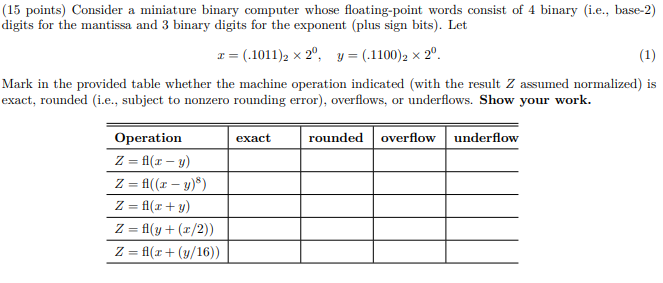
(15 points) Consider a miniature binary computer whose floating-point words consist of 4 binary i.e., base-2) digits for the mantissa and 3 binary digits for the exponent (plus sign bits). Let I=(.1011)2 x 20, y=(.1100)2 x 20. (1) Mark in the provided table whether the machine operation indicated (with the result Z assumed normalized) is exact, rounded i.e., subject to nonzero rounding error), overflows, or underflows. Show your work. exact rounded overflow underflow Operation Z = f( -y) Z = f((- y)) Z = f(x+y) Z=f(y + (2/2)) Z = f(x+(y/16)) (15 points) Consider a miniature binary computer whose floating-point words consist of 4 binary i.e., base-2) digits for the mantissa and 3 binary digits for the exponent (plus sign bits). Let I=(.1011)2 x 20, y=(.1100)2 x 20. (1) Mark in the provided table whether the machine operation indicated (with the result Z assumed normalized) is exact, rounded i.e., subject to nonzero rounding error), overflows, or underflows. Show your work. exact rounded overflow underflow Operation Z = f( -y) Z = f((- y)) Z = f(x+y) Z=f(y + (2/2)) Z = f(x+(y/16))
Step by Step Solution
There are 3 Steps involved in it

Get step-by-step solutions from verified subject matter experts
 Study Help