







Question: (15 points) Consider the Delta II booster engine whose parameters are given in Table 4.2 of the notes. Take the exhaust to be an
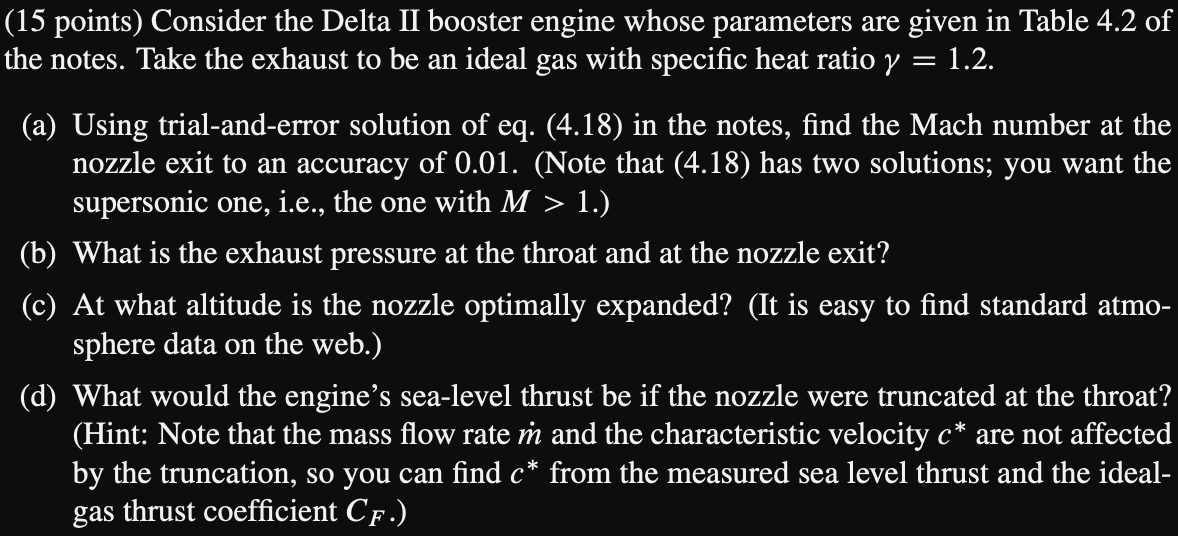
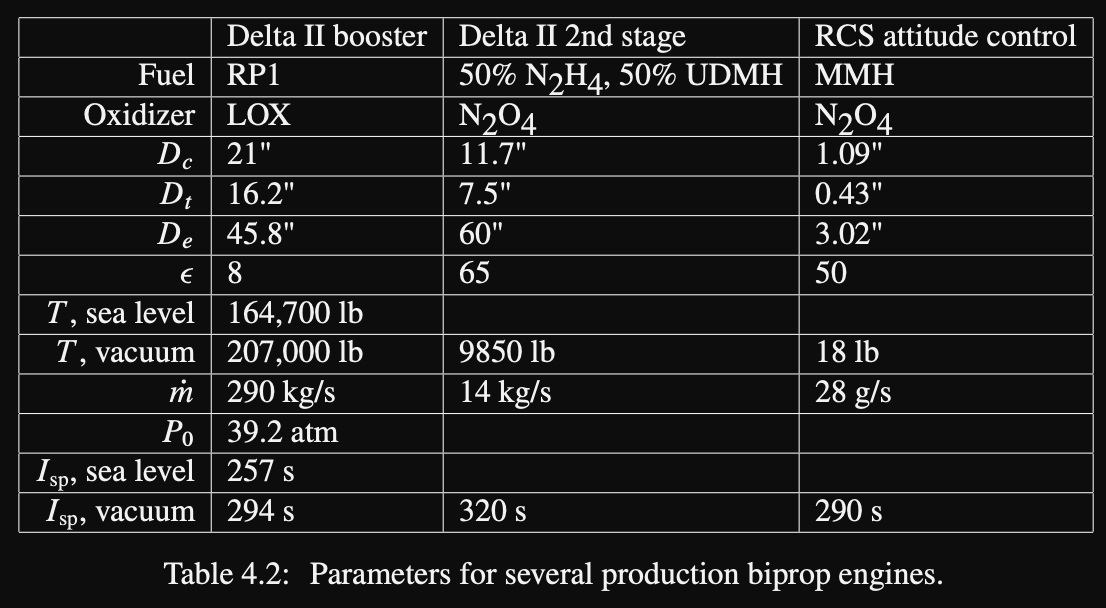

(15 points) Consider the Delta II booster engine whose parameters are given in Table 4.2 of the notes. Take the exhaust to be an ideal gas with specific heat ratio y = 1.2. (a) Using trial-and-error solution of eq. (4.18) in the notes, find the Mach number at the nozzle exit to an accuracy of 0.01. (Note that (4.18) has two solutions; you want the supersonic one, i.e., the one with M > 1.) (b) What is the exhaust pressure at the throat and at the nozzle exit? (c) At what altitude is the nozzle optimally expanded? (It is easy to find standard atmo- sphere data on the web.) (d) What would the engine's sea-level thrust be if the nozzle were truncated at the throat? (Hint: Note that the mass flow rate and the characteristic velocity c* are not affected by the truncation, so you can find c* from the measured sea level thrust and the ideal- gas thrust coefficient CF.) Delta II booster Delta II 2nd stage RCS attitude control Fuel RP1 50% N2H4, 50% UDMH MMH Oxidizer LOX N204 N204 De 21" 11.7" 1.09" Dt 16.2" 7.5" 0.43" De 45.8" 60" 3.02" 8 65 50 T, sea level T, vacuum 164,700 lb 207,000 lb 9850 lb 18 lb m 290 kg/s 14 kg/s 28 g/s Po 39.2 atm Isp, sea level Isp, vacuum 257 s 294 s 320 s 290 s Table 4.2: Parameters for several production biprop engines. A A* +1 (4.18) || = 1 2 - [ (1+222)], M
Step by Step Solution
There are 3 Steps involved in it

Get step-by-step solutions from verified subject matter experts
 Study Help