







Question: (15 pts) Problem 5 Consider the following 3 data sets: A=[8, 6, 7, 5, 3, 0, 9] B=[2, 29, 84, 2, 10, 69, 3, 31,
(15 pts) Problem 5
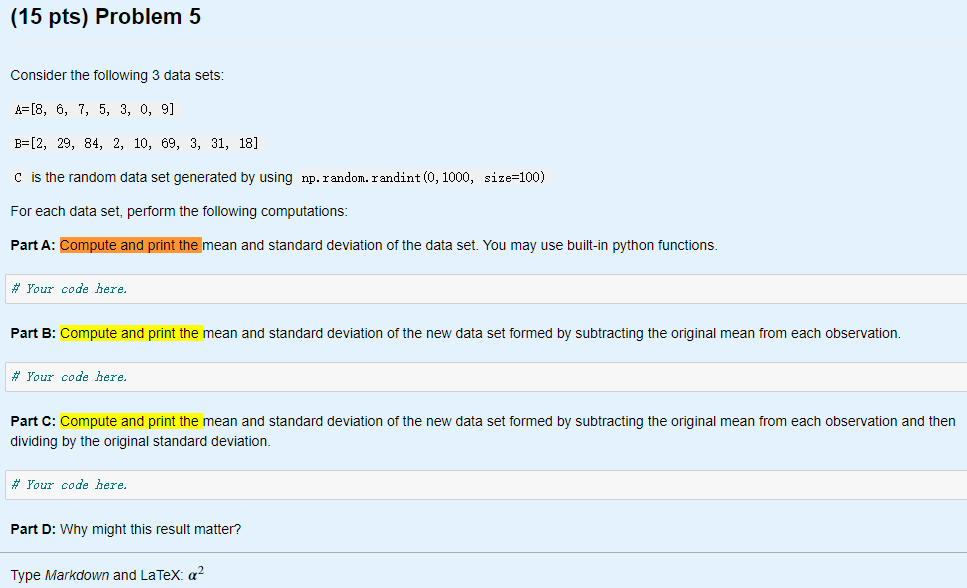
Consider the following 3 data sets:
A=[8, 6, 7, 5, 3, 0, 9]
B=[2, 29, 84, 2, 10, 69, 3, 31, 18]
C is the random data set generated by using np.random.randint(0,1000, size=100)
For each data set, perform the following computations:
Part A: Compute and print the mean and standard deviation of the data set. You may use built-in python functions.
In [ ]:
# Your code here.
Part B: Compute and print the mean and standard deviation of the new data set formed by subtracting the original mean from each observation.
In [ ]:
# Your code here.
Part C: Compute and print the mean and standard deviation of the new data set formed by subtracting the original mean from each observation and then dividing by the original standard deviation.
In [ ]:
# Your code here.
Part D: Why might this result matter?
Type Markdown and LaTeX: 2
(15 pts) Problem 5 Consider the following 3 data sets: A=[8, 6, 7, 5, 3, 0, 9] B=(2, 29, 84, 2, 10, 69, 3, 31, 18] C is the random data set generated by using np.random.randint(0, 1000, size=100) For each data set, perform the following computations: Part A: Compute and print the mean and standard deviation of the data set. You may use built-in python functions. # Your code here. Part B: Compute and print the mean and standard deviation of the new data set formed by subtracting the original mean from each observation. # Your code here. Part C: Compute and print the mean and standard deviation of the new data set formed by subtracting the original mean from each observation and then dividing by the original standard deviation. # Your code here. Part D: Why might this result matter? Type Markdown and Latex: a
Step by Step Solution
There are 3 Steps involved in it

Get step-by-step solutions from verified subject matter experts
 Study Help