







Question: 15. Suppose Euler's method, with increment dx, is used to numerically solve the differential equation -= f(x, y) with dx the initial condition that (Xo,
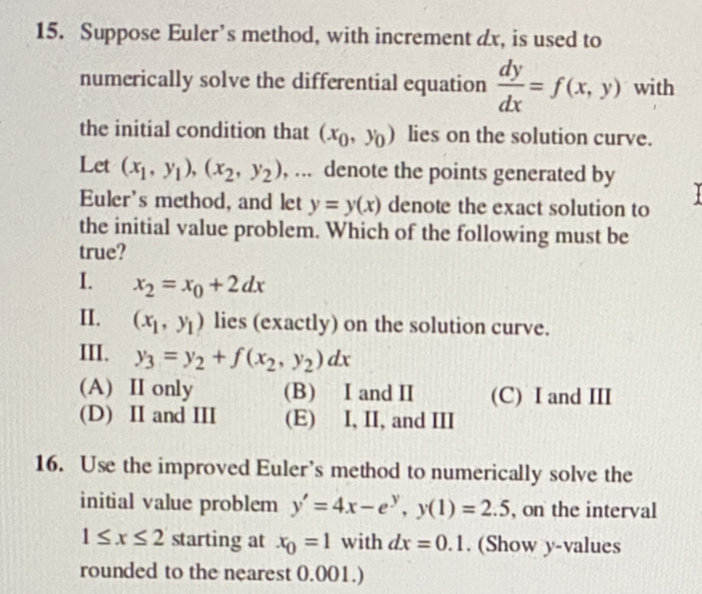
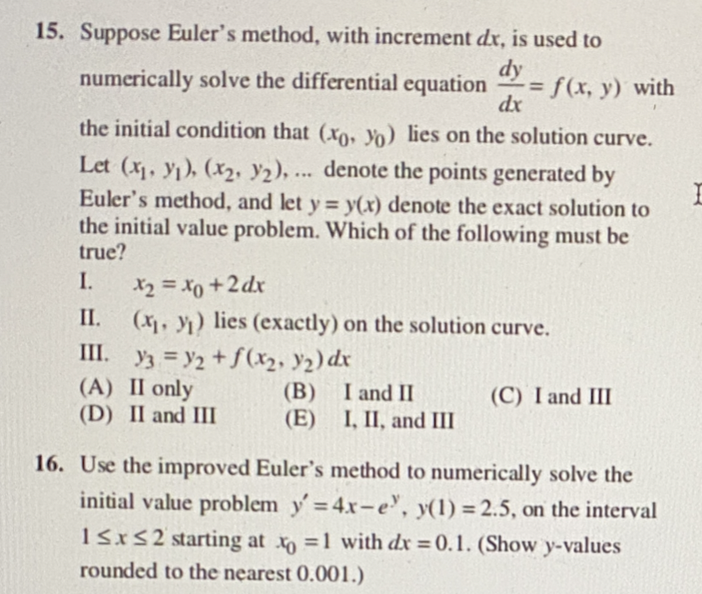
15. Suppose Euler's method, with increment dx, is used to numerically solve the differential equation -= f(x, y) with dx the initial condition that (Xo, Jo) lies on the solution curve. Let (x1 , y1), (X2, )2), ... denote the points generated by Euler's method, and let y = y(x) denote the exact solution to the initial value problem. Which of the following must be true? 1. *2 = X0+2dx II. (x, y) ) lies (exactly) on the solution curve. III. y3 = y2 + f (x2, )2) dx (A) II only (B) I and II (C) I and III (D) II and III (E) I, II, and III 16. Use the improved Euler's method to numerically solve the initial value problem y' =4x-ey, y(1) =2.5, on the interval I S.x S 2 starting at No = 1 with dx = 0.1. (Show y-values rounded to the nearest 0.001.)
Step by Step Solution
There are 3 Steps involved in it

Get step-by-step solutions from verified subject matter experts
 Study Help