







Question: 16. Plotting Amplitude Modulated Waves Step 1: Understanding the problem Amplitude modulation (AM) is a modulation technique used in electronic communication, most commonly for transmitting
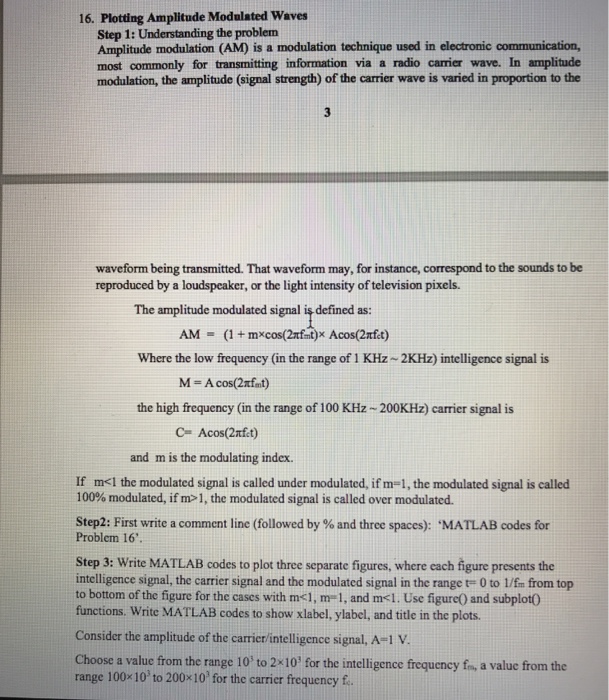
16. Plotting Amplitude Modulated Waves Step 1: Understanding the problem Amplitude modulation (AM) is a modulation technique used in electronic communication, most commonly for transmitting information via a radio carrier wave. In amplitude modulation, the amplitude (signal strength) of the carrier wave is varied in proportion to the waveform being transmitted. That waveform may, for instance, correspond to the sounds to be reproduced by a loudspeaker, or the light intensity of television pixels. The amplitude modulated signal i defined as: AM-(1 +mxcos(2nfmt)x Acos(2nfet) Where the low frequency (in the range of 1 KHz 2KHz) intelligence signal is M = A cos(2xf1) the high frequency (in the range of 100 KHz-200KHz) carrier signal is and m is the modulating index. If m
Step by Step Solution
There are 3 Steps involved in it

Get step-by-step solutions from verified subject matter experts
 Study Help