





Question: 16-20: True or False? (True =A and False = B) 16. Unless your ideas contain common knowledge and statistics are never common knowledge always cite
16-20: True or False? (True =A and False = B) 16.
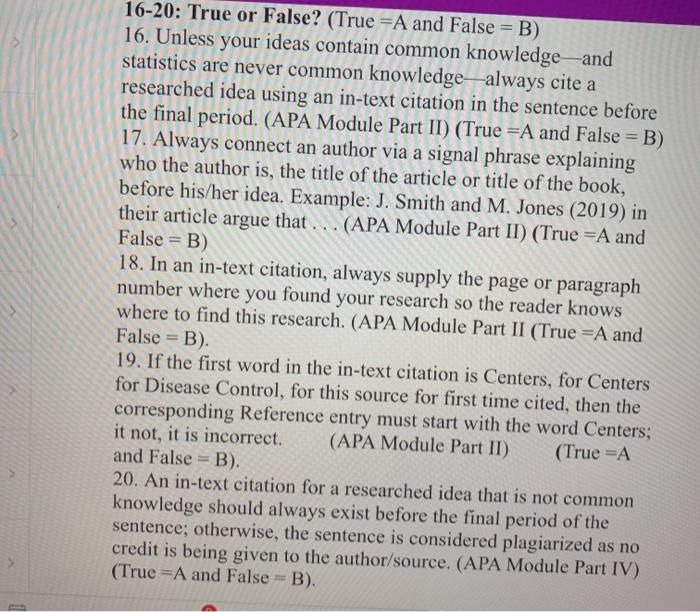
16-20: True or False? (True =A and False = B) 16. Unless your ideas contain common knowledge and statistics are never common knowledge always cite a researched idea using an in-text citation in the sentence before the final period. (APA Module Part II) (True =A and False = B) 17. Always connect an author via a signal phrase explaining who the author is, the title of the article or title of the book, before his/her idea. Example: J. Smith and M. Jones (2019) in their article argue that ... (APA Module Part II) (True =A and False = B) 18. In an in-text citation, always supply the page or paragraph number where you found your research so the reader knows where to find this research. (APA Module Part II (True =A and False = B). 19. If the first word in the in-text citation is Centers, for Centers for Disease Control, for this source for first time cited, then the corresponding Reference entry must start with the word Centers: it not, it is incorrect. (APA Module Part II) (True =A and False = B). 20. An in-text citation for a researched idea that is not common knowledge should always exist before the final period of the sentence; otherwise, the sentence is considered plagiarized as no credit is being given to the author/source. (APA Module Part IV) (True =A and False = B)

Step by Step Solution

There are 3 Steps involved in it

1 Expert Approved Answer
Step: 1 Unlock blur-text-image

Question Has Been Solved by an Expert!

Get step-by-step solutions from verified subject matter experts

Step: 2 Unlock
Step: 3 Unlock

Students Have Also Explored These Related General Management Questions!