







Question: 17) For a linear programming problem, assume that a given resource has not been fully used. We can 17) conclude that the shadow price associated
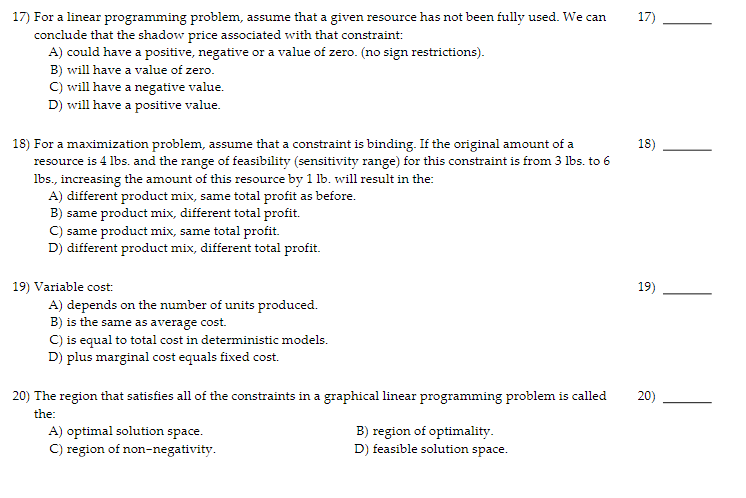
17) For a linear programming problem, assume that a given resource has not been fully used. We can 17) conclude that the shadow price associated with that constraint: A) could have a positive, negative or a value of zero. (no sign restrictions). B) will have a value of zero. C) will have a negative value. D) will have a positive value. 18) For a maximization problem, assume that a constraint is binding. If the original amount of a resource is 4lbs. and the range of feasibility (sensitivity range) for this constraint is from 3lbs. to 6 lbs., increasing the amount of this resource by 1lb. will result in the: A) different product mix, same total profit as before. B) same product mix, different total profit. C) same product mix, same total profit. D) different product mix, different total profit. 19) Variable cost: 19) A) depends on the number of units produced. B) is the same as average cost. C) is equal to total cost in deterministic models. D) plus marginal cost equals fixed cost. 20) The region that satisfies all of the constraints in a graphical linear programming problem is called 20) the: A) optimal solution space. B) region of optimality. C) region of non-negativity. D) feasible solution space
Step by Step Solution
There are 3 Steps involved in it

Get step-by-step solutions from verified subject matter experts
 Study Help