







Question: (17%) Problem 1: Dr. John Paul Stapp was a U.S. Air Force officer who studied the effects of extreme deceleration on the human body.
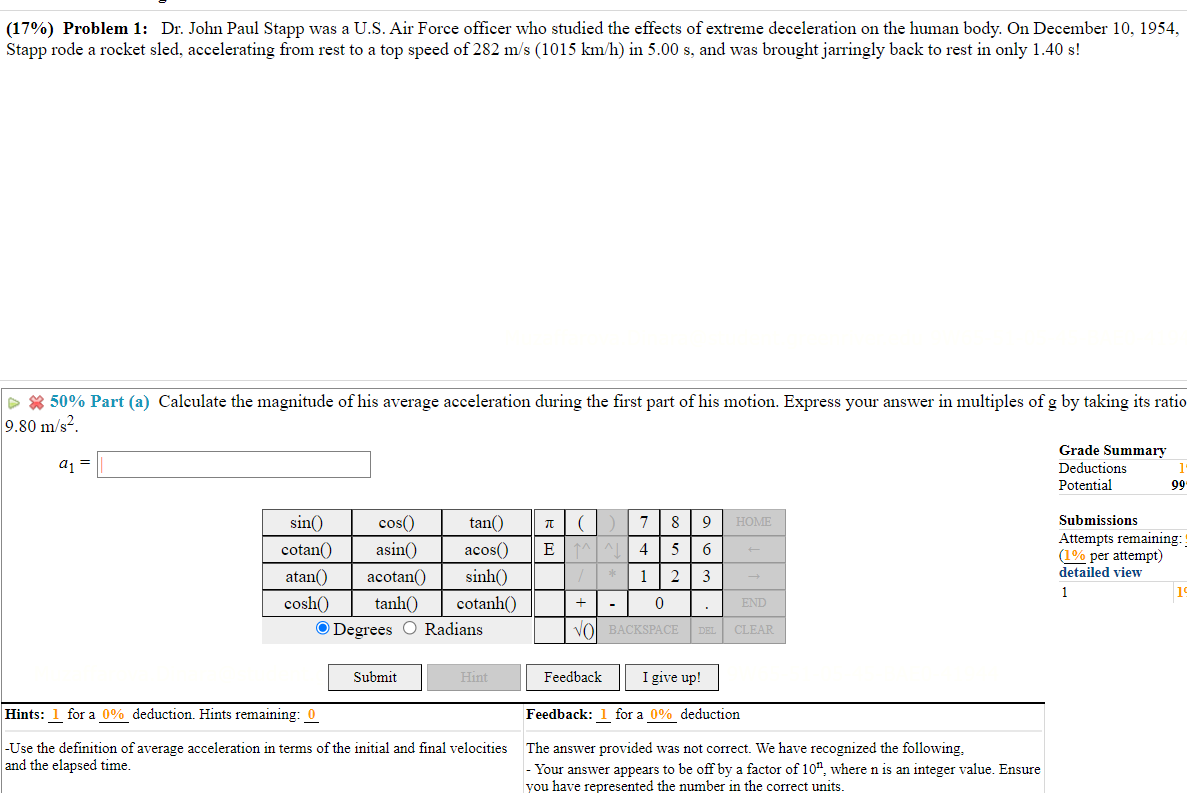
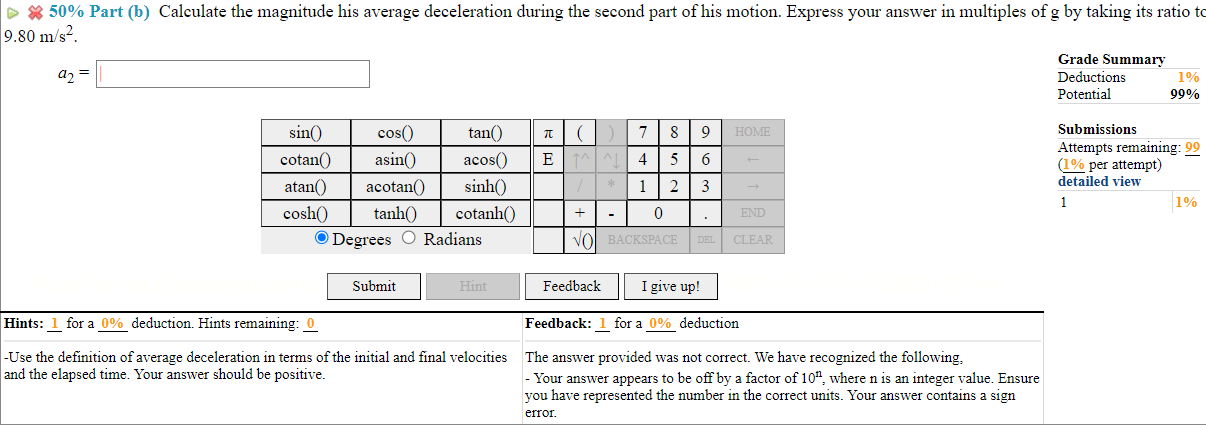
(17%) Problem 1: Dr. John Paul Stapp was a U.S. Air Force officer who studied the effects of extreme deceleration on the human body. On December 10, 1954, Stapp rode a rocket sled, accelerating from rest to a top speed of 282 m/s (1015 km/h) in 5.00 s, and was brought jarringly back to rest in only 1.40 s! 50% Part (a) Calculate the magnitude of his average acceleration during the first part of his motion. Express your answer in multiples of g by taking its ratio 9.80 m/s. a1 = () E4 sin() cos() tan() 7 8 9 HOME cotan asin() acos() 5 6 atan() acotan cosh() tanh Degrees sinh() * 1 2 3 cotanh() + - 0 END Radians VO BACKSPACE DEL CLEAR Submit Hint Feedback I give up! Hints: 1 for a 0% deduction. Hints remaining: 0 Grade Summary Deductions Potential Submissions 1 99 Attempts remaining: (1% per attempt) detailed view 1 19 Feedback: 1 for a 0% deduction -Use the definition of average acceleration in terms of the initial and final velocities The answer provided was not correct. We have recognized the following. and the elapsed time. -Your answer appears to be off by a factor of 10", where n is an integer value. Ensure you have represented the number in the correct units. 50% Part (b) Calculate the magnitude his average deceleration during the second part of his motion. Express your answer in multiples of g by taking its ratio to 9.80 m/s. a = () sin() cos() tan() 7 8 9 HOME cotan atan() cosh asin() acos() acotan() sinh() tanh() cotanh() Degrees Radians EMN4 5 6 1 2 3 + - 0 END VO BACKSPACE DEL CLEAR Submit Hint Feedback I give up! Hints: 1 for a 0% deduction. Hints remaining: 0 Grade Summary Deductions Potential Submissions 1% 99% Attempts remaining: 99 (1% per attempt) detailed view 1 1% Feedback: 1 for a 0% deduction -Use the definition of average deceleration in terms of the initial and final velocities The answer provided was not correct. We have recognized the following. and the elapsed time. Your answer should be positive. -Your answer appears to be off by a factor of 10", where n is an integer value. Ensure you have represented the number in the correct units. Your answer contains a sign error.
Step by Step Solution
There are 3 Steps involved in it

Get step-by-step solutions from verified subject matter experts
 Study Help