







Question: Help in solving the following questions. Five students have compared their scores in some practice papers that they sat before their exam. Their marks were
Help in solving the following questions.
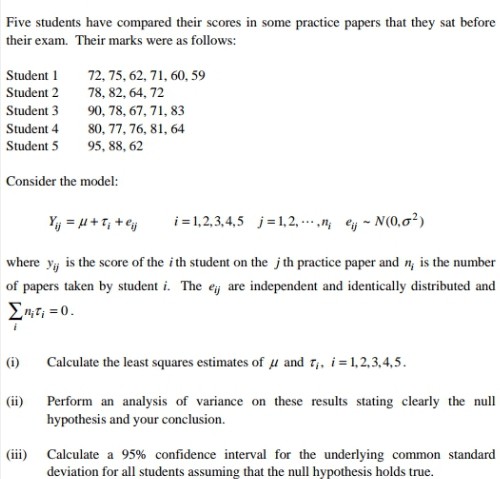
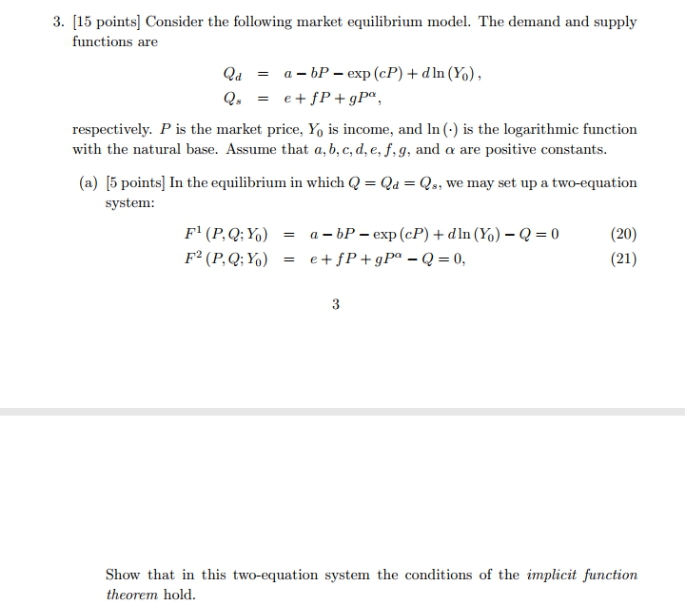
Five students have compared their scores in some practice papers that they sat before their exam. Their marks were as follows: Student 1 72, 75, 62, 71, 60. 59 Student 2 78, 82, 64, 72 Student 3 90, 78, 67, 71, 83 Student 4 80, 77, 76, 81, 64 Student 5 95, 88, 62 Consider the model: i =1,2,3.4,5 j =1,2. ... .n; e; - N(0.02) where yo is the score of the ith student on the / th practice paper and n, is the number of papers taken by student i. The ey are independent and identically distributed and Ent; =0. (1) Calculate the least squares estimates of / and r;. i = 1,2,3,4,5. (ii) Perform an analysis of variance on these results stating clearly the null hypothesis and your conclusion. (iii) Calculate a 95% confidence interval for the underlying common standard deviation for all students assuming that the null hypothesis holds true.3. [15 points] Consider the following market equilibrium model. The demand and supply functions are 1 = a- bP - exp (cP) + dIn (Yo) , Q. = e+fP+gpo, respectively. P is the market price, Yo is income, and In (.) is the logarithmic function with the natural base. Assume that a, b, c, d, e, f, g, and o are positive constants. (a) [5 points] In the equilibrium in which Q = Qa = Qs, we may set up a two-equation system: F' (P.Q;Yo) = a-bP - exp (cP) + din (Yo) - Q=0 (20) F2 (P.Q; Yo) = e+fP+ gpo - Q=0, (21) 3 Show that in this two-equation system the conditions of the implicit function theorem hold
Step by Step Solution
There are 3 Steps involved in it

Get step-by-step solutions from verified subject matter experts
 Study Help