







Question: 1.73. Mass Transfer in Bubble Column Bubble columns are used for liquid aeration and gas-liquid reactions. Thus, finely suspended bubbles produce large interfacial areas for
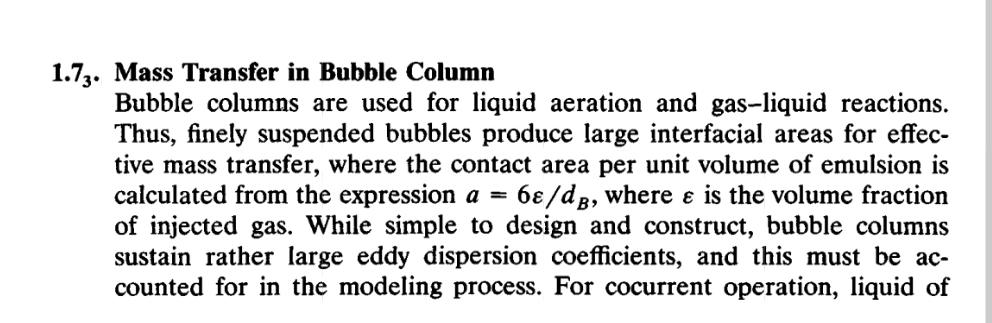
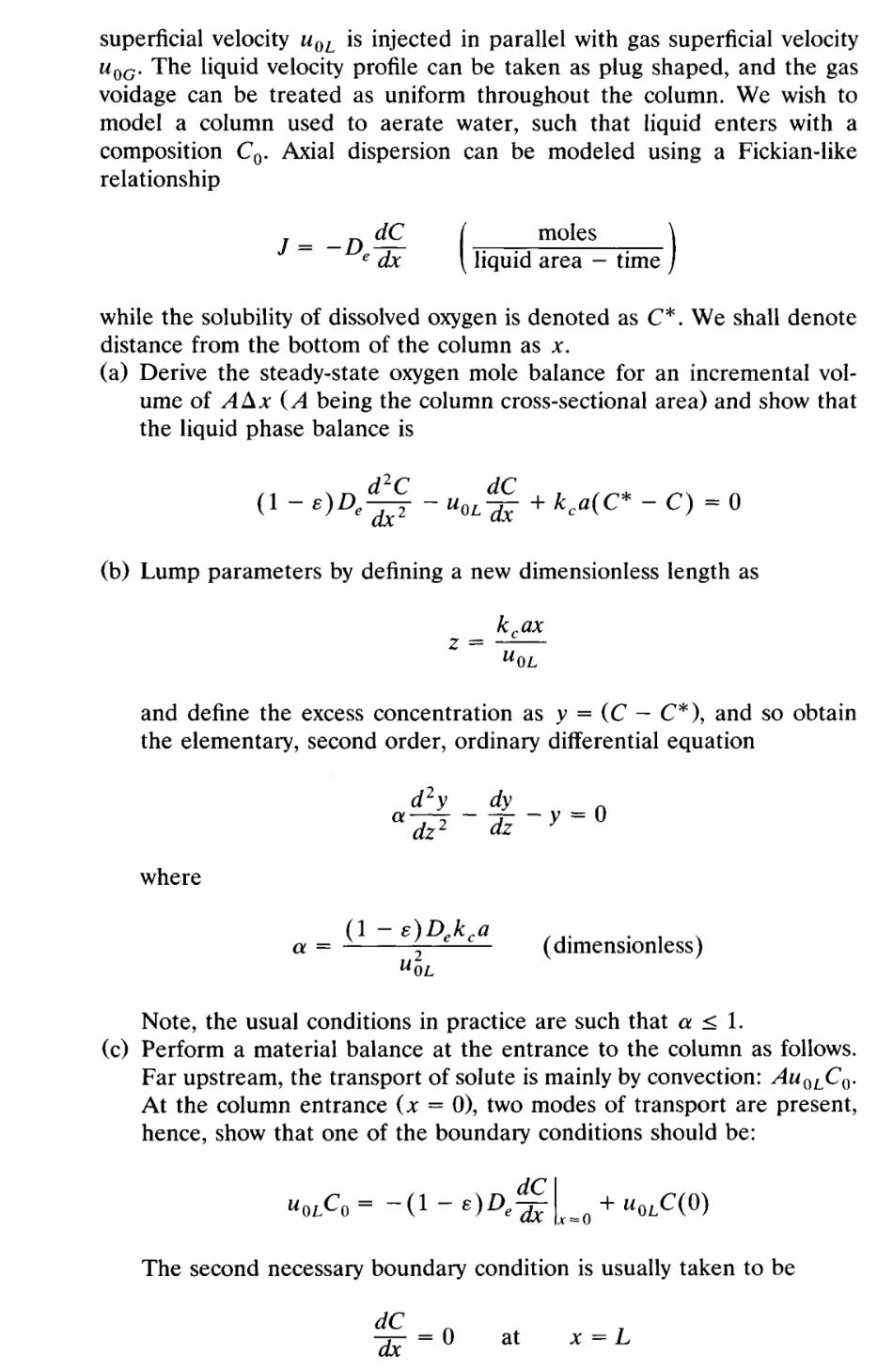

1.73. Mass Transfer in Bubble Column Bubble columns are used for liquid aeration and gas-liquid reactions. Thus, finely suspended bubbles produce large interfacial areas for effec- tive mass transfer, where the contact area per unit volume of emulsion is calculated from the expression a = 6/db, where e is the volume fraction of injected gas. While simple to design and construct, bubble columns sustain rather large eddy dispersion coefficients, and this must be ac- counted for in the modeling process. For cocurrent operation, liquid of superficial velocity UoL is injected in parallel with gas superficial velocity Uog. The liquid velocity profile can be taken as plug shaped, and the gas voidage can be treated as uniform throughout the column. We wish to model a column used to aerate water, such that liquid enters with a composition Co. Axial dispersion can be modeled using a Fickian-like relationship dC J = - - De dx moles liquid area - time while the solubility of dissolved oxygen is denoted as C*. We shall denote distance from the bottom of the column as x. (a) Derive the steady-state oxygen mole balance for an incremental vol- ume of AAX (A being the column cross-sectional area) and show that the liquid phase balance is dC (1 )De UOL dx dC + k a(C* C) = 0 di? (b) Lump parameters by defining a new dimensionless length as Z- k ax UOL and define the excess concentration as y = (C - C*), and so obtain the elementary, second order, ordinary differential equation dy dy - y = 0 where (1 ) Dek, a = (dimensionless) Uol Note, the usual conditions in practice are such that a s 1. (c) Perform a material balance at the entrance to the column as follows. Far upstream, the transport of solute is mainly by convection: AuolCo. At the column entrance (x = 0), two modes of transport are present, hence, show that one of the boundary conditions should be: dC Voz Co = -(1 )D. TO = + uolC(0) The second necessary boundary condition is usually taken to be dC dx 0 at X = L where L denotes the position of the liquid exit. What is the physical meaning of this condition? The two boundary conditions are often referred as the Danckwerts type, in honor of P. V. Danckwerts
Step by Step Solution
There are 3 Steps involved in it

Get step-by-step solutions from verified subject matter experts
 Study Help