







Question: 18. Additional Problem 3-14 Find a regular expression to describe the following language: {A, a, ab, abb, abbb) Then, explain why your regular expression also
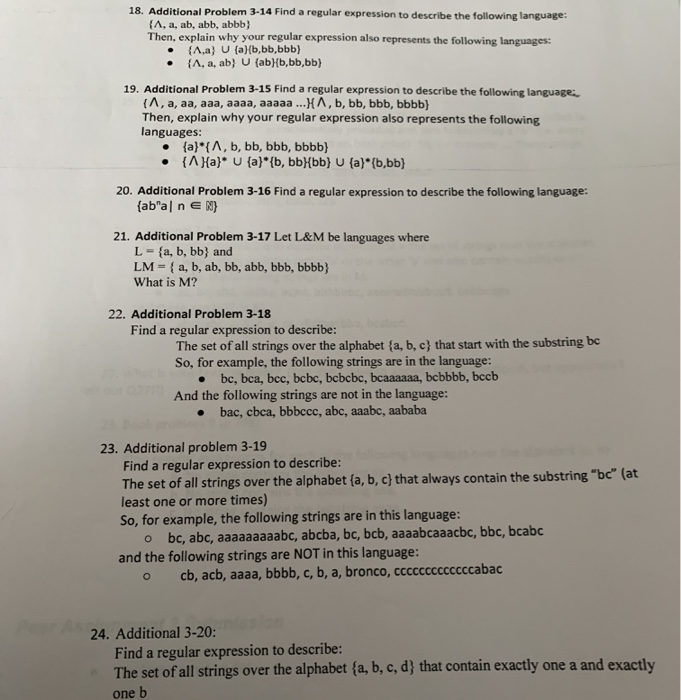
18. Additional Problem 3-14 Find a regular expression to describe the following language: {A, a, ab, abb, abbb) Then, explain why your regular expression also represents the following languages: {A,a) U {a}{b,bb,bbb} {A, a, ab) U (ab}{b,bb,bb) 19. Additional Problem 3-15 Find a regular expression to describe the following language: {1, a, aa, aaa, aaaa, aaaaa ...}A, b, bb, bbb, bbbb} Then, explain why your regular expression also represents the following languages: {a} {A, b, bb, bbb, bbbb} {1}{a}* U {a}*{b, bb}{bb} U (a)* {b,bb} 20. Additional Problem 3-16 Find a regular expression to describe the following language: {ab'a n E N} 21. Additional Problem 3-17 Let L&M be languages where L = {a,b, bb) and LM= { a, b, ab, bb, abb, bbb, bbbb) What is M? 22. Additional Problem 3-18 Find a regular expression to describe: The set of all strings over the alphabet {a,b,c} that start with the substring be So, for example, the following strings are in the language: bc, bca, bcc, bcbc, bcbcbc, bcaaaaaa, bebbbb, bccb And the following strings are not in the language: bac, cbca, bbbccc, abc, aaabc, aababa 23. Additional problem 3-19 Find a regular expression to describe: The set of all strings over the alphabet (a, b, c) that always contain the substring "bc" (at least one or more times) So, for example, the following strings are in this language: o bc, abc, aaaaaaaaabc, abcba, bc, bcb, aaaabcaaacbc, bbc, bcabc and the following strings are NOT in this language: O cb, acb, aaaa, bbbb, c, b, a, bronco, cccccccccccccabac 24. Additional 3-20: Find a regular expression to describe: The set of all strings over the alphabet (a, b, c, d} that contain exactly one a and exactly one b
Step by Step Solution
There are 3 Steps involved in it

Get step-by-step solutions from verified subject matter experts
 Study Help