





Question: 18) Suppose that h(x) is a continuous function and is defined for (3, h(3)) is an absolute maximum. all x greater than or equal to
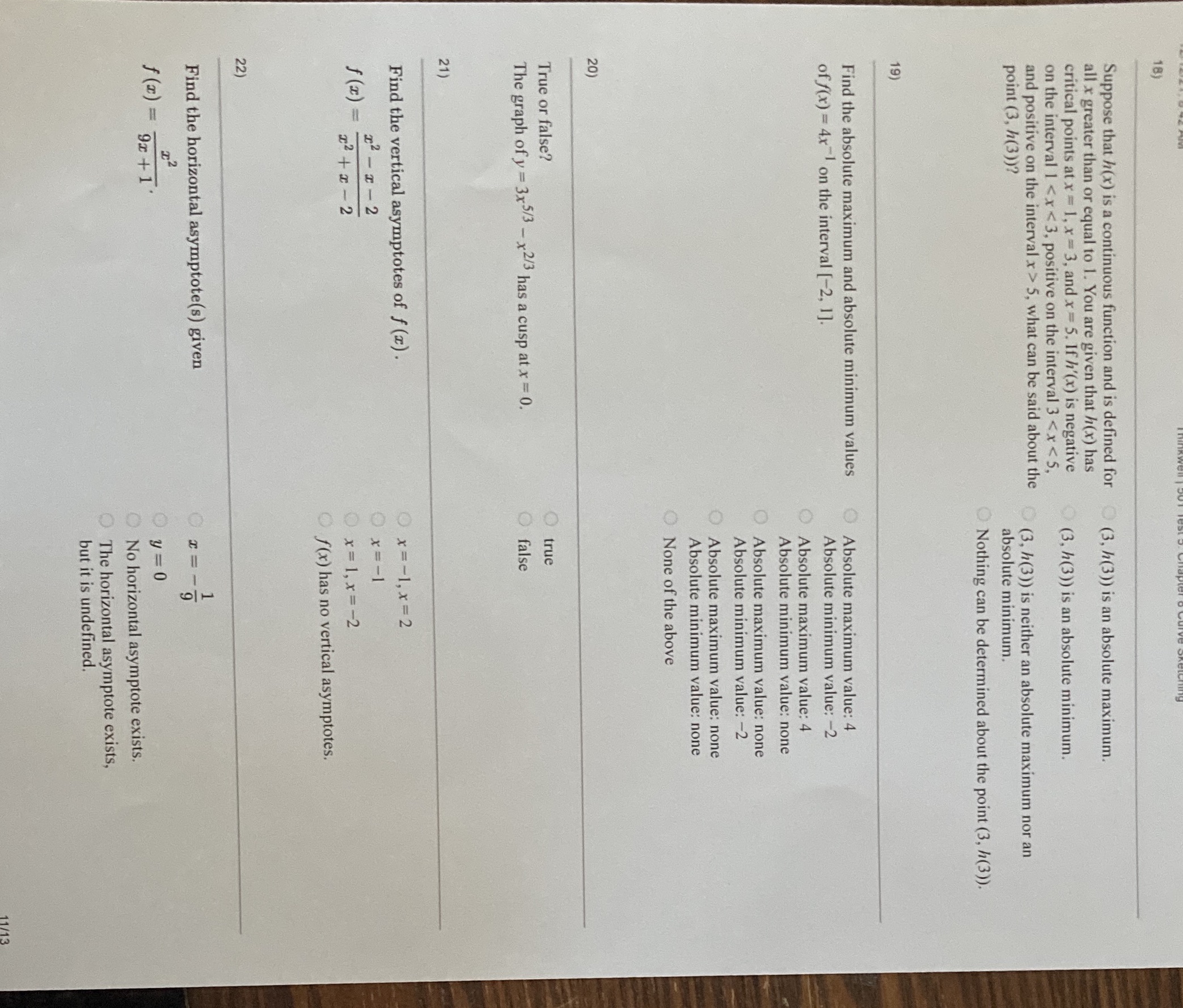
 18) Suppose that h(x) is a continuous function and is defined

for (3, h(3)) is an absolute maximum. all x greater than or

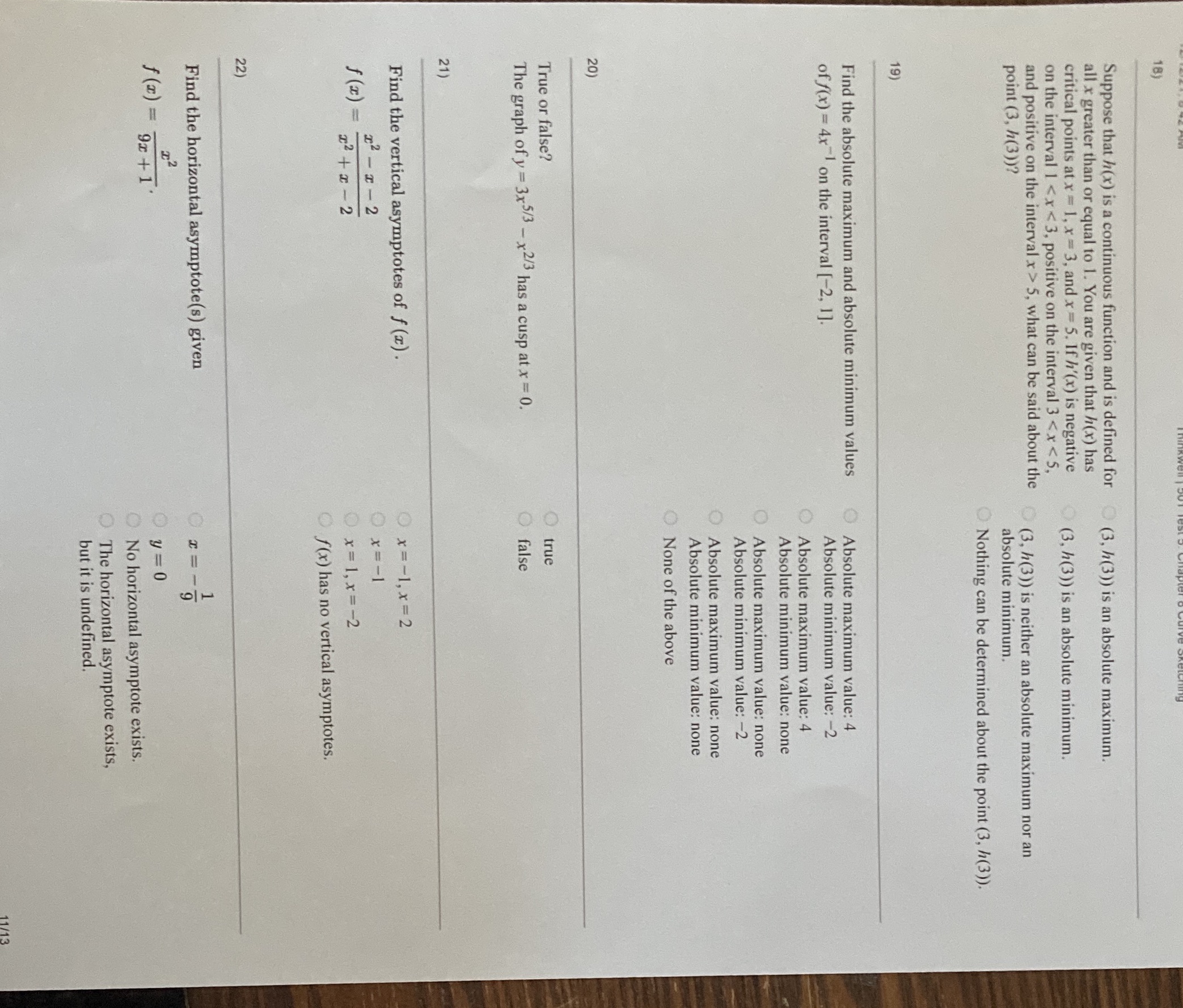
18) Suppose that h(x) is a continuous function and is defined for (3, h(3)) is an absolute maximum. all x greater than or equal to 1. You are given that h(x) has critical points at x = 1, x = 3, and x = 5. If h'(x) is negative on the interval 1 5, what can be said about the point (3, h(3))? (3, h(3)) is neither an absolute maximum nor an absolute minimum. Nothing can be determined about the point (3, h(3)). Find the absolute maximum and absolute minimum values Absolute maximum value: 4 of f(x) = 4x-' on the interval [-2, 1]. Absolute minimum value: -2 O Absolute maximum value: 4 Absolute minimum value: none Absolute maximum value: none Absolute minimum value: -2 O Absolute maximum value: none Absolute minimum value: none None of the above True or false? true The graph of y = 3x513 - x2/3 has a cusp at x = 0. false Find the vertical asymptotes of f (I) . O x = -1, x=2 12 - 1 - 2 O x=-1 f (I ) = 72 + 1 - 2 O x = 1, x=-2 Of (x) has no vertical asymptotes. Find the horizontal asymptote(s) given f (x) = 9x + 1' Oy=0 No horizontal asymptote exists. The horizontal asymptote exists, but it is undefined

Step by Step Solution

There are 3 Steps involved in it

1 Expert Approved Answer
Step: 1 Unlock blur-text-image
Question Has Been Solved by an Expert!

Get step-by-step solutions from verified subject matter experts

Step: 2 Unlock
Step: 3 Unlock

Students Have Also Explored These Related Mathematics Questions!