







Question: 18. Without a complexing agent, at high potential in the aqueous system, gold can dissolve in a high pH solution. What type of complex is
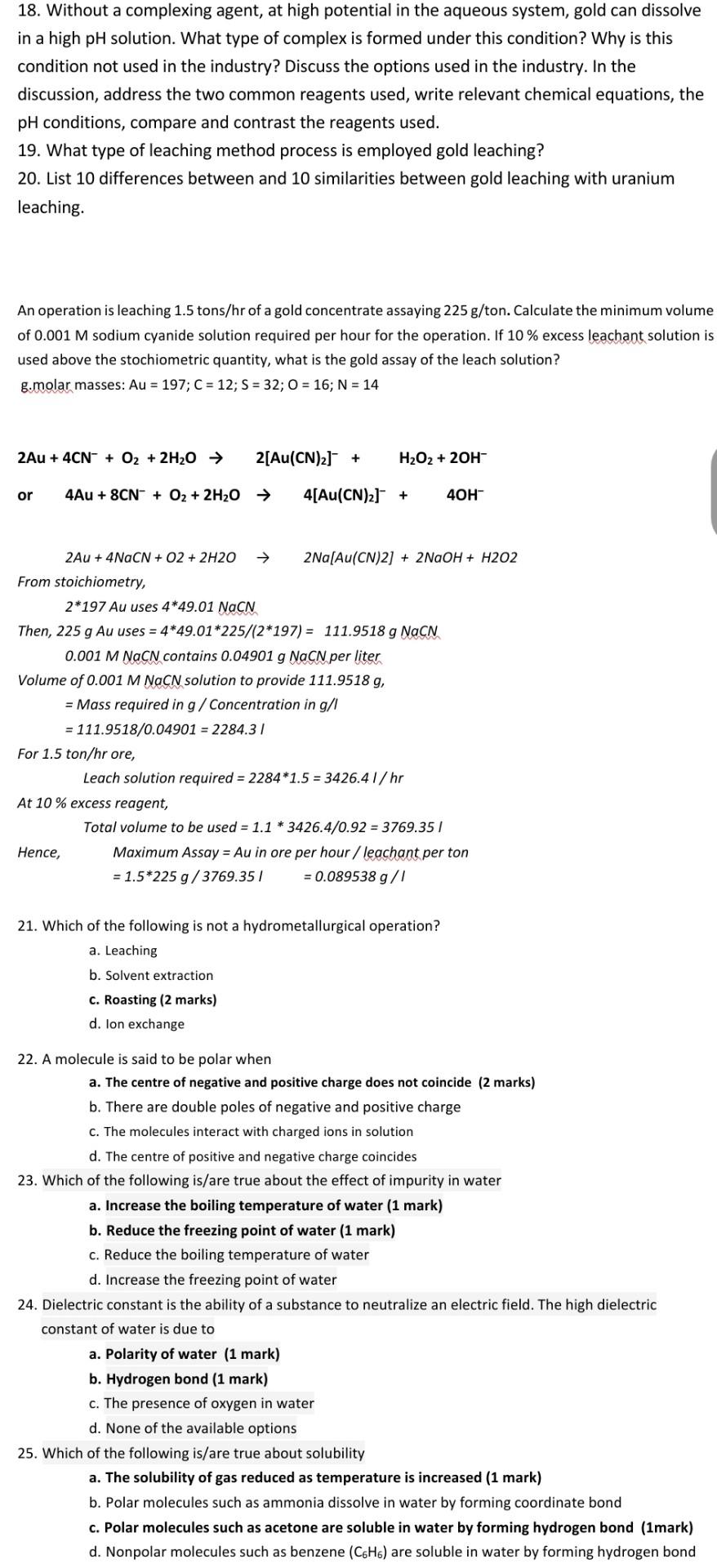
18. Without a complexing agent, at high potential in the aqueous system, gold can dissolve in a high pH solution. What type of complex is formed under this condition? Why is this condition not used in the industry? Discuss the options used in the industry. In the discussion, address the two common reagents used, write relevant chemical equations, the pH conditions, compare and contrast the reagents used. 19. What type of leaching method process is employed gold leaching? 20. List 10 differences between and 10 similarities between gold leaching with uranium leaching An operation is leaching 1.5 tons/hr of a gold concentrate assaying 225 g/ton. Calculate the minimum volume of 0.001 M sodium cyanide solution required per hour for the operation. If 10% excess leachant solution is used above the stochiometric quantity, what is the gold assay of the leach solution? g.molar masses: Au = 197; C = 12; S = 32; O = 16; N = 14 2Au + 4CN + O2 + 2H2O 2[Au(CN)2] + H2O2 + 2OH- or 4Au + 8CN + O2 + 2H20 4[Au(CN)2] + 40H- 2AU + 4NaCN + O2 + 2H20 2 Na[Au(CN)2] + 2NaOH + H202 From stoichiometry, 2*197 Au uses 4*49.01 NaCN Then, 225 g Au uses = 4*49.01*225/(2*197) = 111.9518 g NaCN 0.001 M NACN contains 0.04901 g NaCN per liter Volume of 0.001 M NaCN solution to provide 111.9518 g, = Mass required in g/Concentration in g/l = 111.9518/0.04901 = 2284.31 For 1.5 ton/hr ore, Leach solution required = 2284*1.5 = 3426.41/hr At 10% excess reagent, Total volume to be used = 1.1 * 3426.4/0.92 = 3769.35/ Hence, Maximum Assay = Au in ore per hour/leachant per ton = 1.5*225 g/3769.35 / = 0.089538 g/l 21. Which of the following is not a hydrometallurgical operation? a. Leaching b. Solvent extraction C. Roasting (2 marks) d. lon exchange 22. A molecule is said to be polar when a. The centre of negative and positive charge does not coincide (2 marks) b. There are double poles of negative and positive charge c. The molecules interact with charged ions in solution d. The centre of positive and negative charge coincides 23. Which of the following is/are true about the effect of impurity in water a. Increase the boiling temperature of water (1 mark) b. Reduce the freezing point of water (1 mark) c. Reduce the boiling temperature of water d. Increase the freezing point of water 24. Dielectric constant is the ability of a substance to neutralize an electric field. The high dielectric constant of water is due to a. Polarity of water (1 mark) b. Hydrogen bond (1 mark) c. The presence of oxygen in water d. None of the available options 25. Which of the following is/are true about solubility a. The solubility of gas reduced as temperature is increased (1 mark) b. Polar molecules such as ammonia dissolve in water by forming coordinate bond c. Polar molecules such as acetone are soluble in water by forming hydrogen bond (1mark) d. Nonpolar molecules such as benzene (C6H6) are soluble in water by forming hydrogen bond
Step by Step Solution
There are 3 Steps involved in it

Get step-by-step solutions from verified subject matter experts
 Study Help