







Question: 18B.9 Diffusion with homogeneous and heterogeneous reactions. Gas A diffuses through a stagnant film to a catalytic surface where A is instantaneously converted to B
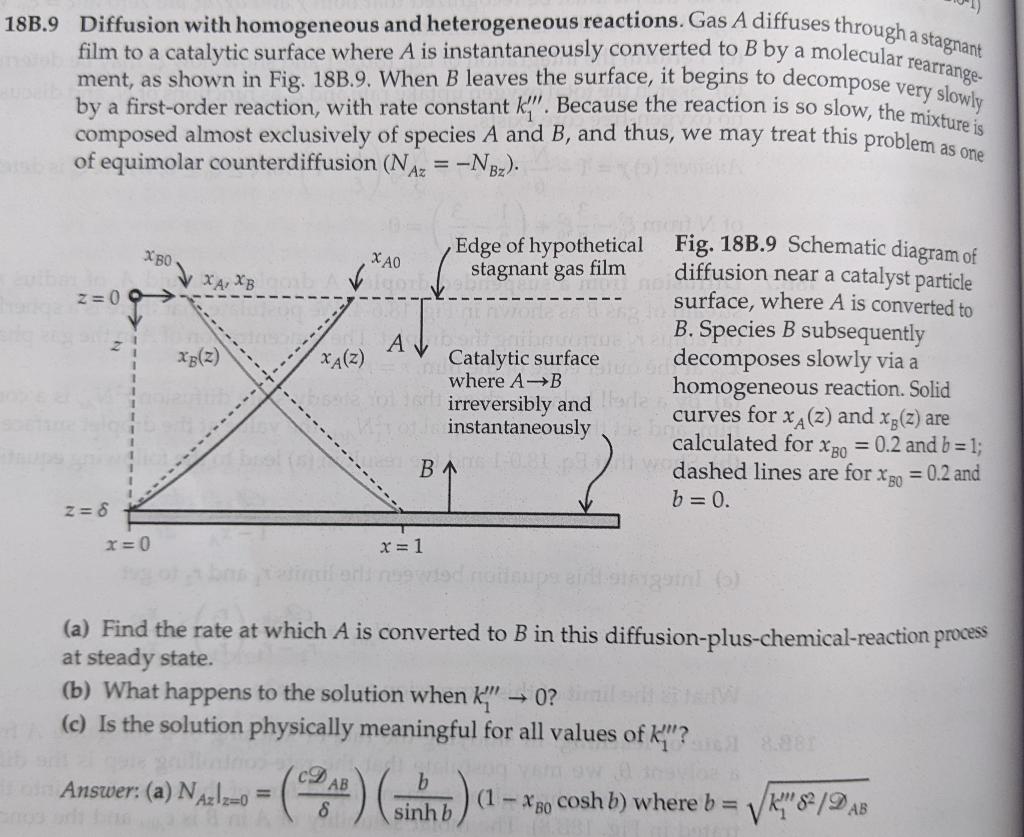
18B.9 Diffusion with homogeneous and heterogeneous reactions. Gas A diffuses through a stagnant film to a catalytic surface where A is instantaneously converted to B by a molecular rearrange- ment, as shown in Fig. 18B.9. When B leaves the surface, it begins to decompose very slowly by a first-order reaction, with rate constant k)". Because the reaction is so slow, the mixture is composed almost exclusively of species A and B, and thus, we may treat this problem as one of equimolar counterdiffusion (NAz = -NBz). XBO 0 , Z= 0 AV XA(z) Edge of hypothetical Fig. 18B.9 Schematic diagram of stagnant gas film diffusion near a catalyst particle surface, where A is converted to B. Species B subsequently Catalytic surface decomposes slowly via a where AB homogeneous reaction. Solid irreversibly and curves for x4 (2) and xg(z) are instantaneously calculated for Xbo = 0.2 and b = 1; dashed lines are for = 0.2 and b = 0. BA Z= 8 X=0 X = 1 (a) Find the rate at which A is converted to B in this diffusion-plus-chemical-reaction process at steady state. (b) What happens to the solution when k!" 0? (c) Is the solution physically meaningful for all values of K"? - Answer: (a) Ngulowo = (*) (sinh b Nazlz=0 CD AB 8 b (1 - cosh b) where b = V K}"S2/D AB
Step by Step Solution
There are 3 Steps involved in it

Get step-by-step solutions from verified subject matter experts
 Study Help