







Question: 19. Database inference is easily solved by: Question options: A Allowing users only access to aggregated data results B White listing C Prepared queries D
19.
Database inference is easily solved by:
Question options:
| A | Allowing users only access to aggregated data results |
| B | White listing |
| C | Prepared queries |
| D | There is not an easily implemented technology solution to prevent database inference |
23.
The recommended procedure for preventing SQL injections is:
Question options:
| A | Prepared queries |
| B | Black listing |
| C | SQL mapping |
| D | White listing |
24.
The process of tracking who accesses a database and which resources are accessed is called _________________________ and the information obtained from this tracking is recorded in a ____________________.
Question options:
| A | auditing, log file |
| B | auditing, archive file |
| C | tracking, log file |
| D | tracking, archive file |
25.
Another name for a transaction is:
Question options:
| A | SQL command |
| B | Concurrency control |
| C | Logical Unit of Work |
| D | Concurrent user action |
26.
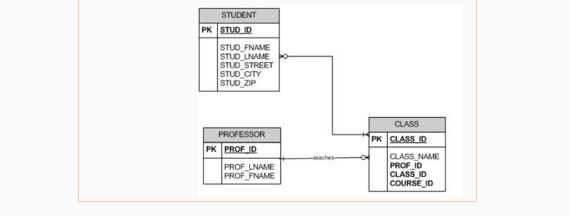
| A | A professor may teach one or more classes but a student must take one or more classes. A class must be taught by one professor but a class may or may not have students. |
| B | A professor is required to teach at least one class and students must take at least one class. |
| C | A professor must teach one or more classes and a class must be taught by one professor. A student may take one or more classes but a class must have one or more students. |
| D | A professor may teach one or more classes and a student may take one or more classes. A class must be taught by one professor and a class must have at least one student. |
28.
Normalization answers which question:
Question options:
| A | How many candidate keys are needed? |
| B | What should the primary key be? |
| C | How many tables? |
| D | What is the cardinality? |
| E | What are the functional dependencies? |
STUD FNAME STUD LNAME- STUD STREET STUD CITY STUD ZP CLASS PK PROF D NAME PROF LNAME PROF FNAME CLASS PROF ID CLASS ID COURSE ID
Step by Step Solution
There are 3 Steps involved in it

Get step-by-step solutions from verified subject matter experts
 Study Help